
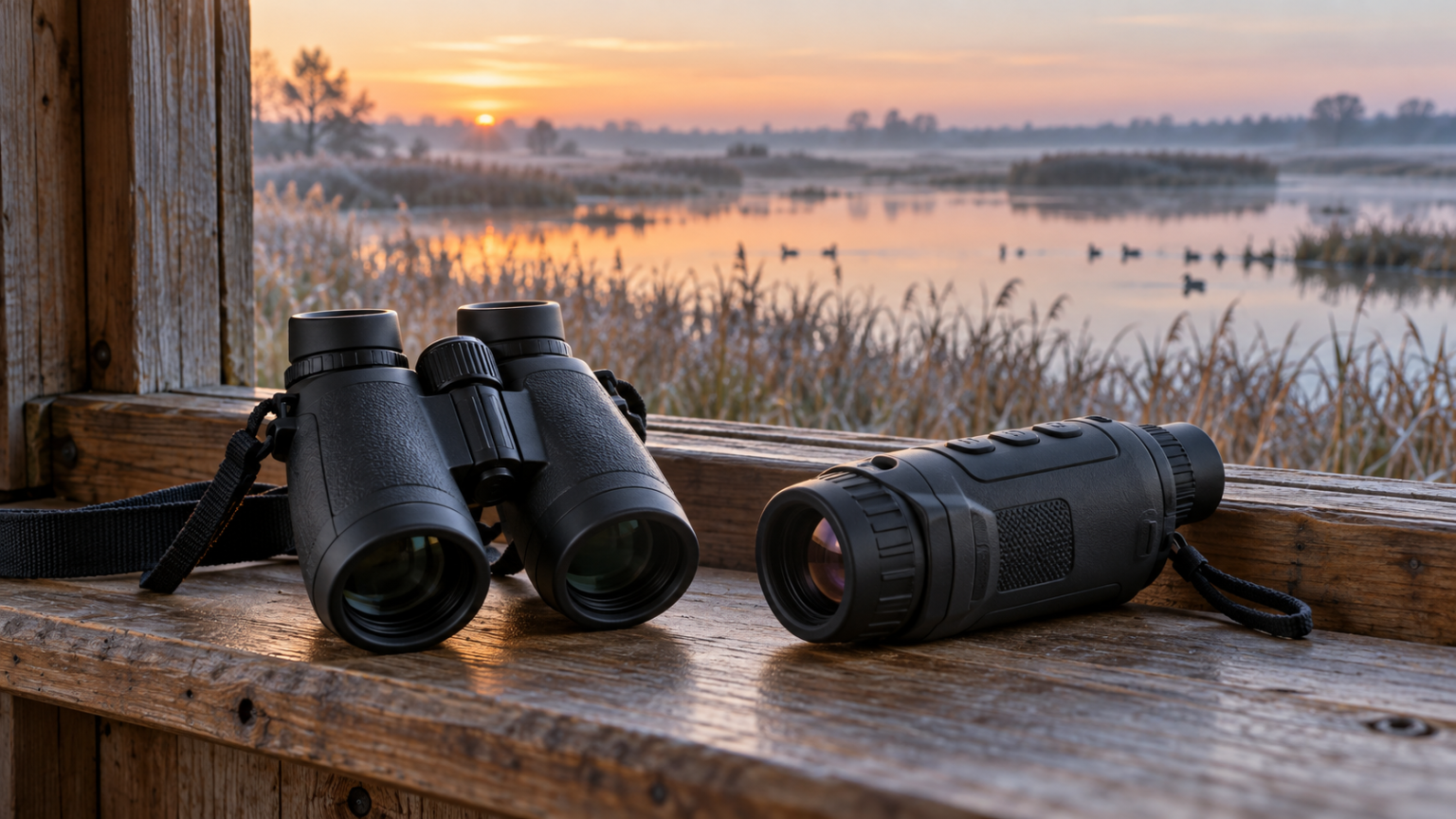
If you are weighing a thermal monocular vs binoculars for birdwatching, start with the job you need done. Conventional binoculars show visible colors, patterns and fine features when there is enough light. A thermal monocular can help locate a bird through its infrared contrast with the surroundings, including in darkness, but its thermal picture does not show ordinary plumage colors. For many birders, thermal is an addition to a familiar identification tool.
If you mainly watch birds during the day and can buy only one instrument, start by establishing whether conventional binoculars already meet your needs. Thermal becomes more compelling when finding a bird is the difficult part of the outing and you have a sensible way to follow up the detection.
The two views answer different questions
Binoculars help answer questions such as: Is there a pale eye stripe? What color is the bill? Are the wing bars clear? A thermal view is more useful for a different first question: Is there a contrasting shape in that area worth examining?
FLIR’s explanation of thermal imaging describes the distinction between detecting infrared energy and forming an ordinary visible-light image. A white or orange bird-shaped patch on a thermal display is a palette representation, not evidence that the bird has white or orange feathers.
Some thermal detail can contribute to an identification, especially when size, shape, movement and context are informative. The important limit is what the image actually establishes. Our guide to interpreting animals in thermal images explains why a detection and a confident identification are different outcomes.
Compare the equipment across a real outing
| Situation | Conventional binoculars contribute | A thermal monocular contributes |
|---|---|---|
| A bird feeding in daylight | Visible markings, color and detailed behavior | A possible locating aid if the bird contrasts with the background |
| A bird hidden behind leaves | A view through any available gaps | A view of exposed thermal fragments through gaps, with the hidden parts still obscured |
| Dusk around dense cover | Useful visual detail while enough light remains | A way to search for contrasting shapes as visible light fades |
| A bird in complete darkness | Little or no useful view without suitable visible illumination | Thermal detection where the bird is exposed and contrast is sufficient |
| A distant, tiny subject | Detail depends on optics, distance and light | Detail depends on sensor, optics, distance and conditions |
The table describes roles, not guaranteed performance. A bird is not automatically conspicuous just because it is alive, and thermal cannot reconstruct an animal concealed behind a solid barrier. See what thermal monoculars can see through for those limits.
Daylight identification usually favors the familiar view
The Cornell Lab’s four keys to bird identification are size and shape, color pattern, behavior and habitat. A thermal image removes ordinary color pattern from that set of visual clues and may simplify other details substantially.
Imagine two small birds feeding at the edge of a hedge. Binoculars may let you compare their facial pattern and wing markings immediately. Thermal may make both birds easier to notice against part of the hedge, but noticing two warm shapes does not necessarily settle which species they are.
That makes conventional binoculars the stronger first purchase for someone whose main goal is learning common daytime birds. Spend time practicing finding, focusing and identifying them before assuming a second imaging system is the missing step.
Thermal earns its place when locating is the bottleneck
Now imagine a different problem: you know a bird is present from a call, but cannot find its position in a darkening area of cover. A thermal search may reveal an exposed shape and give you a branch, gap or section of habitat to examine more carefully.
The value is the direction it gives your attention. If light allows, switch to binoculars or a conventional monocular to inspect the visible field marks. If darkness prevents that second view, record the observation at the level your evidence supports rather than forcing a species name.
Before buying, think of specific outings where this problem occurs. “I often struggle to locate birds along this shaded edge at dusk” is a useful requirement. “Thermal will let me identify everything I cannot see” is an expectation the equipment cannot reliably fulfill.
Our thermal birding technique guide covers the search routine. This equipment decision is about whether that routine solves a frequent problem for you.
Consider how you will carry and switch between them
Using both instruments adds more than the weight printed on two specification sheets. There are straps, caps, a battery plan and a second set of controls. Work out where each optic will sit when you lower it and whether the straps or cases interfere.
Practice transferring a position from one view to the other. Identify a stable landmark such as a forked branch or a break in the hedge, lower the thermal unit, and raise the binoculars toward that landmark. A location remembered only as “near the middle of the screen” can be hard to recover.
Keep controls simple during that transition. A familiar thermal palette and modest digital enlargement can be more useful than changing several settings while the bird moves. The aim is to preserve the observation, not to inspect every menu.
If carrying full-size binoculars plus thermal is impractical, compare the portability tradeoffs in monoculars vs binoculars. That comparison concerns conventional optics; replacing binoculars with a conventional monocular does not add thermal capability.
Check close focus and useful image detail
Birding often involves subjects much closer than the large-animal detection distance advertised on a thermal product page. Check minimum focus before assuming a device suits nearby birds, and consider the scene width you need to find an active subject.
Also separate seeing a small thermal spot from resolving a useful outline. Detector resolution, lens choice and distance work together. Our thermal resolution guide explains why display pixel count alone is not enough to compare two instruments.
Use the task-based questions in how to choose a thermal monocular before moving to a shortlist. For birding, weight, comfortable viewing, close focus and a usable search field can matter more than an impressive maximum number.
Being able to find a roost does not justify approaching it
Thermal makes some birds easier to locate without visible illumination. That capability still calls for restraint around nests, resting birds and sensitive sites. The ABA Code of Birding Ethics asks birders to limit disturbance, respect habitat and consider the consequences of sharing bird locations.
Stay with the observation point you can use without changing the bird’s behavior. If a closer view requires pushing into cover or repeatedly disturbing a resting bird, end that attempt. A distant, incomplete record is preferable to a better image obtained by disrupting the subject.
When recording, preserve enough context to explain the sighting and be careful with precise location details. Our guide to recording birds with thermal addresses those practical choices.
Decide which problem deserves your next purchase
Choose conventional binoculars first when your main need is comfortable daytime observation and visible identification detail. Consider thermal when locating birds in difficult light is a recurring task, you understand its image limits and the extra equipment fits your routine.
If thermal has a clear role, compare the best thermal monoculars for birding against that role. The strongest setup is the one that helps you find the bird and assess the evidence without making either step harder.

Elliot Vantage is an optics enthusiast and the editor behind Optic Horizon, covering monoculars, binoculars, thermal optics, and related outdoor gear. He researches manufacturer documentation, optical specifications, product features, pricing, and use-case differences to help readers understand their options and choose equipment that fits their needs.