
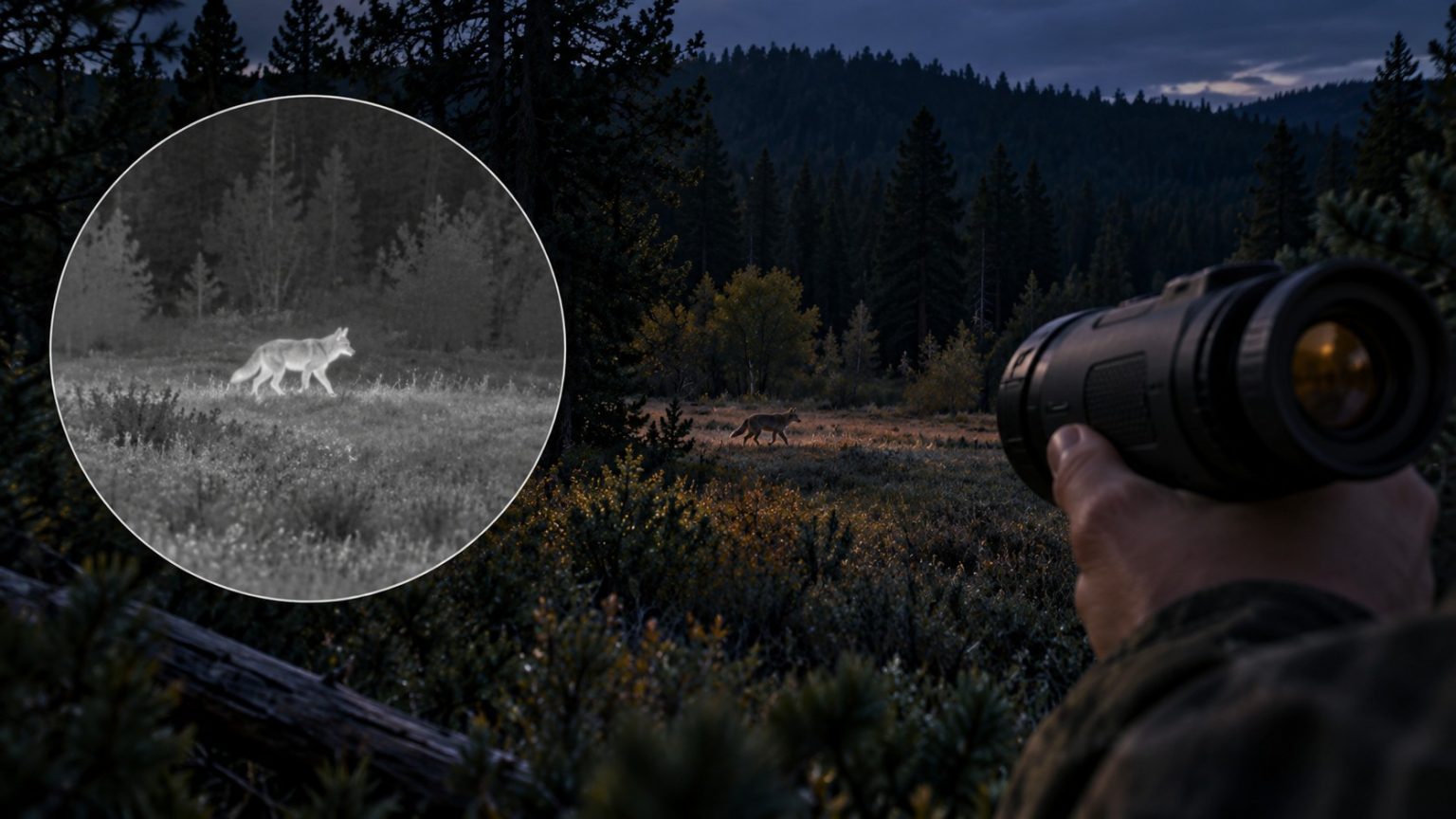
Interpreting animals in thermal images starts with recognizing the difference between a visible shape and a supported identification. Thermal can help you notice an exposed animal, but a distant silhouette may not contain enough information to distinguish a coyote from a domestic dog or another similarly shaped subject.
Use the image to gather evidence, and keep the conclusion no more specific than the evidence allows. Apparent size, one ear shape or a familiar-looking gait is not a reliable identification by itself.
This guide concerns observation and image interpretation. If you are choosing equipment, our thermal monoculars for coyote hunting comparison explains the trade-offs between viewing coverage, detector resolution and ranging features.
Start with what a thermal image represents
A thermal image is a processed view of infrared radiation reaching the sensor. It is not a conventional photograph with natural coat colors.
Fur, exposed surfaces, posture, background conditions and viewing angle can all affect the visible outline. A feature that is obvious in daylight may merge with another feature or disappear into the background in thermal.
Our explanation of how thermal monoculars work covers that imaging process. The practical consequence is to interpret the actual image, rather than mentally adding familiar details it does not show.
Use an evidence ladder
Instead of moving directly from “thermal spot” to “coyote,” work through progressively more demanding questions.
| Observation | A reasonable provisional description | What you still need to establish |
|---|---|---|
| A contrasting spot in an opening | Unresolved thermal feature | Whether it is an animal or a background object |
| A shape moves independently of the background | Moving subject, possibly an animal | General body form and context |
| A head, body and legs are distinguishable | Animal-shaped subject | Whether the available features support a narrower classification |
| Several consistent canid-like features are visible | Possible canid | Whether distinguishing evidence supports coyote rather than dog or another animal |
| The required diagnostic information is clear and consistent | An identification supported to the level observed | Any details or alternative explanations still unresolved |
The table is an observation framework, not a species-identification test. It does not assign a distance at which the next stage becomes reliable.
Our thermal range guide explains why detection, recognition and identification require different amounts of information.
Familiar coyote features are clues, not a thermal checklist
MassWildlife’s description of the eastern coyote notes its dog-like body form, pointed erect ears and bushy tail. Those are useful natural-history characteristics, but they do not become exclusive identifiers when reduced to a distant thermal silhouette.
Domestic dogs vary widely, and several can share a similar outline. Coat color is also unavailable as a natural-color field mark in the thermal view.
Even an apparently convincing characteristic can change with posture or obstruction. An ear turned away may not show the expected outline. A tail partly hidden by grass may look shorter. A frontal view may obscure proportions that seem clear in profile.
Treat these observations as pieces of a larger assessment rather than a rule such as “pointed ears plus a low tail equals coyote.”
Why apparent size can mislead you
A subject’s size on the screen depends on its physical size, distance and the device’s viewing geometry. Without a reliable distance or an appropriate reference in the same scene, a large image does not establish a large animal.
As a simple geometric illustration, a half-meter feature at one distance can subtend approximately the same angle as a one-meter feature at twice that distance. The display can make them look similar in extent.
That is one reason to keep surrounding landmarks visible. However, do not assume a tree or fence is at the same distance as the subject simply because it appears beside it in a flat image.
A rangefinder can contribute distance information if it obtains a return from the intended target. It still does not identify the animal or guarantee that the measured return came from the feature you assumed.
Observation improves when you keep context
Begin with the broader scene
At the widest useful view, note terrain, openings, nearby structures and the subject’s position. This helps you relocate the subject and compare its movement with fixed features.
Then inspect more closely if the image supports it. Our thermal field-of-view guide explains why a concentrated view can show more samples on a target while sacrificing surrounding coverage.
Watch several moments rather than one frame
A short sequence can reveal whether an apparent leg is part of the animal or a background feature. A changing angle may expose a previously hidden part of the outline.
Movement is additional evidence, not a unique species signature. An animal that briefly behaves as you expect is not thereby confirmed as the species you expected to find.
Separate observation from expectation
Before assigning a label, describe the visible facts in ordinary language: “four-legged animal,” “partly obscured,” “tail visible briefly,” or “head shape unresolved.”
This simple habit makes it easier to notice uncertainty. If every description already contains the word “coyote,” you may be treating the assumption as evidence.
What can make an outline unreliable?
Too few native samples
When only a small number of detector pixels describe a target, important features may merge. A large eyepiece screen can enlarge that limited information without adding the missing measurements.
See our thermal resolution explanation for the distinction between native detector detail, display resolution and digital enlargement.
Weak contrast or changing conditions
A feature may be difficult to separate from its background. Better sensitivity can help with subtle differences under suitable conditions, but it cannot guarantee a detailed shape. Our NETD guide explains that separate aspect of performance.
Obstruction
Vegetation can hide the parts of the animal you most need to see. A visible torso and an ambiguous head are still a partial observation. Waiting for a naturally clearer view is different from assuming the hidden outline.
Settings and enlargement
Brightness, contrast, sharpening and palette choices affect presentation. A more dramatic-looking boundary should not automatically be treated as a newly resolved anatomical feature.
Return to a familiar setting if adjustments make the subject harder to interpret. A palette change can help your perception, but it does not reveal natural coat markings.
Two examples of keeping the conclusion accurate
Example one: a moving spot across a field. The feature moves independently and sometimes appears elongated. You cannot consistently resolve a head, legs or tail. “Unidentified moving thermal subject” is more accurate than a species label.
Example two: a clearer animal near a habitat edge. You can follow a four-legged outline and see some canid-like proportions, but a branch repeatedly hides the head. “Possible canid, partly obscured” preserves useful information without claiming what the image did not establish.
These are hypothetical observations, not reports from field tests. They illustrate how to describe uncertainty rather than how to identify a particular species at a fixed distance.
A short record makes later review more useful
If recording is supported, preserve a brief sequence rather than relying only on a selected still. Note the exact model, starting view or zoom, known or estimated distance, conditions and the parts of the animal that were obscured.
When sharing the clip, separate what you observed from what you suspect. “Possible coyote; head unresolved” is more useful than presenting an uncertain label as confirmed.
Do not infer a person’s identity, an animal’s health or a precise body temperature from a bright shape alone. A wildlife observation monocular is not automatically a calibrated diagnostic instrument.
Keep equipment selection tied to the limitation
If you repeatedly find animals but cannot interpret them, identify what is missing before choosing an upgrade. More suitable viewing geometry may help spatial sampling; better sensitivity may help contrast. Neither removes an opaque barrier.
Our guide to why hunters use thermal monoculars discusses benefits and practical limits. The coyote-observation buying guide then compares complete devices rather than promising a universal identification distance.
Frequently asked questions
Can you reliably tell a coyote from a dog with thermal?
Some observations may provide useful distinguishing evidence; others do not. There is no universal silhouette rule or device specification that guarantees the distinction in every scene. Keep uncertain observations unresolved.
Is the tail enough to identify a coyote?
No. Visibility, angle, posture, coat and similar-looking animals can make a single characteristic misleading. Look for consistent supporting evidence and acknowledge what remains hidden.
Does more digital zoom solve uncertainty?
It can help inspect existing information. If the distinguishing detail was not captured or is obstructed, enlargement alone cannot establish it.
What should a hunter do when the animal remains uncertain?
Do not take a shot at an unidentified animal. A thermal detection or an assumed silhouette is not sufficient identification. Keep observation and any subsequent action tied to confirmed information and the applicable official rules.
An unresolved observation is a valid result
Thermal imaging can be excellent at directing your attention to something you would otherwise miss. Its value grows when you describe what the image supports clearly. Find the subject, gather the available evidence and leave the species uncertain whenever the distinguishing information is absent.

Elliot Vantage is an optics enthusiast and the editor behind Optic Horizon, covering monoculars, binoculars, thermal optics, and related outdoor gear. He researches manufacturer documentation, optical specifications, product features, pricing, and use-case differences to help readers understand their options and choose equipment that fits their needs.