
Affiliate disclosure: As an Amazon Associate, Optic Horizon earns from qualifying purchases.
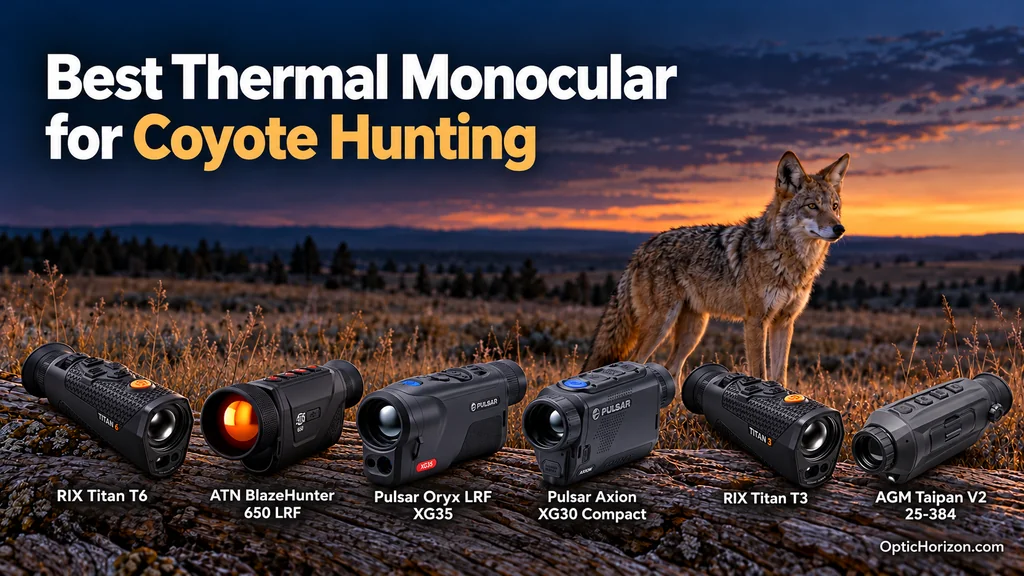
The best thermal monocular for coyote hunting should help you find an animal, examine its shape and movement, and judge distance without making the landscape difficult to scan. Our starting recommendation is the RIX Titan T6: its 640×480 detector, 12.5° horizontal field of view, built-in laser rangefinder and replaceable 18650 battery make a balanced combination for mixed terrain.
There are good reasons to choose something else. The ATN BlazeHunter 650 LRF concentrates its view on a smaller area for open-field observation. The Pulsar Axion XG30 Compact shows more ground at once in a smaller package. A 384-class model can also make sense when keeping the purchase price down matters more than having a 640-class detector.
Below, we compare six Amazon-listed handheld scanners, explain their trade-offs and separate useful specifications from misleading range claims.
In This Guide…
Quick comparison: which thermal scanner fits your needs?
| Thermal monocular | Our pick for | Native detector | Lens / base magnification | Horizontal field of view | Laser rangefinder |
|---|---|---|---|---|---|
| RIX Titan T6 | Best overall balance | 640×480 | 35 mm / 2.2× | 12.5° | Yes |
| ATN BlazeHunter 650 LRF | Open-field observation | 640×512 | 50 mm / 3.5× | 8.7° | Yes |
| Pulsar Oryx LRF XG35 | Long outings and battery continuity | 640×480 | 35 mm / 2.5× | 12.5° | Yes |
| Pulsar Axion XG30 Compact | Compact, wide-view scanning | 640×480 | 30 mm / 2× | 14.6° | No |
| RIX Titan T3 | A lower-cost rangefinder option | 384×288 | 25 mm / 2.6× | 10.5° | Yes |
| AGM Taipan V2 25-384 | A budget scanner without laser ranging | 384×288 | 25 mm / 2.5× | 10.5° | No |
Field of view is the manufacturer’s specification at base magnification. Digital zoom narrows the displayed scene. Detector resolution describes the thermal sensor, not the eyepiece display or recorded video.
How we selected these models
We checked manufacturer product pages and model-specific manuals, then matched each recommendation to an exact Amazon.com listing. We prioritized native resolution, viewing coverage, ranging, power arrangements and meaningful differences between models. These are research-based recommendations; we have not conducted controlled field tests of all six scanners.
Amazon offers, stock and delivery eligibility can change. Check the exact model, seller, included accessories and warranty coverage before ordering. Current prices matter particularly when comparing the two 384-class options.
1. RIX Titan T6 — Best overall balance
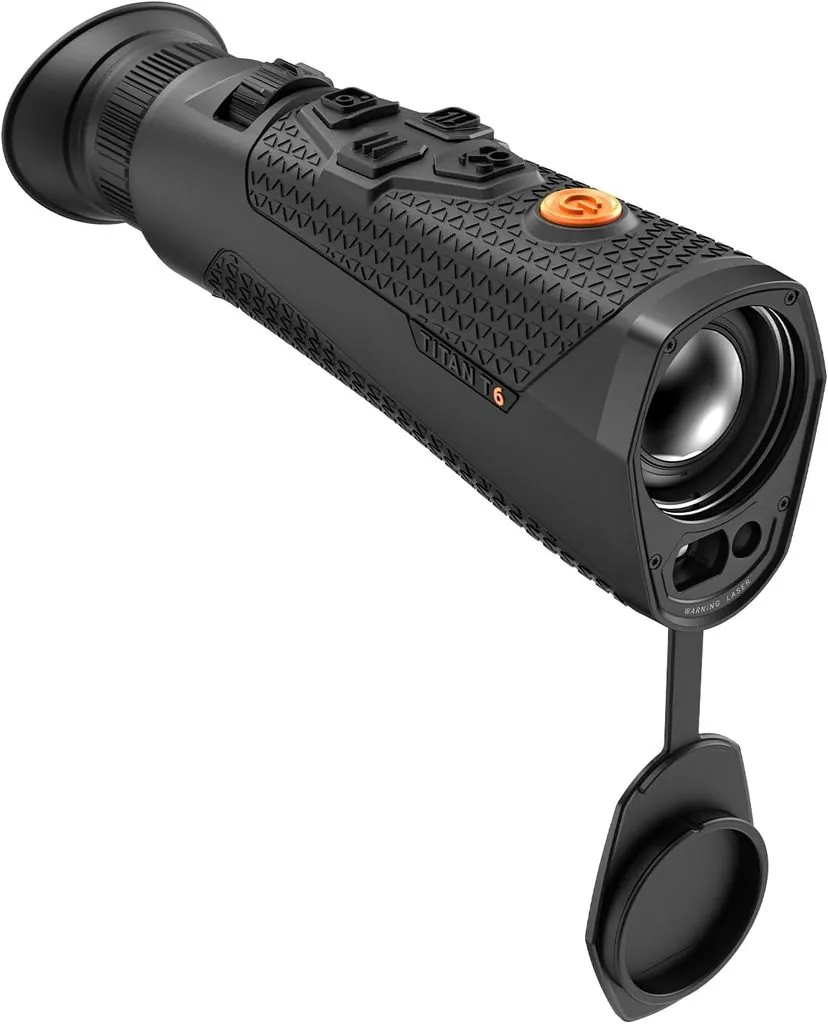
The Titan T6 is our first pick for someone who wants one thermal scanner for a mixture of open ground and narrower viewing areas. Its 12.5° horizontal field of view provides a useful middle ground between the wider Axion and the more concentrated ATN.
The combination matters more than the headline magnification. A 640×480 detector supplies the native thermal image, while the laser rangefinder adds measured distance. Electronic image stabilization is another useful feature to evaluate when comparing handheld viewing comfort.
The T6 also uses a removable 18650 battery rather than a proprietary removable pack. Follow RIX’s battery specifications when choosing spares; the cell format alone does not establish compatibility.
Key features
- 640×480, 12 μm thermal detector with a 50 Hz refresh rate.
- 35 mm F0.9 objective, 2.2× base magnification and 12.5° horizontal field of view.
- Integrated laser rangefinder and electronic image stabilization.
- Replaceable 18650 battery, USB-C external power and 32 GB of storage.
Pros
- Combines a 640-class detector with a moderately wide scanning view.
- Includes both ranging and stabilization in one handheld device.
- Removable battery supports carrying compatible spares.
Cons
- The ATN places the same horizontal detector count across a narrower angle.
- It is larger than the Axion XG30 Compact.
- Its listed five-hour battery runtime makes spare power relevant for longer outings.
Verdict
Choose the Titan T6 when you want a versatile 640-class monocular with integrated ranging. Its appeal is the combination of features, rather than a claim that it identifies coyotes at a universal distance.
2. ATN BlazeHunter 650 LRF — Best for open-field observation
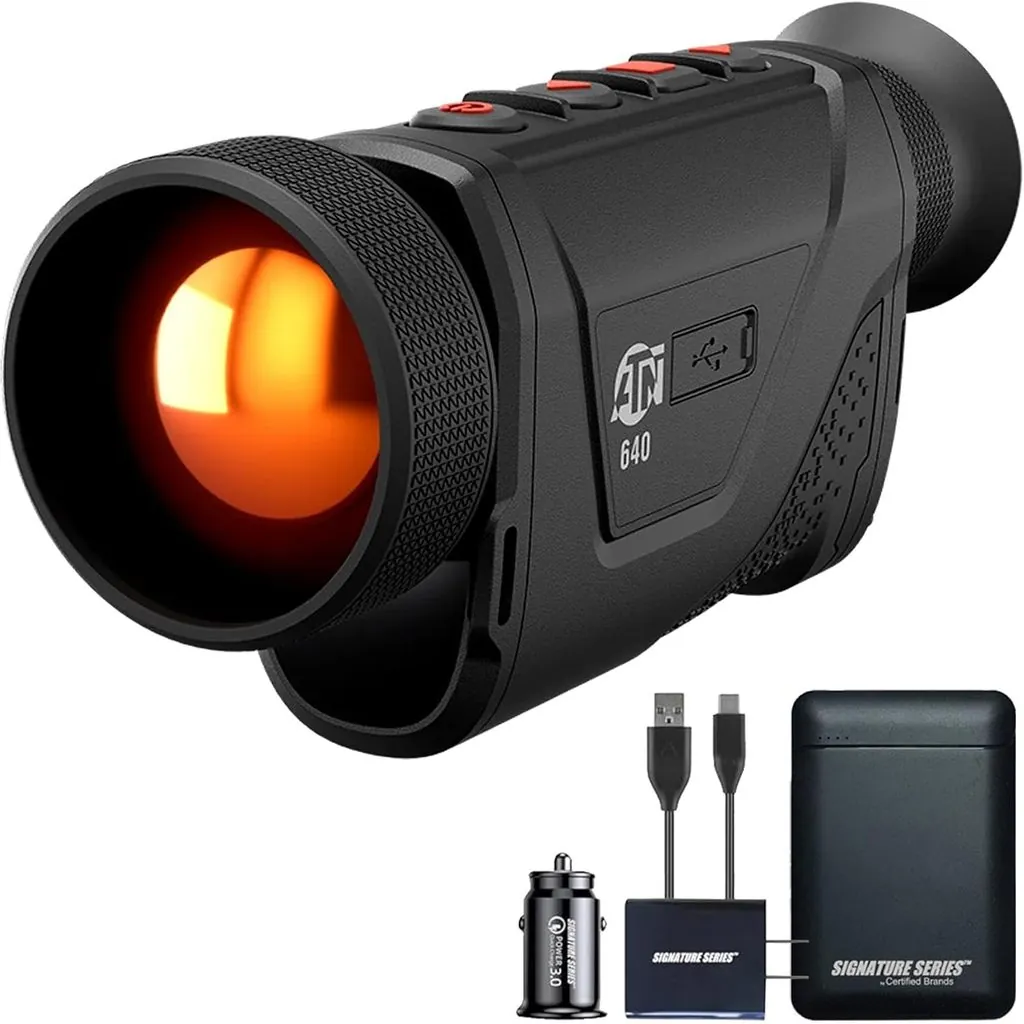
The BlazeHunter 650 LRF takes a different approach. Its 50 mm lens and 8.7° horizontal field of view concentrate a 640-pixel-wide detector on less ground than the other models here.
That geometry is attractive when small, distant animals occupy too little of a wider image. It places more native detector samples across the same angular target than a wider-view, 640-pixel model. Actual identification still depends on contrast, atmosphere, focus and processing.
The compromise is coverage: a narrower view means more repositioning to examine the same landscape. Someone regularly observing close animals or several separated openings may prefer a wider scanner.
ATN lists seven hours per battery, with two rechargeable batteries included. Its advertised 14-hour total combines both batteries; it is not a 14-hour rating for one cell.
Key features
- 640×512, 12 μm detector operating at 50 Hz.
- 50 mm objective, 3.5× base magnification and 8.7° horizontal field of view.
- Built-in laser rangefinder and 32 GB of internal memory.
- Replaceable 18650 battery system with two batteries and a charger included.
Pros
- Narrower viewing angle favors concentrated observation of a smaller area.
- Retains a 640-pixel-wide native detector.
- Includes distance measurement and a spare battery.
Cons
- Shows the least horizontal ground at once in this comparison.
- Extending operation across both included batteries requires a change.
- Amazon may present this model through “See All Buying Options”; inspect the available seller offer.
Verdict
Choose the 650 LRF if your priority is examining open ground through a concentrated view. For broad scanning in a compact package, the Axion is a better starting point.
3. Pulsar Oryx LRF XG35 — Best for long outings
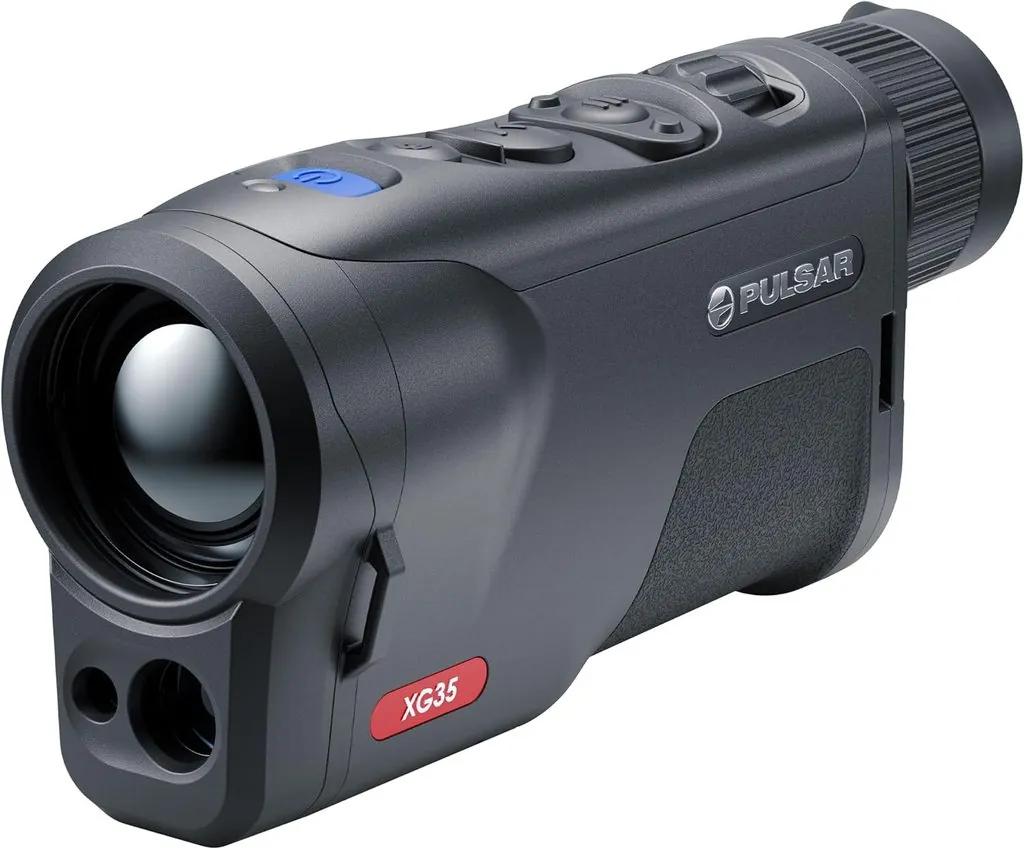
The Oryx LRF XG35 stands out for its power arrangement. It combines an internal battery with a removable APS 5 pack, giving it a different approach to extended use than a scanner powered by one removable cell.
Pulsar rates the combined batteries for 12 hours at 22°C. Treat that as a stated test-condition figure: recording, Wi-Fi, rangefinder use and operating conditions affect actual runtime.
Its core imaging specifications are closely matched to the Titan T6: a 640×480 detector, 35 mm objective and 12.5° horizontal field of view. The battery arrangement is therefore a clearer reason to favor the Oryx than an assumption that its larger maximum zoom automatically produces more detail.
At 500 g with the battery, it also requires a more substantial carry commitment than the compact Axion.
Key features
- 640×480, 12 μm detector with a 50 Hz refresh rate.
- 35 mm F1.0 objective, 2.5× base magnification and 12.5° horizontal field of view.
- Integrated laser rangefinder and 64 GB of recording storage.
- Internal battery plus removable APS 5 pack; IP67 protection.
Pros
- Dual batteries support extended operation without relying solely on one removable pack.
- Offers the same horizontal viewing coverage as the Titan T6.
- Larger storage allocation suits frequent recording.
Cons
- Uses a proprietary removable battery pack.
- Weighs substantially more than the Axion XG30 Compact.
- The combined 12-hour rating is conditional, not a promise for every outing.
Verdict
Choose the Oryx when extended operation and its dual-battery system are worth the extra carrying weight. It is a strong alternative to the Titan T6 for buyers who prefer Pulsar’s power arrangement.
4. Pulsar Axion XG30 Compact — Best compact scanner
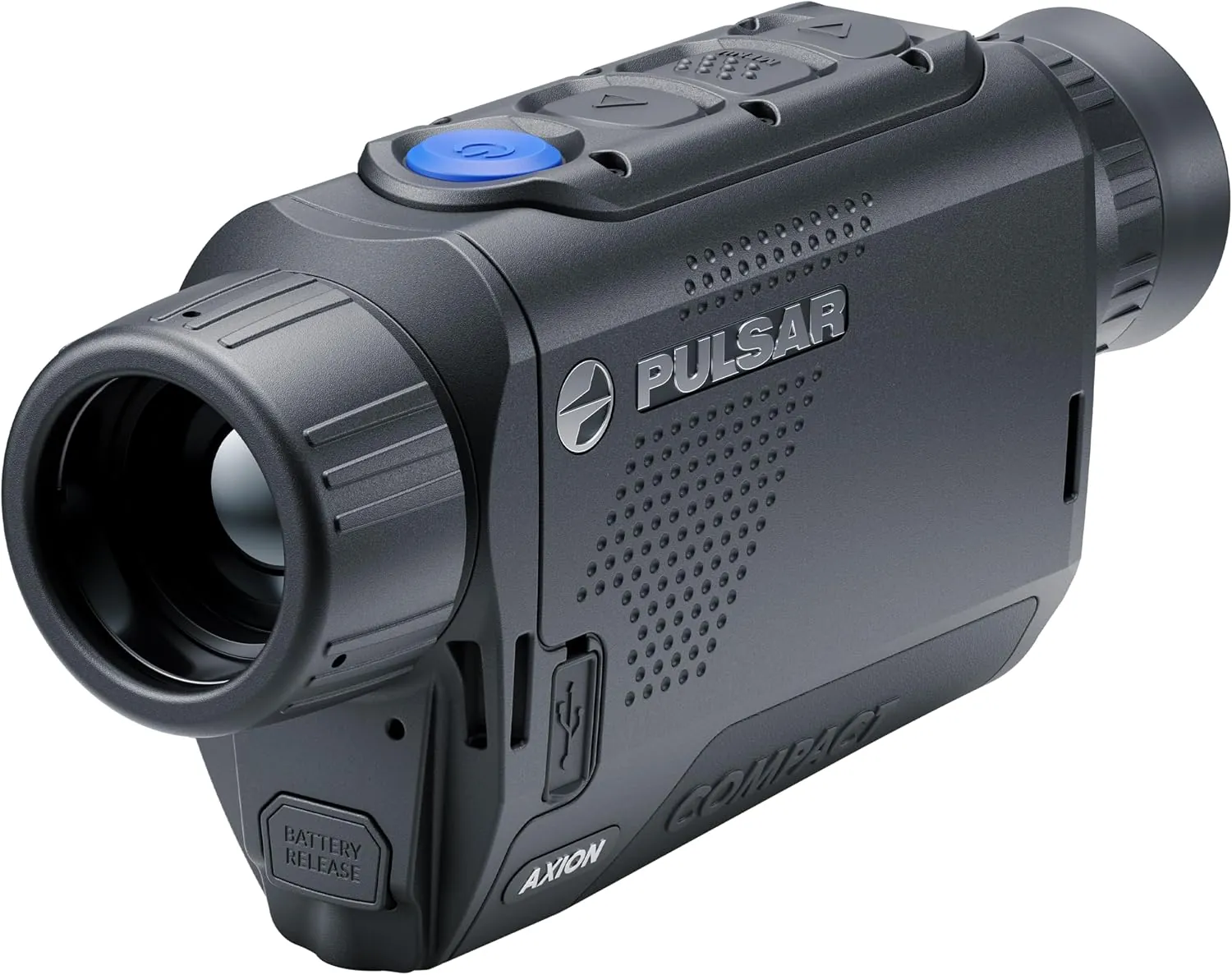
The Axion XG30 Compact makes its case through size and coverage. At 310 g with its battery, it is lighter than the Oryx. Its 14.6° horizontal field of view is also the widest in this shortlist.
That is a practical combination for hunters who carry their scanner frequently and want to examine a broad scene without immediately zooming in. It retains a 640×480 detector, so choosing a compact body does not mean dropping to a 384-class sensor.
There are two important compromises. It has no built-in laser rangefinder, and its 640×400 eyepiece display is lower in resolution than those in several larger models here. That display specification is separate from the 640×480 thermal detector.
Key features
- 640×480, 12 μm thermal detector at 50 Hz.
- 30 mm objective, 2× base magnification and 14.6° horizontal field of view.
- Removable APS 3 battery, rated for seven hours at 22°C.
- 64 GB of storage, USB-C power and IPX7 protection.
Pros
- Widest horizontal coverage among these six models.
- Compact dimensions and lower carrying weight.
- Provides a 640-class detector without an integrated rangefinder.
Cons
- Distance measurement requires a separate solution.
- Proprietary APS 3 battery system.
- Lower-resolution eyepiece display is a compromise to assess before buying.
Verdict
Choose the Axion if a small, wide-view thermal scanner suits your needs better than an all-in-one rangefinding device. It is particularly logical when you already have a suitable way to measure distance.
5. RIX Titan T3 — Best lower-cost rangefinder option
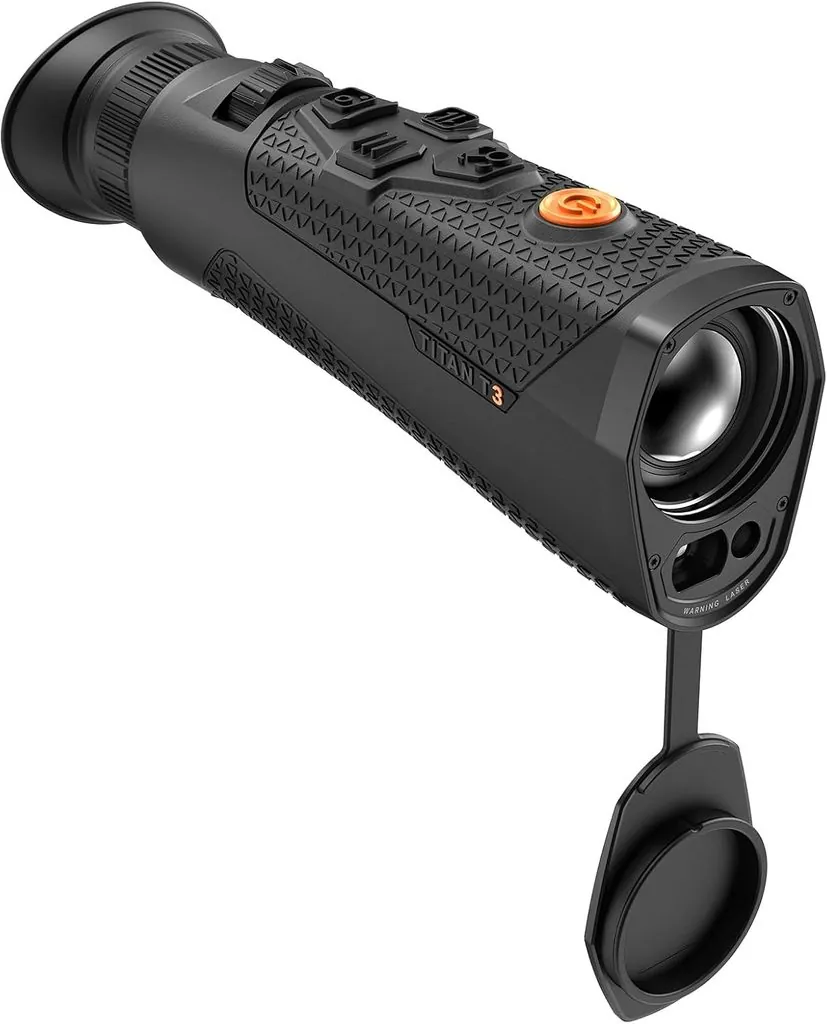
The Titan T3 preserves several of the T6’s useful features while moving to a 384×288 detector and 25 mm lens. It still includes laser ranging, electronic stabilization and a removable 18650 battery.
This makes it worth comparing with a budget scanner that lacks a rangefinder. If measured distance is a priority, an integrated unit may be preferable to buying and carrying another device.
The reduction in native resolution is meaningful. Its 1920×1080 OLED display does not turn the detector into a 1080p thermal sensor. The T6 supplies more native thermal samples while also covering a wider horizontal angle.
The T3 shares the T6’s body design, so the lower price tier should not be mistaken for a notably smaller handheld unit.
Key features
- 384×288, 12 μm thermal detector with a 50 Hz refresh rate.
- 25 mm F0.9 objective, 2.6× base magnification and 10.5° horizontal field of view.
- Built-in laser rangefinder, electronic stabilization and 32 GB of storage.
- Replaceable 18650 battery and IP67 protection.
Pros
- Retains integrated distance measurement in a lower-cost model.
- Includes stabilization rather than making it exclusive to the T6.
- Offers removable batteries and USB-C external power.
Cons
- Fewer native thermal pixels than the four 640-class recommendations.
- Narrower viewing coverage than the T6 despite its smaller lens.
- Similar body size to the T6.
Verdict
Choose the Titan T3 when integrated ranging matters more than upgrading to a 640-class detector. Compare its current price with the Taipan before deciding how much the rangefinder is worth to you.
6. AGM Taipan V2 25-384 — Best budget scanner without laser ranging
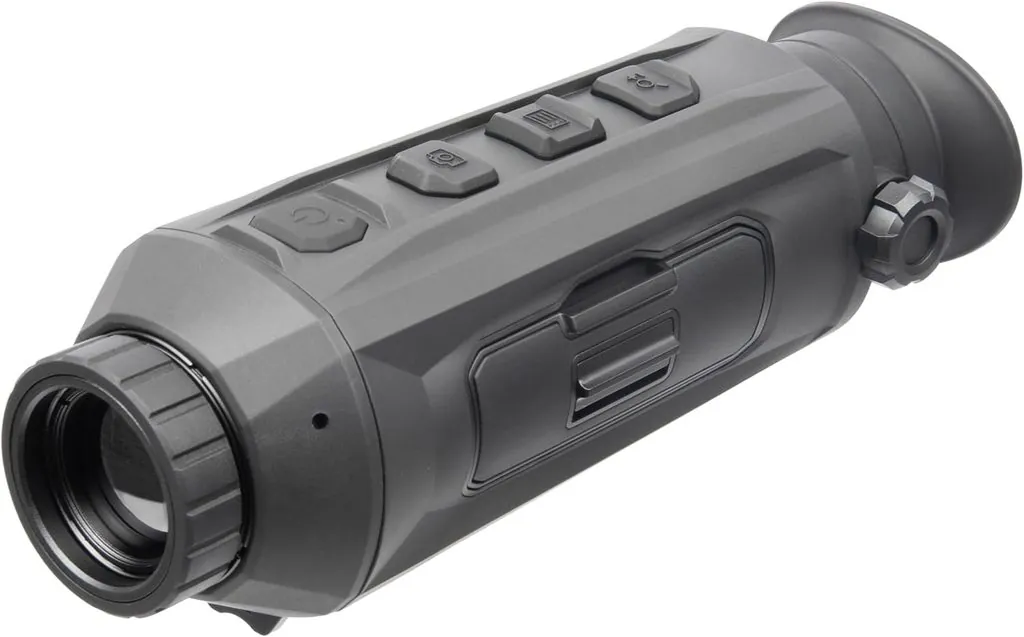
The Taipan V2 25-384 is the simpler choice for buyers who want a 384-class scanner and do not need a built-in laser rangefinder. Its 25 mm lens and 10.5° horizontal field of view place it close to the Titan T3 in basic scene coverage.
Its removable 18650 battery is a useful change from a sealed-battery approach. AGM lists two batteries in the package and up to 6.5 hours of operation. The model also supports USB-C external power.
The buying decision is largely about price and ranging. If the Taipan is meaningfully less expensive and you already have a suitable distance-measurement tool, its simpler feature set can be sensible. If prices are close, the Titan T3 deserves attention for its integrated laser rangefinder.
Key features
- 384×288, 12 μm thermal detector operating at 50 Hz.
- 25 mm objective, 2.5× base magnification and 10.5° horizontal field of view.
- One removable 18650 battery in use, with two included.
- 16 GB of storage, Wi-Fi, USB-C external power and IP67 protection.
Pros
- Practical option when keeping the purchase price down is a priority.
- Replaceable battery avoids depending entirely on a sealed internal cell.
- Includes recording and wireless connectivity.
Cons
- No built-in laser rangefinder; estimating distance is not equivalent to laser measurement.
- Lower native detector resolution than the 640-class models.
- Less storage than the other recommendations.
Verdict
Choose the Taipan when you want a straightforward scanner and can make a meaningful saving by foregoing integrated ranging. A 640-class upgrade is more compelling if small, distant subjects dominate your viewing.
How to choose a thermal monocular for coyote hunting
Match field of view to the ground you need to examine
A wider view shows more landscape in one frame. A narrower view concentrates the detector on a smaller area. Neither arrangement is automatically better: the right balance depends on whether broad coverage or examining a small subject matters more.
Here is what the published horizontal angles mean at a common distance:
| Model or group | Horizontal field of view | Approximate scene width at 200 yards |
|---|---|---|
| Pulsar Axion XG30 Compact | 14.6° | 51.2 yards |
| RIX Titan T6 / Pulsar Oryx LRF XG35 | 12.5° | 43.8 yards |
| RIX Titan T3 / AGM Taipan V2 25-384 | 10.5° | 36.8 yards |
| ATN BlazeHunter 650 LRF | 8.7° | 30.4 yards |
These are geometric calculations from manufacturer angles at base magnification: scene width = 2 × distance × tan(field of view ÷ 2). They describe coverage, not tested coyote-detection or identification distances. Stabilization or image cropping can affect the displayed view.
For example, the Axion’s published angle covers about 21 more horizontal yards than the ATN’s at 200 yards. The ATN distributes its 640 detector columns across a smaller area, giving it finer native angular sampling. Whether that translates into a useful identification advantage depends on the complete imaging system and conditions.
Compare the detector before the display or maximum zoom
The thermal detector captures the infrared information. The eyepiece display presents that image; it cannot create missing sensor measurements.
Likewise, digital zoom enlarges a portion of the image. Processing may make it easier to view, but higher zoom numbers do not establish higher native detail.
A 384-class scanner can be a reasonable purchase when cost matters and subjects occupy enough of the frame. A 640-class model gives more flexibility, particularly when comparing models with similar viewing angles. Resolution alone still does not establish a reliable species-identification distance.
Our thermal monocular resolution guide explains the differences between 256-, 384- and 640-class detectors.
Keep detection and identification separate
A visible heat signature establishes that something is present. Recognizing an animal-shaped subject is a further step. Distinguishing a coyote from a domestic dog or another animal requires enough useful information to resolve the ambiguity.
Manufacturer detection figures may use a deer-sized target or another defined test object. They should not be relabeled as distances at which a coyote can be confidently identified.
Teledyne FLIR’s explanation of detection, recognition and identification describes the influence of weather, background clutter, camera settings and operator experience. Without comparable testing on a defined target, a fixed identification-distance claim is difficult to substantiate.
Decide whether integrated ranging earns its place
A thermal monocular with a rangefinder combines observation and distance measurement. It does not establish species identity, and the advertised maximum ranging distance is not a promise that every small animal will return a measurement at that distance.
Choose integrated ranging if it solves a real gap in your equipment. If you already have a suitable distance-measurement solution, the Axion or Taipan may offer a better allocation of your budget.
Compare battery arrangements, not just headline hours
The listed battery figures represent different arrangements. ATN’s 14-hour figure combines two batteries used in succession; Pulsar’s Oryx figure combines an internal battery and removable pack. Those are different from a runtime quoted for one installed cell.
Consider how you will recharge, carry spares and handle a depleted battery. Cold conditions and enabled features can change the result. Use batteries and chargers specified for the device.
Allow for weather and obstructed views
Thermal imaging works without visible light, but it does not remove every visibility problem. Fog and rain can reduce usable range, and solid vegetation can hide an animal. A thermal view through gaps in brush is different from seeing through dense foliage.
FLIR explains these material and weather limitations. For the underlying technology, see how thermal monoculars work.
Frequently asked questions
Does a thermal monocular need an infrared illuminator?
No. These monoculars detect thermal infrared radiation rather than relying on reflected light from an illuminator. They can operate during the day or at night, although useful contrast and detail still depend on the scene and conditions.
Do I need a 35 mm or 50 mm lens?
There is no universal minimum lens size. Lens size must be considered with detector dimensions, pixel pitch and field of view. The 25 mm models here have narrower published horizontal coverage than the 35 mm Titan T6, illustrating why lens size alone is an incomplete buying rule.
Can a thermal monocular reliably tell a coyote from a dog?
Only when the image provides enough information to distinguish them. A small silhouette, partial view or similar-looking animal may remain ambiguous. Thermal detection and a distance reading do not, by themselves, provide positive species identification.
Can I use a handheld thermal scanner instead of a thermal scope?
A handheld monocular serves observation and scanning. It is not a substitute for a purpose-built aiming optic. Using a separate scanner also lets you examine a scene without pointing a firearm at everything you wish to observe.
Is thermal equipment legal for coyote hunting?
Rules depend on the jurisdiction, land, season and method of use. Check the current wildlife-agency regulations for the location where you intend to hunt. Our guide to why hunters use thermal monoculars covers their practical benefits and limits.
Which one should you buy?
Start with the RIX Titan T6 as the balanced choice, then decide whether a wider view, a more concentrated image, a different power system or a lower purchase price would serve you better. Those are the differences that justify choosing another model.
Match the scanner to the ground you observe and the equipment you already own. Maximum zoom and an impressive advertised detection distance are secondary to getting that fit right.

Elliot Vantage is an optics enthusiast and the editor behind Optic Horizon, covering monoculars, binoculars, thermal optics, and related outdoor gear. He researches manufacturer documentation, optical specifications, product features, pricing, and use-case differences to help readers understand their options and choose equipment that fits their needs.