
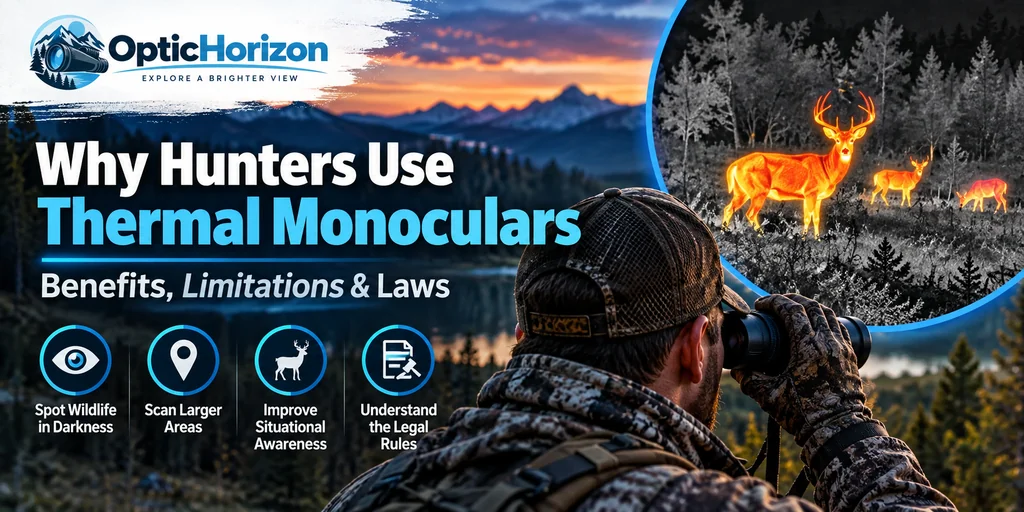
A thermal monocular gives hunters something conventional binoculars and daylight optics cannot: the ability to detect thermal contrast without relying on visible light. That can make it useful for scanning fields, spotting animals in darkness, checking brush lines, and locating warm-bodied wildlife that may blend into the background.
The headline is deliberately strong, but a thermal monocular is not literally essential for every type of hunting. Its value depends on the species you pursue, when and where you hunt, local regulations, your budget, and whether thermal equipment is legal for the activity you have in mind.
Used appropriately, thermal can add a very different layer of situational awareness to a hunting kit. It is best understood as a detection tool rather than a replacement for binoculars, a riflescope, or positive visual identification.
If you want the technical explanation first, see our guide to how thermal monoculars work.
Table of Contents
Why Hunters Use Thermal Monoculars
Thermal imaging detects infrared radiation from a scene and converts differences in that detected energy into an electronic image. Warm animals can often stand out from cooler surroundings, even when there is not enough visible light for ordinary optics to provide a useful view.
NASA explains that humans, animals, and other objects emit infrared radiation that our eyes cannot see. Thermal imaging instruments detect infrared energy and turn it into an image we can interpret. NASA’s infrared overview provides a useful introduction to the underlying science.
For hunters, that difference matters because finding an animal and identifying an animal are not always the same task. A thermal monocular can make detection easier in some conditions, while conventional optics may still be better for confirming visual details such as antlers, markings, or other identifying features.
1. Detect Animals When Visible Light Is Limited
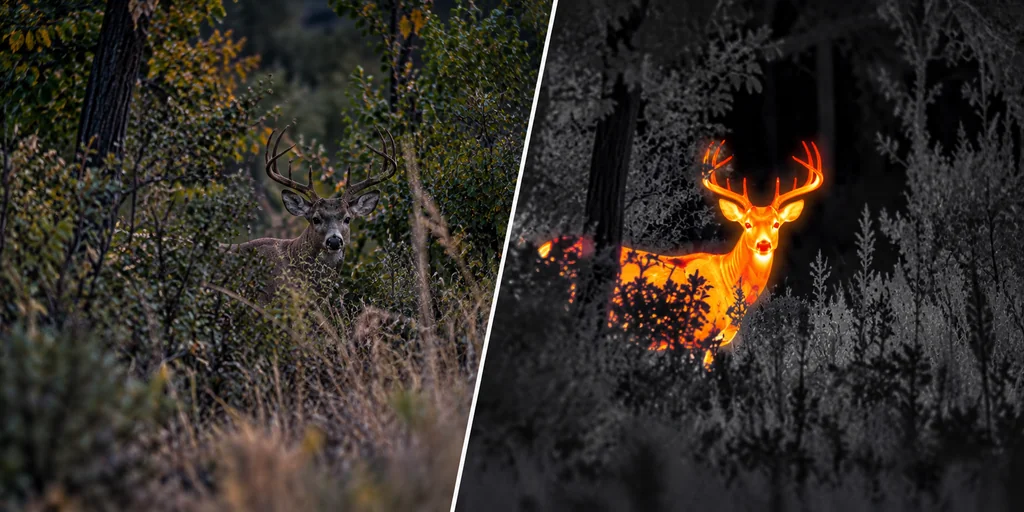
The most obvious advantage of thermal is that it does not depend on visible illumination to form a thermal image. A thermal monocular can therefore reveal thermal contrast in complete darkness without needing moonlight, a spotlight, or an infrared illuminator.
This can be useful when scanning before sunrise, after sunset where legal, or in other low-light conditions. An animal that is difficult to distinguish with the naked eye may stand out clearly when its thermal radiation differs from the surrounding vegetation or ground.
That does not mean thermal performance is identical at every hour. The amount of contrast between an animal and its surroundings can change as the ground, vegetation, rocks, and other surfaces warm and cool throughout the day.
2. Scan Large Areas More Efficiently
A handheld thermal monocular can be useful as a scanning device because it allows you to search for thermal contrast rather than trying to identify every shape in a dark or visually cluttered landscape.
In open fields, along tree lines, or across relatively unobstructed terrain, a warm-bodied animal may be easier to notice thermally than with conventional optics. A wider field of view can make scanning easier, while a narrower field of view can make a distant target occupy more of the image.
This is one reason focal length and field of view matter so much when comparing thermal monoculars. A longer focal length is not automatically better; it typically trades some viewing width for a tighter view of distant targets.
3. Spot Thermal Contrast That Conventional Optics Can Miss
Conventional binoculars and monoculars depend on visible light reflected from the scene. Thermal imaging works differently, so an animal that visually blends with grass, trees, or a dark background may still produce noticeable thermal contrast.
This can be particularly useful when the animal is partially obscured by visual clutter. But thermal should not be described as seeing through solid cover. Trees, walls, thick vegetation, earth, and other solid materials can block the infrared radiation coming from a target.
FLIR notes that thermal cameras do not see through walls and cannot see through trees or wood, although thermal contrast can sometimes make a partially visible person or animal easier to notice in a cluttered environment. FLIR’s explanation of what thermal imaging can and cannot see through is a useful reference.
4. Thermal Does Not Need an IR Illuminator
Digital night vision and thermal imaging are often grouped together because both can help after dark, but they work differently.
Digital night-vision devices use electronic image sensors and may rely on available visible or near-infrared light. Many also use an infrared illuminator to light the scene in wavelengths the sensor can detect.
A thermal monocular does not need an IR illuminator to reveal thermal contrast. It detects thermal infrared radiation from the scene itself. That makes thermal particularly useful when the goal is simply to locate warm targets in darkness.
5. Thermal Can Help With Game Recovery
After a shot, a thermal monocular may help a hunter search for an animal or identify warm areas in the surrounding terrain. In suitable conditions, thermal contrast can make an animal easier to locate than it would be with visible-light optics alone.
But this is a capability, not a guarantee. Thick vegetation can block the target, weather can reduce thermal range, surrounding surfaces can retain heat, and thermal contrast may change with time and environmental conditions.
For those reasons, thermal should complement rather than replace normal tracking practices, careful shot placement, visual inspection, and any recovery methods required by local hunting rules.
6. Improve Situational Awareness Around the Hunting Area
A thermal monocular can also help a hunter understand what is moving nearby before relying on magnified visible-light optics. It may reveal animals crossing an opening, movement near a field edge, or warm-bodied subjects in areas that look almost completely dark to the eye.
That can be useful for observation and orientation, but the thermal image should not be treated as sufficient identification for a shot. Detection, recognition, and identification are different tasks.
Teledyne FLIR describes detection as determining that an object is present, recognition as classifying the general type of object, and identification as resolving enough information to distinguish the specific object or relevant details. FLIR’s discussion of detection, recognition, and identification explains why advertised detection range should not be confused with positive identification range.
Where Thermal Monoculars Fall Short
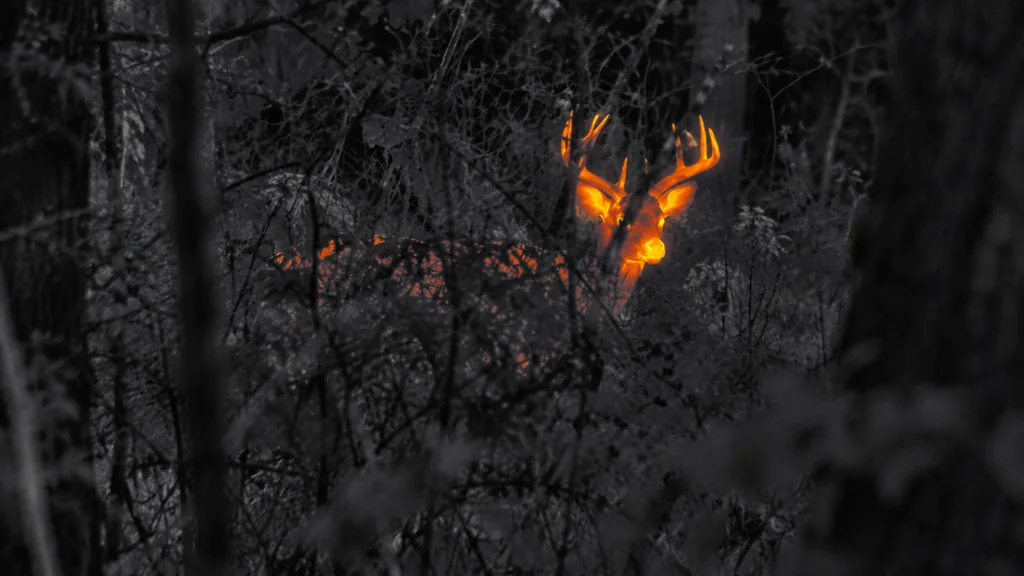
Thermal imaging is powerful, but it is not “heat X-ray vision.” Understanding its limits is especially important in hunting, where an image that shows a warm shape may not provide enough detail for a responsible decision.
Thermal Cannot See Through Walls or Dense Cover
A thermal monocular normally shows infrared radiation coming from surfaces visible to the sensor. A wall, tree trunk, thick brush, or other solid obstruction can prevent the detector from receiving infrared radiation from the animal behind it.
Fog, Rain, Humidity, and Snow Can Reduce Performance
Thermal can remain useful in some conditions where visible-light viewing becomes difficult, but it is not immune to weather. Water droplets and atmospheric moisture can reduce infrared transmission and shorten useful detection range.
FLIR explains that fog and rain can significantly reduce thermal-camera range and that performance depends on the atmosphere, target size, target-to-background temperature difference, detector, optics, and other system characteristics. See FLIR’s analysis of thermal imaging in fog and rain.
Thermal Usually Does Not See Through Ordinary Window Glass
Common window glass is generally opaque to the long-wave infrared wavelengths used by many handheld thermal imagers. Instead of seeing a target through the window, the device may show the glass surface and reflected thermal radiation.
Digital Zoom Does Not Create New Sensor Detail
Digital zoom enlarges the image produced by the detector. It can make a target easier to view on the display, but it does not add thermal pixels that were not captured by the sensor in the first place.
Detection Is Not Identification
A manufacturer may advertise a long detection range, but detecting that something warm is present at a distance is very different from determining exactly what that object is. Hunters should pay attention to recognition and identification capability rather than treating the largest advertised range number as the most important specification.
Thermal Monocular vs Binoculars vs Digital Night Vision
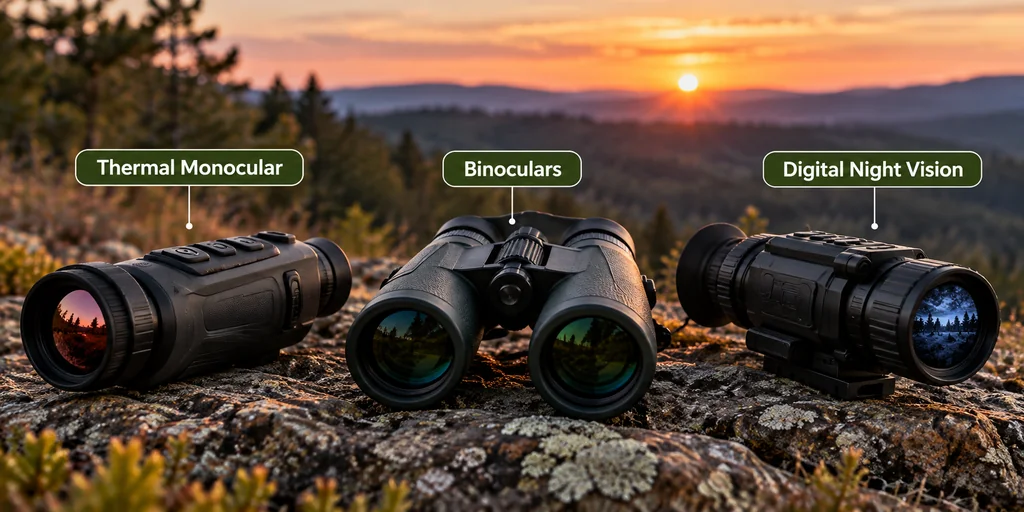
| Device | How It Forms an Image | Main Strength for Hunters | Main Limitation |
|---|---|---|---|
| Thermal monocular | Detects thermal infrared radiation | Finding thermal contrast in darkness and visually difficult scenes | Less natural visual detail; cannot see through solid obstacles |
| Conventional binoculars or monocular | Magnifies visible light with optical lenses and prisms | Natural detail, color, and visual identification | Needs usable visible light |
| Digital night vision | Uses an electronic image sensor, often with near-IR illumination | Electronic viewing in very low light or darkness | May depend on an IR illuminator when ambient light is insufficient |
These technologies are better viewed as complementary tools than direct replacements for one another. Thermal is particularly strong at detection. Conventional optics remain excellent for natural daytime viewing and visual detail. Digital night vision provides another electronic option when visible light is limited.
If you are comparing conventional daytime optics rather than thermal devices, our guide to the best monoculars under $100 explains the trade-offs among magnification, field of view, eye relief, weight, and optical design.
Is It Legal to Use a Thermal Monocular While Hunting?
There is no single rule that applies everywhere. Thermal-imaging laws can vary by country, state or province, species, season, land type, time of day, and whether the device is handheld or attached to a weapon.
For example, Pennsylvania authorizes handheld and sporting-arm-mounted night-vision and infrared thermal optics for hunting certain furbearers. By contrast, Montana’s 2026 black bear regulations state that thermal imaging devices fall within prohibited electronic motion-tracking devices while hunting. These examples illustrate why a hunter should never assume that a thermal device is legal simply because it is sold locally or legal in another jurisdiction.
Before using thermal equipment in the field, check the current regulations published by the wildlife authority that governs the exact place, species, season, and method you plan to hunt. Useful examples of official sources include the Pennsylvania Game Commission and Montana Fish, Wildlife & Parks hunting regulations.
Regulations change. This article is general information, not legal advice.
What Specifications Matter Most to Hunters?
Thermal Resolution
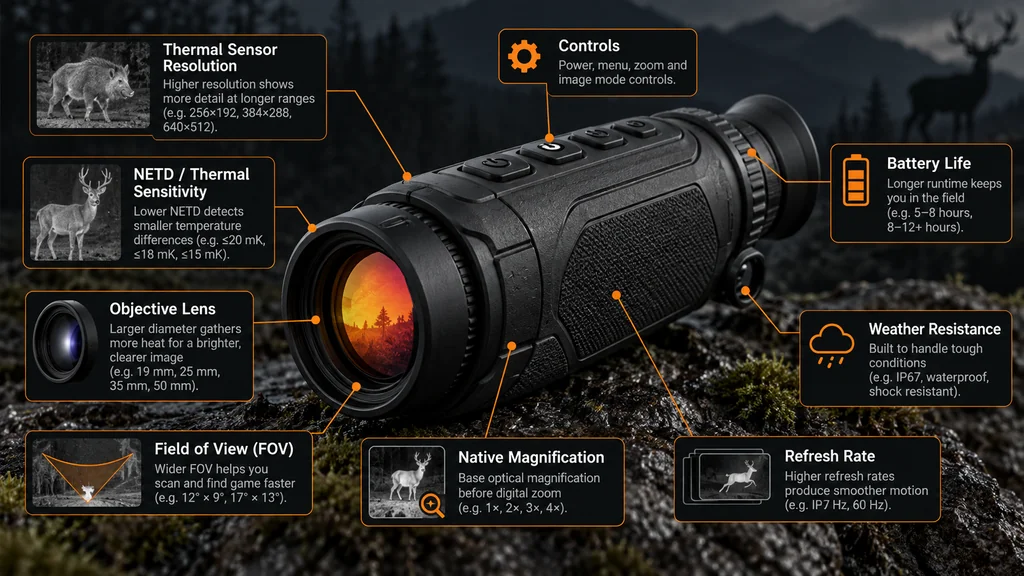
Thermal resolution tells you how many detector pixels are used to form the thermal image. Common formats include 256×192, 320×240, 384×288, and 640×512. More detector pixels can provide more spatial detail when other system factors are comparable, but resolution should not be judged alone.
Thermal Sensitivity (NETD)
NETD describes a thermal imager’s ability to distinguish small differences in thermal signal under specified conditions. Lower NETD values generally indicate better thermal sensitivity, which can help reveal subtle contrast in difficult scenes.
Focal Length and Field of View
Shorter focal lengths generally provide a wider field of view, which can be useful for scanning. Longer focal lengths usually provide a narrower field of view that makes a distant target occupy more of the image. The right balance depends on terrain and expected viewing distance.
Native Magnification and Digital Zoom
Native optical characteristics matter more than a large digital-zoom number. Digital zoom simply enlarges the available thermal image and therefore should not be mistaken for additional detector resolution.
Refresh Rate
A higher refresh rate can make motion appear smoother when scanning or following moving animals. This matters more in dynamic scenes than it does when observing a stationary target.
Battery Life and Power Options
For a field device, battery life affects usefulness just as much as image quality. Consider expected runtime, cold-weather performance, whether the battery is replaceable, and whether the monocular can be powered or charged from a portable battery pack.
Weather Resistance, Weight, and Controls
A hunting monocular needs to be practical to carry and operate outdoors. Housing protection, overall weight, button layout, focus control, startup time, and usability with gloves can matter more in real use than an impressive specification that rarely affects the way you hunt.
Who Benefits Most From a Thermal Monocular?
Thermal is most useful when detection is difficult with ordinary vision: low-light observation, legal nighttime hunting, scanning large areas, locating warm-bodied animals against a cooler background, or searching for an animal after a shot.
A hunter who operates almost entirely in bright daylight and open terrain may get less value from thermal than someone who regularly encounters low light, dense visual clutter, or legally permitted nighttime activity. That is why thermal should be chosen around a real use case rather than purchased simply because it is another piece of electronic hunting gear.
Frequently Asked Questions
Can a thermal monocular see animals in complete darkness?
Yes. Thermal imaging does not require visible illumination to create a thermal image. Its usefulness still depends on target-to-background thermal contrast, atmospheric conditions, optics, detector performance, and distance.
Can a thermal monocular see through brush?
Not through dense vegetation in the literal sense. Leaves, branches, tree trunks, and other material can block infrared radiation. If part of an animal is visible between openings, however, its thermal contrast may make that exposed portion easier to notice.
Can thermal imaging identify an animal at the same distance it can detect it?
No. Detection generally requires much less image detail than recognition or identification. A device may detect a warm object at a long distance without providing enough detail to determine exactly what it is.
Does thermal work during the day?
Yes. Thermal imaging does not depend on darkness. Daytime conditions can change the thermal contrast of the scene because sunlight warms the ground, vegetation, rocks, buildings, and other surfaces.
Can thermal replace binoculars?
Usually not. Thermal and conventional optics provide different information. Thermal is useful for finding thermal contrast, while binoculars provide a natural visible-light image with color and visual detail. Many users will find the two technologies complementary.
Is a thermal monocular legal for hunting?
That depends entirely on the jurisdiction and activity. Rules may vary by species, season, location, time of day, and device type. Always verify the current regulations with the relevant wildlife authority before hunting with thermal equipment.
Final Thoughts
The strongest reason hunters carry thermal monoculars is not that thermal replaces every other optic. It is that thermal adds a detection capability conventional visible-light optics do not provide.
A good thermal monocular can help reveal animals in darkness, speed up scanning, highlight thermal contrast in visually confusing terrain, and assist with some recovery searches. At the same time, it cannot see through solid cover, weather can reduce performance, detection should not be confused with identification, and hunting laws can sharply restrict when thermal equipment may be used.
For hunters whose conditions and local regulations make thermal useful, that combination of capabilities can make a handheld thermal monocular a valuable addition to the kit. The key is to treat it as a specialized observation tool and understand both what it can do and where its limits begin.

Elliot Vantage is an optics enthusiast and the editor behind Optic Horizon, covering monoculars, binoculars, thermal optics, and related outdoor gear. He researches manufacturer documentation, optical specifications, product features, pricing, and use-case differences to help readers understand their options and choose equipment that fits their needs.