
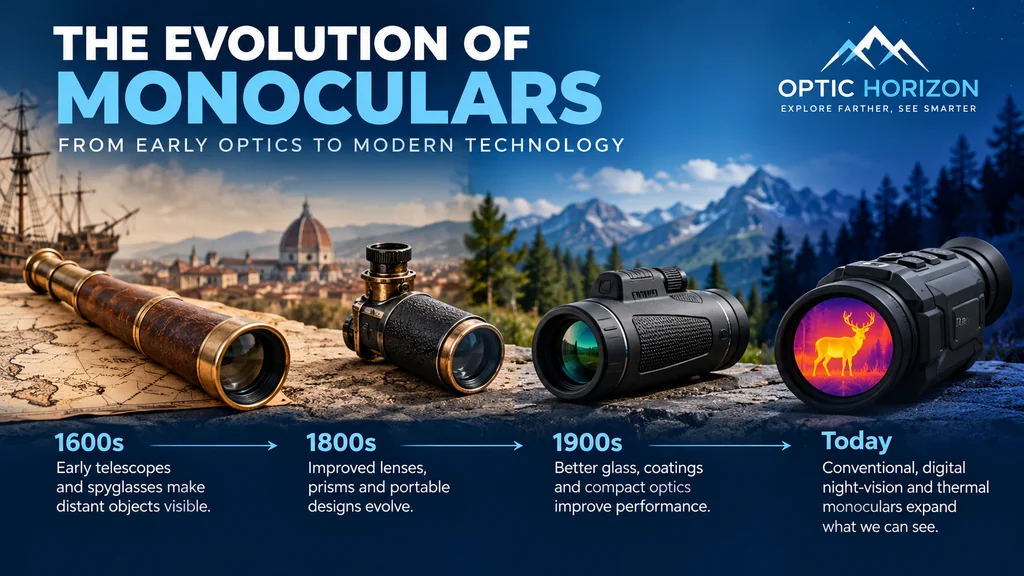
A modern monocular can fit in a jacket pocket, yet the optical principles behind it developed over centuries.
Today, monoculars are used for birdwatching, hiking, wildlife observation, travel, surveillance, and other situations where portable magnification is useful. Digital night-vision and thermal monoculars have expanded the category even further, allowing users to observe scenes that conventional visible-light optics cannot.
The history of the monocular is therefore not the story of a single invention. It is part of the broader development of lenses, telescopes, prisms, precision optical manufacturing, electronic imaging, and infrared technology.
Here is how those developments eventually produced the monoculars we use today.
Table of Contents
From Early Lenses to Magnifying Optics
Long before the modern monocular existed, people understood that shaped transparent materials could alter the appearance of objects.
Practical spectacles emerged in northern Italy during the late 13th century, building on earlier knowledge of how shaped transparent materials could bend light. These early optical devices were designed to improve vision at close distances rather than magnify faraway objects, but they demonstrated something fundamental: carefully shaped lenses could manipulate light in useful and predictable ways.
The major breakthrough for viewing distant objects came much later.
1608: The Telescope Changes Long-Distance Viewing
The history of the modern monocular is closely connected to the development of the refracting telescope.
The earliest documented telescope appeared in the Netherlands in 1608, when spectacle maker Hans Lippershey applied for a patent for an instrument that made distant objects appear closer. Other Dutch lens makers were working on similar ideas around the same period, so historians are cautious about attributing the concept entirely to one inventor.
The basic concept was remarkably important: place an objective lens and an eyepiece at opposite ends of a tube and use their optical relationship to magnify a distant scene.
That principle established the foundation for generations of handheld telescopes and, eventually, conventional optical monoculars.
Galileo Improves the Telescope
Galileo Galilei did not invent the telescope.
After learning about the Dutch instrument, Galileo built and improved his own versions in 1609. Surviving instruments preserved by Museo Galileo show the type of lens arrangement he used, and some of his telescopes achieved magnification of roughly 14× to 21×.
Galileo famously pointed the instrument toward the sky, but telescopes were also useful for terrestrial observation. Their ability to make distant objects appear closer naturally made portable versions valuable outside astronomy.
This is where the lineage leading toward the traditional spyglass and modern monocular becomes much clearer.
The Spyglass Makes Magnification Portable
Early telescopes could be cumbersome, but the idea of a portable telescope had obvious advantages.
Over time, handheld refracting telescopes evolved into the instruments commonly associated with sailors, explorers, military observers, and travelers. Collapsible draw-tube designs made them easier to carry while preserving enough optical length for useful magnification.
By the early 19th century, manufacturers were producing increasingly sophisticated handheld telescopes. A surviving Fraunhofer spyglass in the Smithsonian collection, made between 1819 and 1826, for example, used an achromatic objective, a four-element erecting eyepiece, and a three-draw brass body covered with wood.
The spyglass is one of the clearest ancestors of today’s conventional monocular: a compact instrument designed to provide magnified viewing through one eye.
But major improvements in optical engineering were still to come.
19th-Century Prisms Help Make Optics More Compact
One of the important problems in optical instrument design is physical length.
A longer optical path can require a longer instrument. Prisms provide a clever solution by folding the path that light travels inside the device.
Italian engineer Ignazio Porro developed an important prism arrangement around the middle of the 19th century. The Smithsonian has a prism monocular made around 1862 using a prism assembly associated with Porro’s design. The museum notes that the arrangement shortened the physical instrument while maintaining a longer focal length.
This principle became enormously important in binocular design and also helped establish the architecture used by compact prism-based viewing instruments.
Instead of looking like a long collapsible sailor’s spyglass, a monocular could become substantially shorter and easier to carry.
The 20th Century Brings Better Glass, Coatings and Manufacturing
By the 20th century, optical instruments benefited from increasingly sophisticated glass production, lens design and precision manufacturing.
The improvements weren’t simply about increasing magnification.
Modern optical performance depends on a combination of factors, including objective diameter, lens geometry, prism design, glass quality, coatings, alignment and manufacturing tolerances.
Optical Coatings Become Important
Every air-to-glass surface can reflect some incoming light rather than transmitting it through the instrument.
Anti-reflective coatings help reduce these reflections and improve light transmission. A major milestone came in 1935, when ZEISS physicist Alexander Smakula developed an anti-reflective coating process that substantially increased light transmission in optical instruments. As coating technology developed, manufacturers were able to apply coatings to multiple optical surfaces.
That’s why modern monocular specifications frequently use terms such as:
- coated
- fully coated
- multi-coated
- fully multi-coated
Those terms describe how coatings are applied across optical surfaces, although coating quality can still differ considerably between products.
Better Weather Protection
Modern outdoor monoculars also became much better suited to harsh environments.
Depending on the model, today’s conventional monoculars may use sealed housings, waterproof construction, internal nitrogen or argon purging, rubber armor and protective lens coatings.
These improvements don’t fundamentally change how a monocular magnifies an image, but they make the instrument far more practical for hiking, birdwatching, wildlife observation and travel.
The Modern Optical Monocular
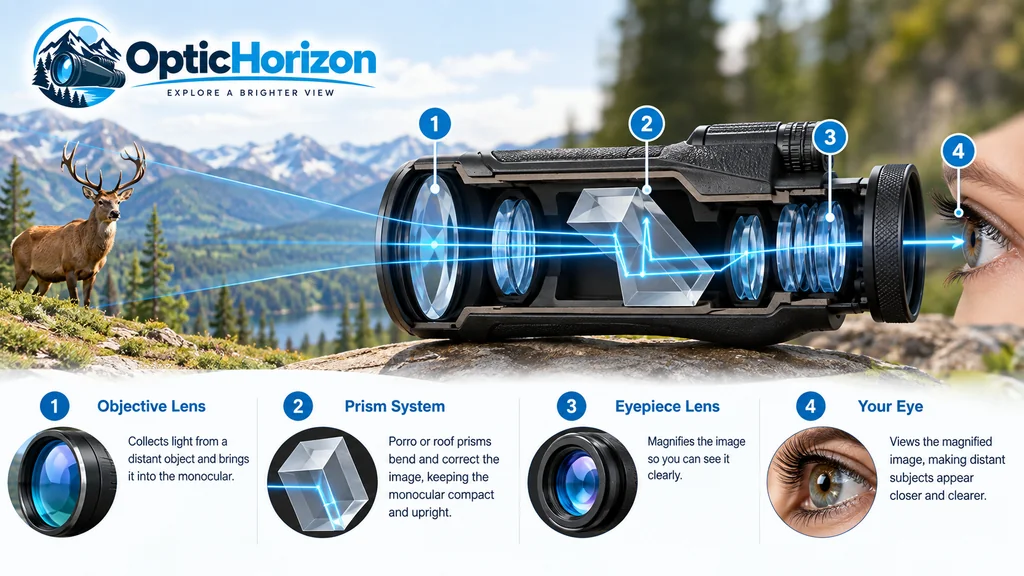
A conventional modern monocular can be thought of as a compact, one-eyed optical telescope.
Light enters through the objective lens, travels through the optical system, and reaches the eyepiece as a magnified image.
The familiar specification 10×25, for example, tells us two basic things:
10× means the instrument provides 10-power magnification.
25 mm refers to the diameter of the objective lens.
Neither number alone determines image quality.
Field of view, eye relief, optical coatings, prism design, close-focus distance, weight and overall optical quality can all affect how useful a monocular is.
This explains why simply choosing the monocular with the largest magnification number isn’t necessarily a good strategy.
Higher magnification generally narrows the field of view and makes hand movement more noticeable. A lower-powered model can therefore be easier to use when scanning wildlife or following moving subjects.
If you’re choosing one rather than studying the technology itself, our guide to the best monoculars under $100 compares several current conventional models by magnification, field of view, weight and intended use.
Monoculars Branch Into Digital Night Vision
The word monocular now describes more than a purely optical device.
Digital night-vision monoculars use electronic imaging technology to create an image on a display rather than relying solely on a traditional direct-view optical path.
Many digital night-vision devices use sensors that can respond to near-infrared wavelengths and pair them with an infrared illuminator. The illuminator sends out infrared light that the sensor can detect even when the scene appears dark to human eyes.
This makes digital night vision fundamentally different from a conventional daylight monocular.
It is also important to distinguish digital night vision from thermal imaging. Although both may help users see when visible light is limited, they create images in very different ways.
Thermal Monoculars Create Another Branch
Thermal monoculars take the concept even further away from traditional visible-light optics.
The scientific foundation goes back to 1800, when astronomer William Herschel discovered infrared radiation while measuring temperatures across the spectrum produced by sunlight passing through a prism. He found the strongest heating effect beyond the visible red portion of the spectrum.
Modern thermal imagers detect infrared radiation emitted by surfaces and convert differences in detected infrared energy into an electronic image. The apparent thermal signal can also be affected by factors such as emissivity and reflected infrared radiation.
NASA explains that objects such as humans emit infrared wavelengths that our eyes cannot see, while infrared-sensitive instruments can detect this otherwise invisible radiation.
That creates a critical distinction:
A conventional optical monocular uses visible light and optical elements to produce a magnified view.
A digital night-vision monocular electronically produces an image and may use near-infrared illumination.
A thermal monocular detects thermal infrared radiation and electronically converts that information into a visible image.
Calling all three devices “monoculars” describes their one-eye viewing format, not identical underlying technology.
How Monoculars Have Changed
The transformation becomes easier to understand when the major developments are viewed together:
| Period | Important development |
|---|---|
| Medieval period | Practical lenses and spectacles develop |
| 1608 | Earliest documented telescope appears in the Netherlands |
| 1609 | Galileo builds and improves telescopes |
| 17th–19th centuries | Handheld telescopes and spyglasses become increasingly practical |
| Mid-19th century | Prism systems help fold optical paths into shorter instruments |
| 20th century | Optical glass, coatings, manufacturing and weather protection improve |
| Modern era | Compact conventional monoculars become widely available |
| Digital era | Electronic sensors enable digital night-vision monoculars |
| Modern thermal era | Infrared detectors enable portable thermal monoculars |
The biggest change is therefore not simply that monoculars became more powerful.
They became smaller, more specialized and technologically diverse.
Conventional vs Digital vs Thermal Monoculars
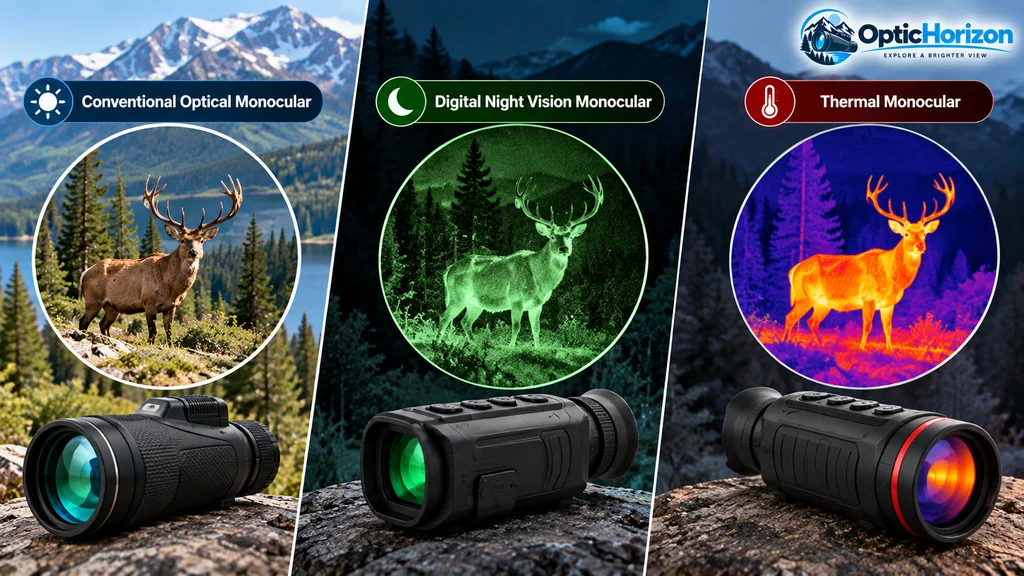
Modern buyers can now encounter very different products under the same general “monocular” label.
| Type | What it uses | Best suited to |
|---|---|---|
| Optical monocular | Visible light and conventional optics | Daytime wildlife, birding, hiking, travel |
| Digital night-vision monocular | Electronic image sensor, often with IR illumination | Observation in low-light or dark conditions |
| Thermal monocular | Thermal infrared detector | Detecting thermal contrast and heat signatures, including in darkness |
These categories shouldn’t be treated as direct substitutes.
A good conventional monocular can provide a natural optical view without batteries. A digital night-vision device can operate when visible light is extremely limited. A thermal monocular can reveal thermal contrast and heat signatures that conventional optics and ordinary visible-light cameras cannot show.
Each solves a different viewing problem.
What Hasn’t Changed
Despite centuries of technological progress, several fundamental trade-offs remain.
Users still have to balance magnification against field of view and stability. Larger objectives can collect more light but usually increase size and weight. Compact instruments are easier to carry but necessarily have less room for large optical components.
And specifications still don’t tell the whole story.
Two monoculars with identical 10×25 specifications can perform differently because of differences in glass, coatings, optical design, manufacturing tolerances and ergonomics.
That’s one reason modern monocular selection is less about finding the largest numbers and more about choosing an optical system appropriate for the intended use.
Where Monocular Technology Stands Today
Modern electronic monoculars can combine features such as image recording, digital magnification, rangefinding, wireless connectivity, and multiple viewing modes, depending on the model.
Conventional optical monoculars follow a much simpler approach. They can provide magnification without batteries, electronic displays, or image-processing hardware.
As a result, modern monoculars now fall into several distinct technological categories. Conventional optics prioritize simplicity and natural viewing, digital night vision uses electronic sensors to operate in very low light, and thermal monoculars detect infrared energy to reveal thermal contrast.
Final Thoughts
The monocular didn’t appear as a single invention.
Its development reflects centuries of progress in optical science and manufacturing—from early lenses and the 17th-century telescope to portable spyglasses, prism systems, improved optical coatings and today’s compact viewing instruments.
Digital night vision and thermal imaging later expanded the meaning of monocular beyond conventional visible-light optics.
Yet the basic goal has remained remarkably consistent: help one person observe something that would otherwise be difficult to see.
Today’s pocket-sized optical monocular may look far removed from a 17th-century telescope, but the connection between them is unmistakable.

Elliot Vantage is an optics enthusiast and the editor behind Optic Horizon, covering monoculars, binoculars, thermal optics, and related outdoor gear. He researches manufacturer documentation, optical specifications, product features, pricing, and use-case differences to help readers understand their options and choose equipment that fits their needs.