Affiliate Disclosure: OpticHorizon.com is a participant in the Amazon Services LLC Associates Program. We may earn a small commission if you buy through our links — at no extra cost to you. This helps us keep the site running and continue producing free, independent buying guides. Our recommendations are based on research, specifications, and real-world considerations, never on commission rates.
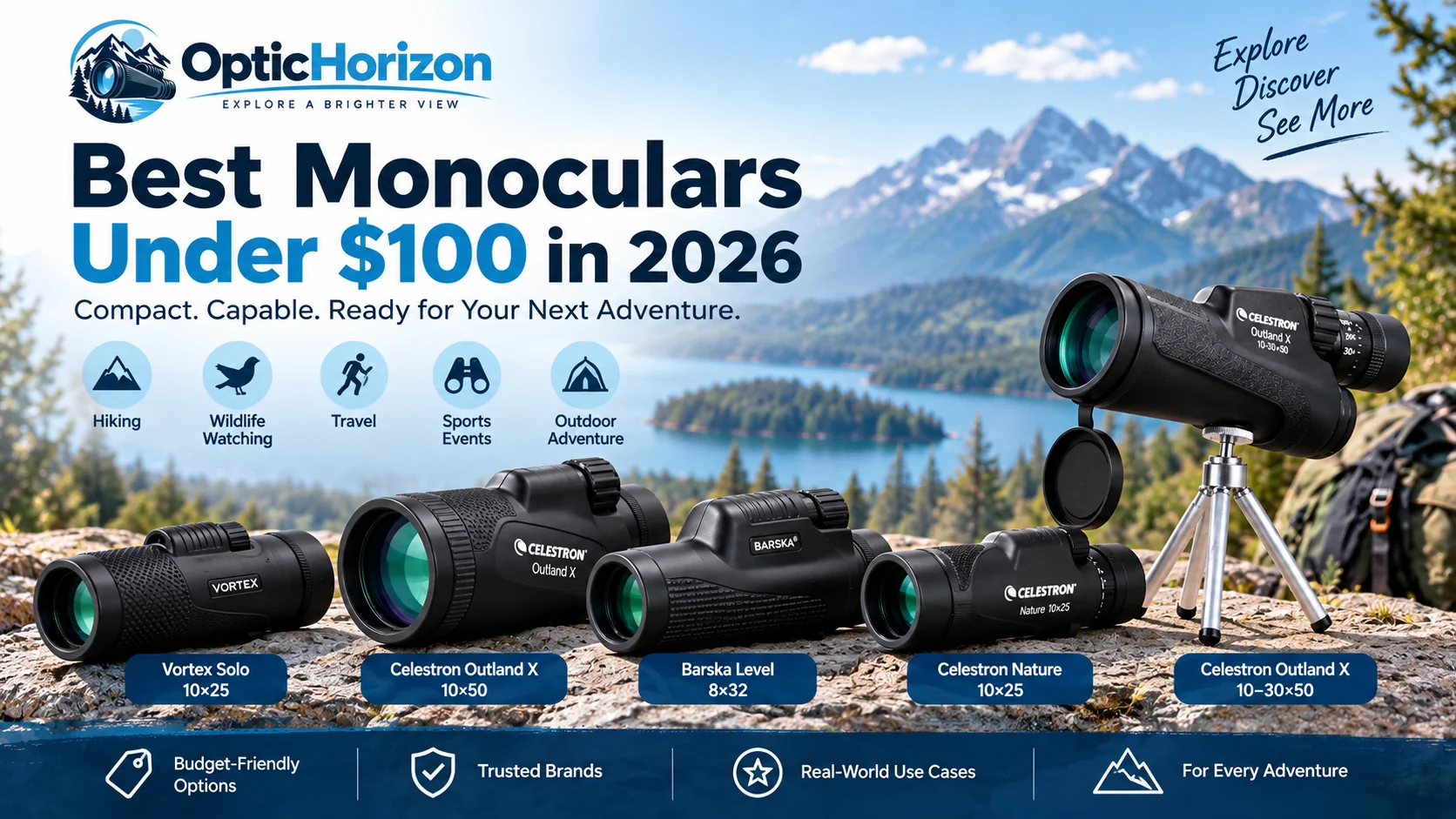
You don’t need to spend $200–$400 to get a monocular that’s actually useful for hiking, wildlife watching, travel, sporting events, or casual birding. In 2026, the under-$100 category offers several solid options from established brands — as long as you know what to look for.
After researching current models and comparing their specifications, features, portability, field of view, weather protection, warranty coverage and current pricing, we narrowed the field to five strong options.
Our top general-purpose pick is the Vortex Solo 10×25 — it’s lightweight, sharp enough for most uses, waterproof, and backed by Vortex’s excellent warranty. If you prefer a larger objective lens or want better smartphone photography potential, the Celestron Outland X 10×50 is the better choice.
Below you’ll find our full comparison, clear pros and cons for each model, and practical buying advice so you can choose the right monocular for your needs without overspending.
Table of Contents
Best Monoculars Under $100 at a Glance
| Image | Product | Best For | Price |
|---|---|---|---|
 | Vortex Solo 10×25 |
| Check Now |
 | Celestron Outland X 10×50 |
| Check Now |
 | Barska Level 8×32 |
| Check Now |
 | Celestron Nature 10×25 |
| Check Now |
 | Celestron Outland X 10–30×50 |
| Check Now |
How We Chose These Monoculars
We did not physically test the monoculars in this guide.
Instead, we researched and compared current models using manufacturer specifications and documentation, focusing on factors that have a meaningful effect on choosing a monocular:
- Magnification
- Objective lens diameter
- Field of view
- Eye relief
- Optical coatings and prism type
- Waterproofing and fog resistance
- Weight and portability
- Close-focus distance
- Tripod compatibility
- Included accessories
- Warranty
- Current price and availability
We also considered whether each monocular makes sense for a specific use rather than simply choosing five products with similar specifications.
Manufacturer specifications are useful for comparing measurable characteristics, but they cannot tell you everything about perceived sharpness, color rendering, focusing feel, sample variation, or long-term durability. Those characteristics normally require controlled hands-on comparison.
Our Top Picks
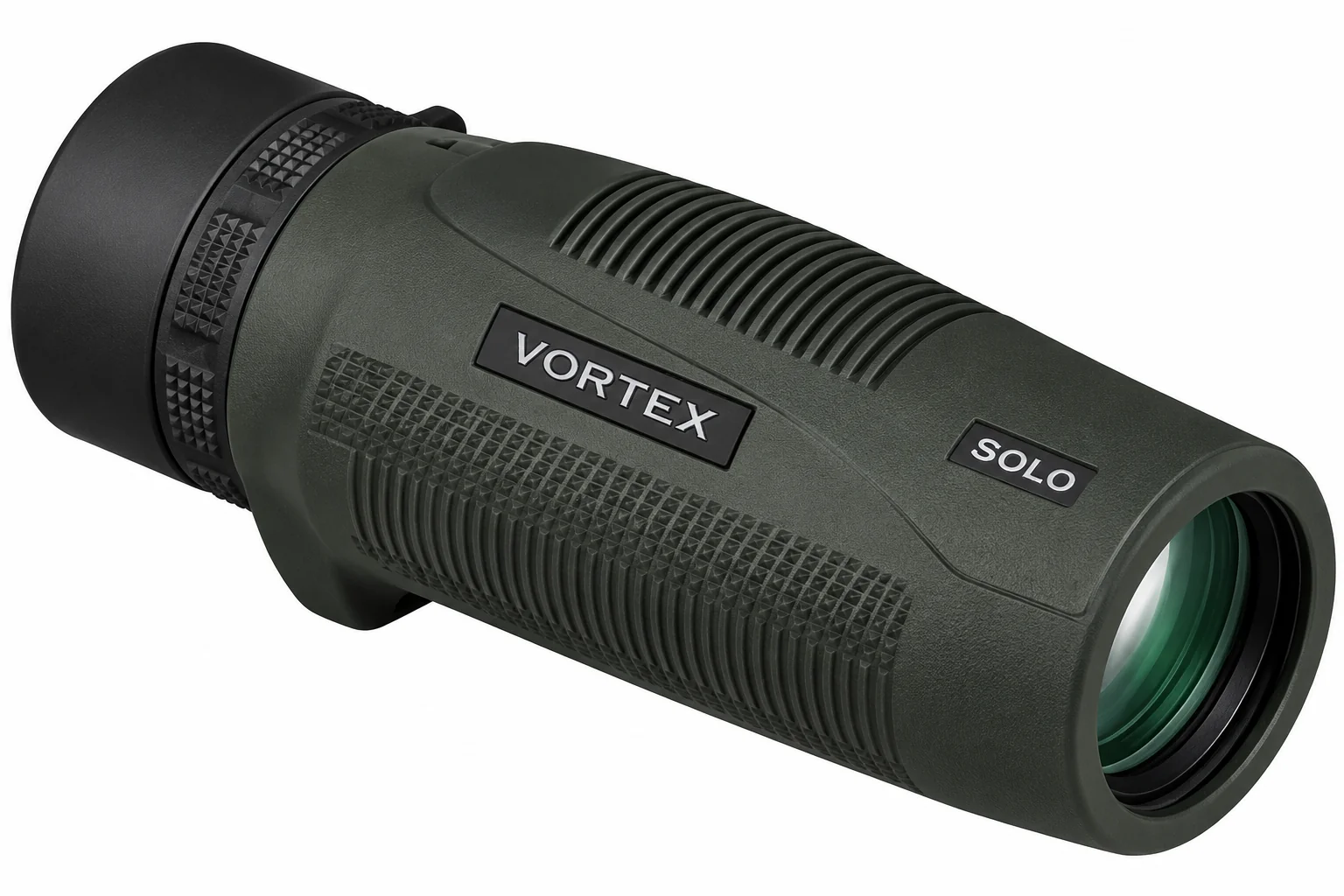
1. Vortex Solo 10×25 — Best Overall
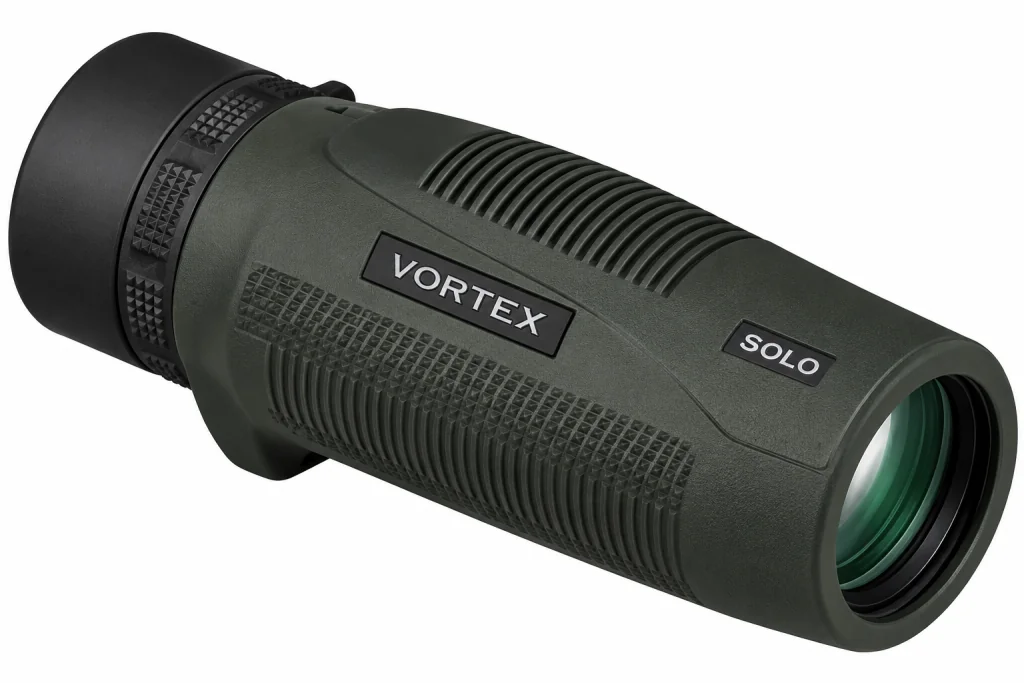
The Vortex Solo 10×25 is our first choice for someone who wants a small monocular that can stay in a backpack, travel bag, or jacket pocket.
Its biggest advantage isn’t extreme magnification or a huge objective lens. It’s the combination of portability, useful specifications, weather protection, and Vortex’s warranty.
The Solo provides 10× magnification through a 25mm objective lens. Vortex specifies a 315-foot field of view at 1,000 yards, 14.5mm of eye relief and a close-focus distance of 16.4 feet.
At only 5.6 ounces, it is considerably easier to carry than a large 10×50 monocular.
Vortex also uses fully multi-coated lenses and nitrogen purging with O-ring sealing. The manufacturer describes the Solo as waterproof, fogproof and shockproof.
Key Specifications
| Specification | Vortex Solo 10×25 |
|---|---|
| Magnification | 10× |
| Objective lens | 25mm |
| Field of view | 315 ft at 1,000 yd |
| Eye relief | 14.5mm |
| Close focus | 16.4 ft |
| Weight | 5.6 oz |
| Lens coating | Fully multi-coated |
| Weather protection | Waterproof and fogproof |
What We Like
The 315-foot field of view is useful for locating subjects, while the 10× magnification provides considerably more detail than viewing with the naked eye.
Its low weight is another major advantage. A monocular is supposed to provide an easier-to-carry alternative to binoculars, and the Solo fulfills that role particularly well.
Vortex also backs the product with its Unlimited, Unconditional Lifetime VIP Warranty.
What to Consider
A 25mm objective is a portability-first design. It cannot gather as much light as a comparable 42mm or 50mm objective.
That makes the Solo more compelling for daytime hiking, sightseeing, sporting events and general wildlife observation than for buyers specifically prioritizing dawn and dusk use.
Price is the other issue. Vortex currently lists an MSRP above $100, although retail pricing can be lower. Only consider it an under-$100 pick when the retailer’s current price actually falls below $100.
Best For
Travelers, hikers and general outdoor users who prioritize portability without moving to an ultra-cheap monocular.
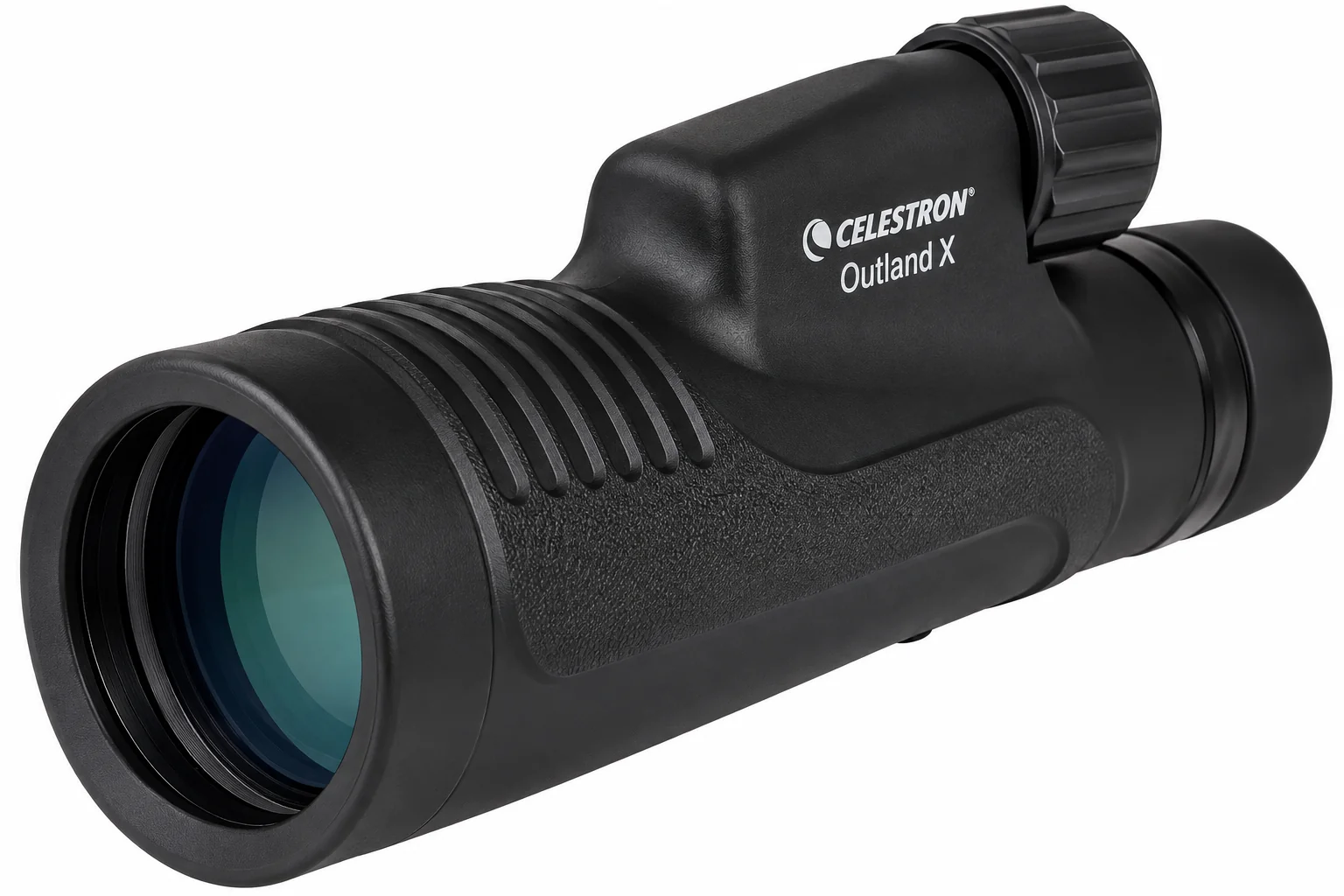
2. Celestron Outland X 10×50 — Best for Smartphone Use
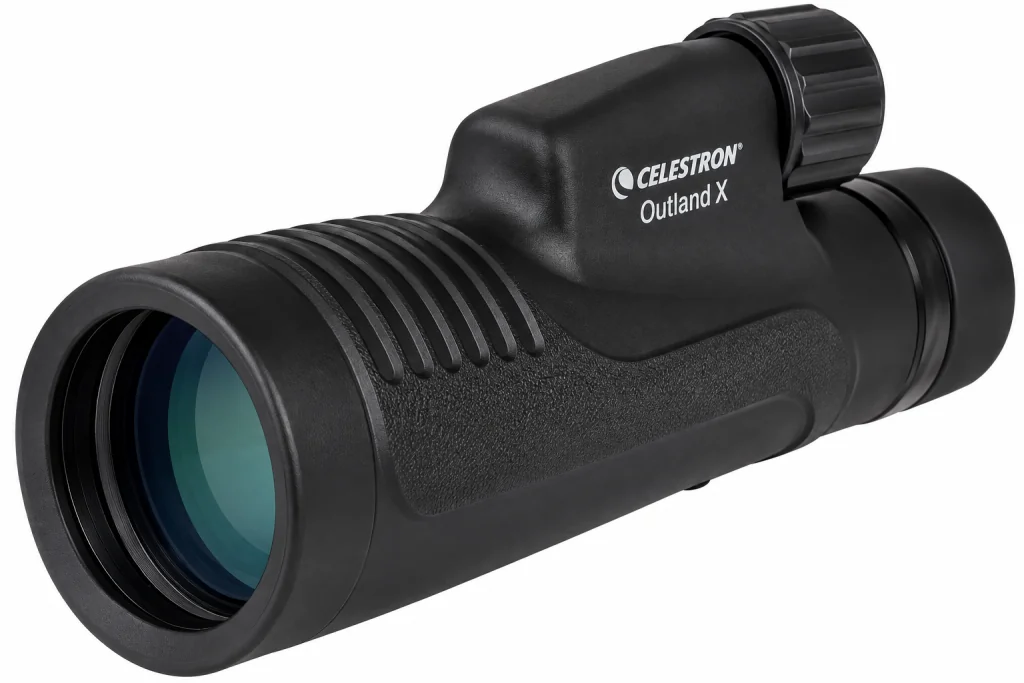
The Celestron Outland X 10×50 takes almost the opposite approach from the Vortex.
Instead of minimizing size and weight, Celestron combines 10× magnification with a much larger 50mm objective lens.
It also includes a smartphone adapter, making this the most interesting option in our selection for buyers who want to experiment with taking photos or videos through a monocular.
Celestron specifies BaK-4 prism glass and multi-coated optics. The body is waterproof and nitrogen-filled to help prevent internal fogging.
Key Specifications
| Specification | Celestron Outland X 10×50 |
|---|---|
| Magnification | 10× |
| Objective lens | 50mm |
| Field of view | 296.8 ft at 1,000 yd |
| Eye relief | 16.8mm |
| Close focus | 8.2 ft |
| Weight | 14.6 oz |
| Prism | BaK-4 |
| Lens coating | Multi-coated |
| Waterproof | Yes |
| Nitrogen-filled | Yes |
| Tripod adaptable | Yes |
| Smartphone adapter | Included |
The 8.2-foot close focus is notably shorter than that of several compact models in this guide.
What We Like
The 50mm objective provides substantially more light-gathering area than a 25mm design.
That doesn’t automatically mean it will produce a better image in every situation—optical quality involves much more than objective diameter—but the larger aperture is useful when light becomes more limited.
The included smartphone adapter is another differentiator. It clamps a compatible phone over the eyepiece so the phone’s camera can capture the image produced by the monocular.
The Outland X is also tripod adaptable, which is valuable for photography and extended viewing.
What to Consider
At 14.6 ounces, this isn’t nearly as pocket-friendly as the Vortex Solo or Celestron Nature.
Smartphone digiscoping also requires patience. Alignment between the camera lens and eyepiece matters, and high digital zoom on a phone doesn’t create additional optical detail.
Best For
Wildlife viewing, sightseeing and buyers who specifically want to experiment with smartphone photography through a monocular.
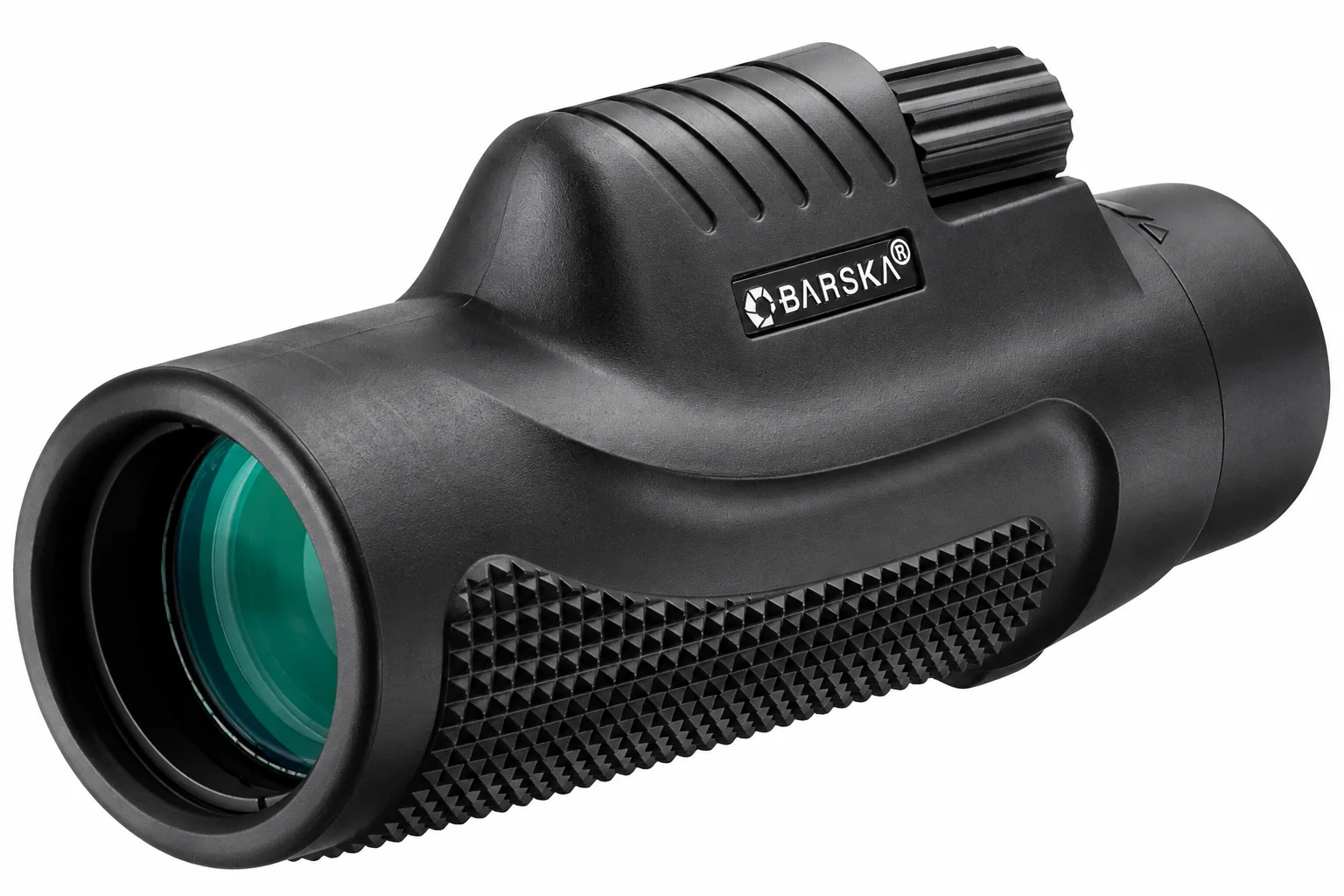
3. Barska Level 8×32 — Best for Easier Handheld Viewing
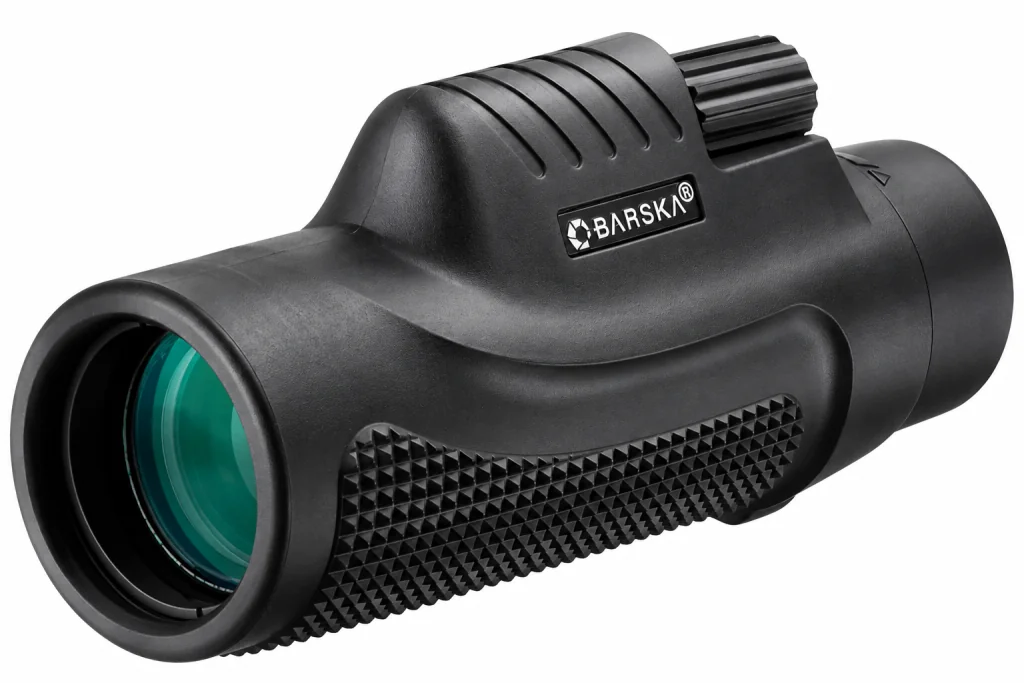
The Barska Level 8×32 is included because its 8× magnification provides an alternative to the many 10× and 12× budget monoculars on the market.
More magnification isn’t automatically better.
Lower magnification generally makes hand movement less visually pronounced and can make it easier to locate and follow moving subjects.
Barska pairs that 8× magnification with a 32mm objective, multi-coated optics and a BK-7 prism. The housing is designed to be waterproof and fogproof, and the body uses rubber armor for additional grip.
Key Specifications
| Specification | Barska Level 8×32 |
|---|---|
| Magnification | 8× |
| Objective lens | 32mm |
| Field of view | 394 ft at 1,000 yd |
| Eye relief | 13.6mm |
| Close focus | 6.56 ft |
| Weight | 10.4 oz |
| Prism | BK-7 |
| Lens coating | Multi-coated |
Why Choose 8× Instead of 10×?
A 10× monocular makes a distant subject appear larger than an 8× monocular, all else being equal.
But magnification also magnifies movement.
For birding, hiking and general nature observation, some users may find an 8× monocular easier to hold steady and quicker to acquire a subject with.
That makes the Barska an interesting alternative for someone who doesn’t actually need maximum magnification.
What We Like
The 32mm objective sits between ultra-compact 25mm monoculars and much larger 50mm models.
That gives this design a useful middle ground between portability and light gathering.
Weather sealing also makes more sense for an outdoor monocular than a basic model that is merely water resistant.
What to Consider
Barska specifies a BK-7 prism, while several alternatives in this guide use BaK-4 prism glass.
Prism material alone doesn’t determine the overall quality of an optical system, so we wouldn’t reject an optic based on that specification alone. However, it is one of the differences worth knowing when comparing these models.
Best For
Birding, hiking and general handheld nature observation where easy subject acquisition matters more than maximum magnification.
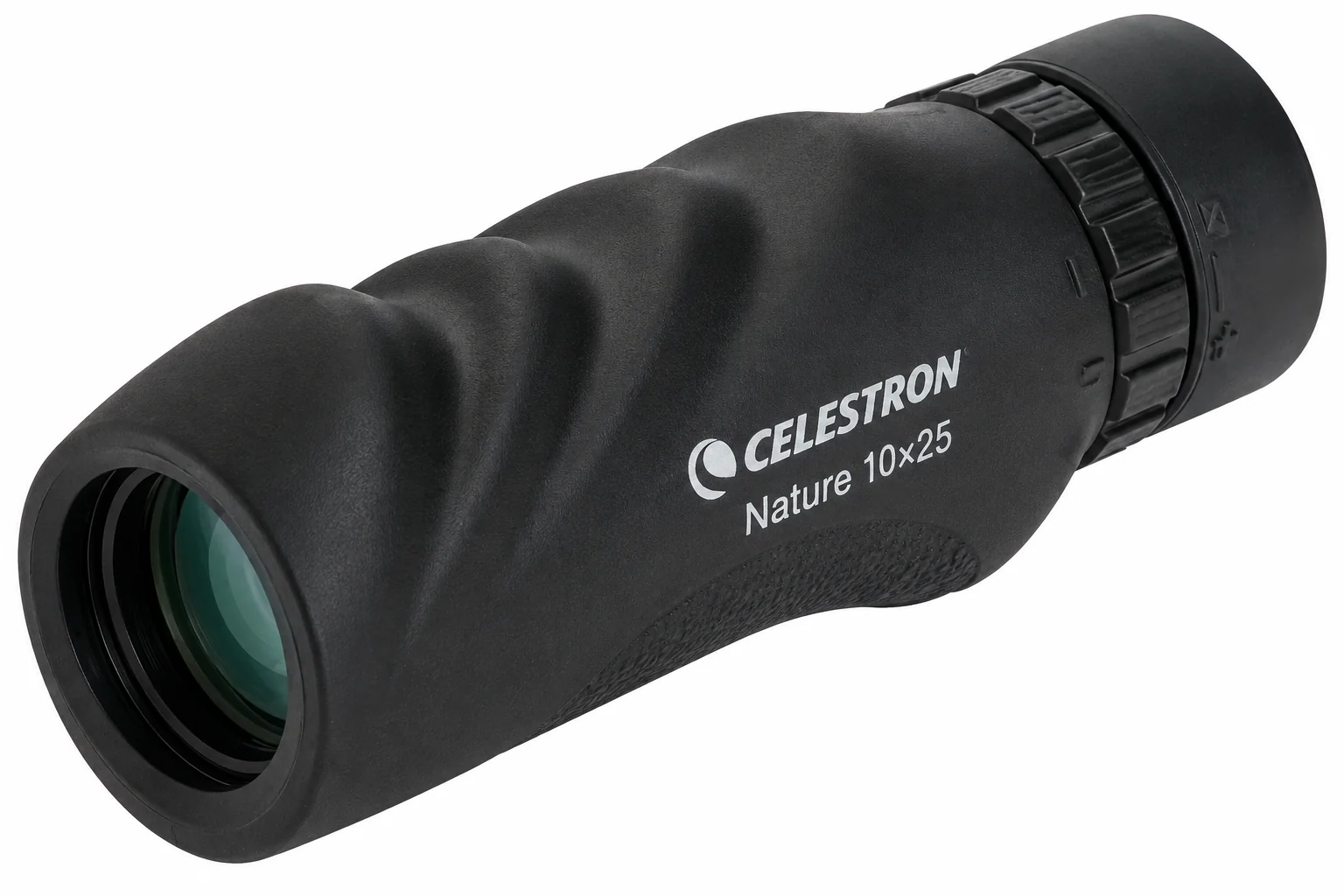
4. Celestron Nature 10×25 — Best for Hiking and Travel
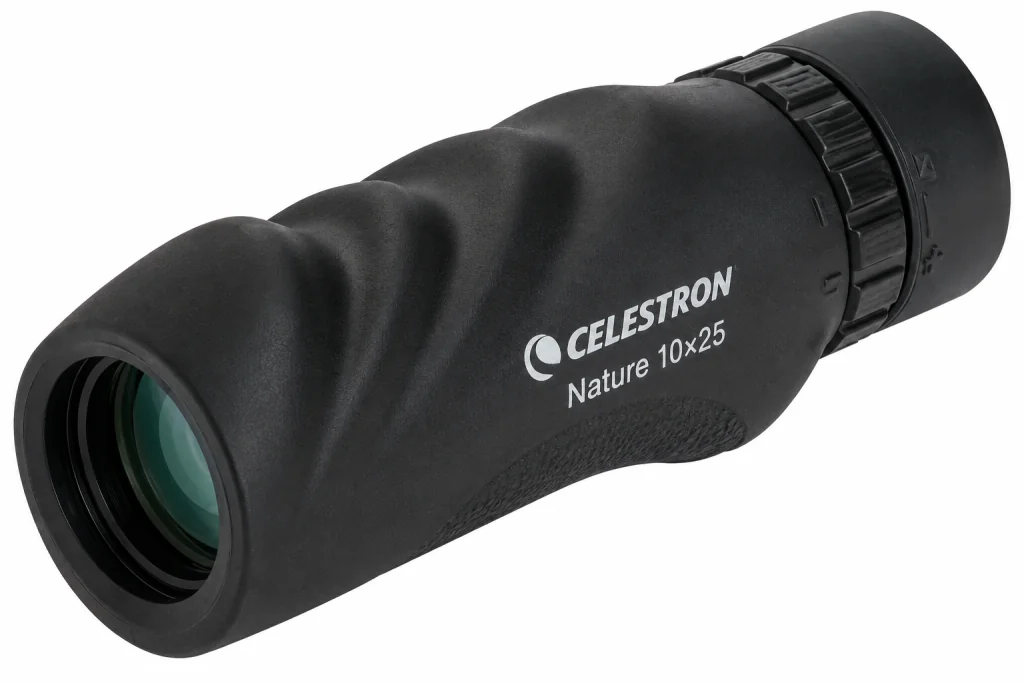
The Celestron Nature 10×25 competes directly with the Vortex Solo in concept.
Both provide 10× magnification, a 25mm objective and a lightweight body.
Celestron specifies a 304-foot field of view at 1,000 yards, 14mm eye relief, an 18-foot close-focus distance and a weight of 6 ounces.
The Nature uses BaK-4 prism glass and multi-coated optics. More importantly for outdoor use, it is waterproof and nitrogen-filled, rather than merely splash resistant.
Key Specifications
| Specification | Celestron Nature 10×25 |
|---|---|
| Magnification | 10× |
| Objective lens | 25mm |
| Field of view | 304 ft at 1,000 yd |
| Eye relief | 14mm |
| Close focus | 18 ft |
| Weight | 6 oz |
| Prism | BaK-4 |
| Lens coating | Multi-coated |
| Waterproof | Yes |
| Nitrogen-filled | Yes |
What We Like
At only 6 ounces, the Nature is easy to carry.
Its specifications are also unusually straightforward for a budget monocular. There are no exaggerated magnification claims or enormous objective sizes attached to a suspiciously tiny body.
You get a conventional 10×25 compact monocular from an established optics manufacturer.
Celestron also provides a limited lifetime warranty.
What to Consider
As with the Vortex, the 25mm objective prioritizes compactness.
If your primary use will be viewing wildlife around dawn or dusk, a larger objective may be more appropriate even though it adds weight.
Best For
Hiking, travel, sporting events and keeping a monocular in a small bag where weight matters.
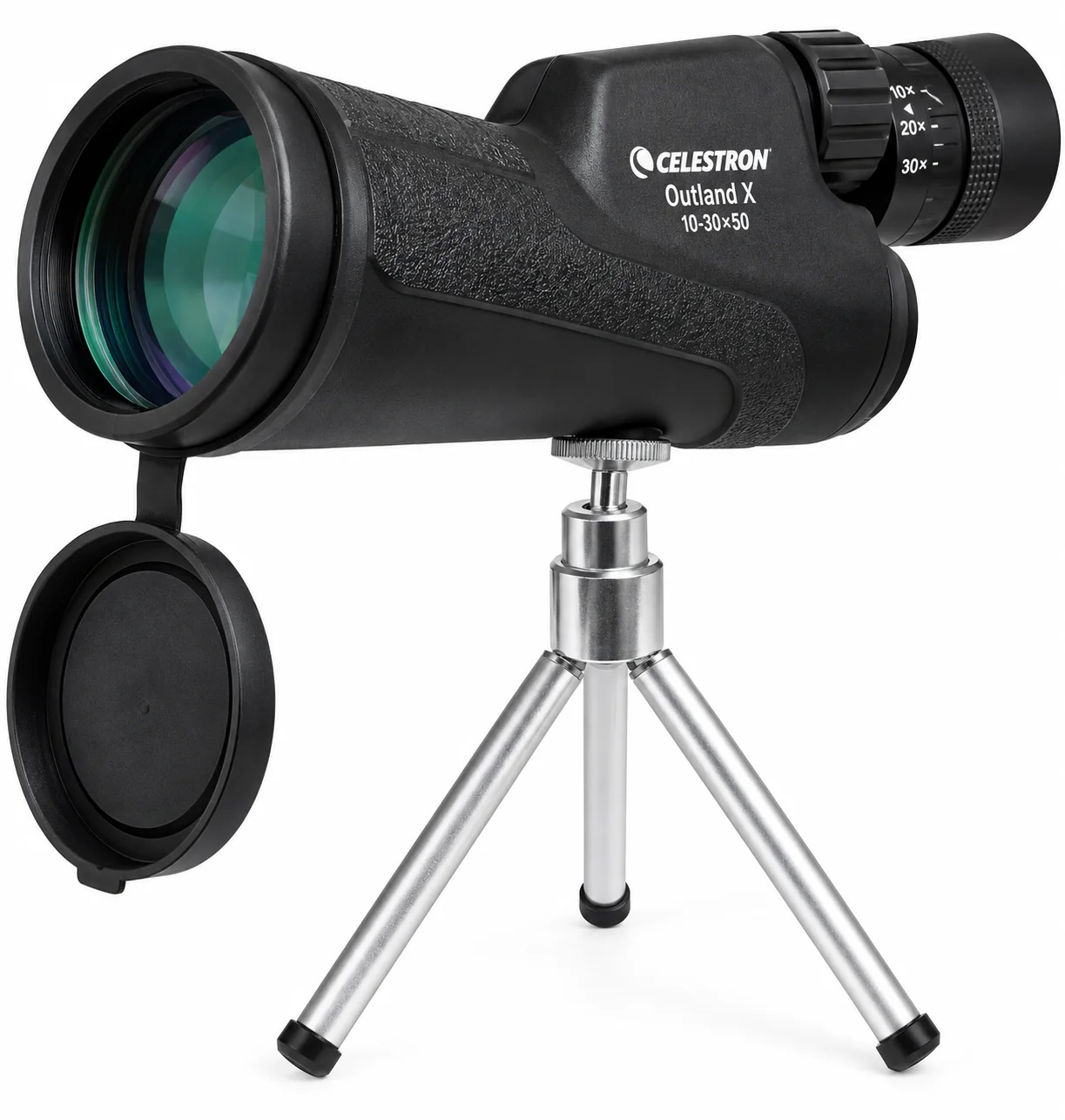
5. Celestron Outland X 10–30×50 — Best Zoom Monocular Under $100
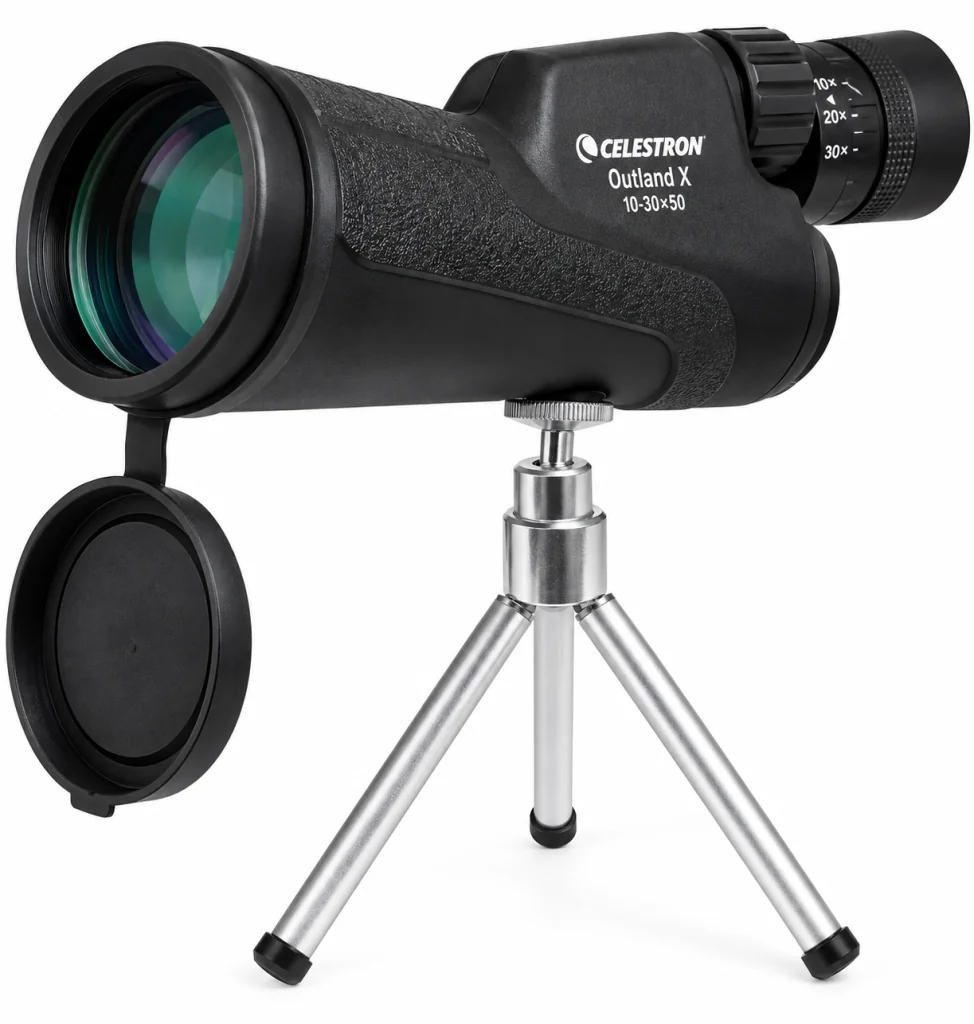
The Celestron Outland X 10–30×50 can zoom from 10× all the way to 30× while using a 50mm objective lens.
Variable-magnification monoculars require a different set of compromises.
Celestron specifies BaK-4 prism glass, multi-coated optics, waterproof construction and nitrogen filling.
A tabletop tripod is included, and that’s important.
At 20× or 30×, normal hand movement becomes dramatically more visible. Although you can use the monocular handheld at the lower end of its range, a tripod becomes increasingly useful as magnification rises.
Key Specifications
| Specification | Celestron Outland X 10–30×50 |
|---|---|
| Magnification | 10–30× |
| Objective lens | 50mm |
| Field of view | 186.9–101 ft at 1,000 yd |
| Eye relief | 16.2–12.5mm |
| Close focus | 8.2 ft at 10× |
| Weight | 16.8 oz |
| Prism | BaK-4 |
| Lens coating | Multi-coated |
| Waterproof | Yes |
| Nitrogen-filled | Yes |
| Tripod adaptable | Yes |
| Tabletop tripod | Included |
The Tradeoff With Zoom
At 10×, Celestron specifies a 5mm exit pupil. At 30×, that falls to about 1.7mm.
The field of view also narrows from about 186.9 feet to 101 feet at 1,000 yards as magnification increases.
That’s normal optical behavior, but it’s important because a specification such as “30×” sounds universally superior when it isn’t.
Higher magnification gives you a larger apparent view of a distant subject, but it also makes the optic harder to hold steady, reduces field of view and, with the same 50mm objective, produces a smaller exit pupil.
What We Like
Few models in this price range provide this much magnification from an established optics company while also including a tripod.
It is a useful option for observing relatively stationary distant subjects where portability isn’t the top priority.
What to Consider
This is not our recommendation for someone wanting a tiny hiking monocular.
It weighs 16.8 ounces and is nearly eight inches long. At higher magnification, plan on using the tripod or another stable support.
Best For
Long-distance observation of stationary subjects when you want more magnification than a conventional 8× or 10× monocular provides.
How to Choose a Monocular Under $100
The numbers printed on a monocular tell you quite a lot once you know what they mean.
A 10×42, for example, provides 10× magnification and has a 42mm objective lens.
Those two numbers affect much of the viewing experience.
8× vs 10× vs 12× Magnification
For most handheld use, 8× or 10× is the sensible range.
An 8× monocular can be easier to hold steady and makes finding moving subjects relatively easy.
A 10× monocular provides additional apparent detail at distance while remaining practical for handheld observation for many users.
Once you move beyond 10×, stability becomes increasingly important. A 12× model can still be useful handheld, but hand shake becomes more noticeable.
At 20× or 30×, support from a tripod, monopod or another stable surface becomes much more useful.
Don’t buy the largest magnification number simply because it is larger.
What Does Objective Lens Size Mean?
The second number indicates the diameter of the objective lens.
For example:
- 10×25 = 25mm objective
- 8×32 = 32mm objective
- 10×50 = 50mm objective
A larger objective has more area available to collect light, but it also makes the monocular larger and heavier.
That’s why a 10×25 can be an excellent travel optic even though a 10×50 has a much larger objective.
There isn’t one universally best size.
For hiking and travel, 25–32mm makes sense.
For less weight-sensitive observation and lower-light conditions, a 42–50mm objective can be more attractive.
Field of View Matters More Than Many Buyers Realize
Field of view tells you how wide an area you can see at a specified distance.
A wider field makes it easier to locate a bird, animal or athlete and then keep the subject in view.
For example, Vortex specifies 315 feet at 1,000 yards for the Solo 10×25.
The Celestron Outland X zoom, meanwhile, narrows considerably as magnification increases.
That’s one reason a 30× monocular isn’t automatically more useful than a conventional 8× or 10× model.
What Is Exit Pupil?
Exit pupil is approximately:
Objective diameter ÷ magnification
A 10×50 therefore has an exit pupil of roughly:
50 ÷ 10 = 5mm
A 10×25 provides:
25 ÷ 10 = 2.5mm
A larger exit pupil can be advantageous when ambient light is limited, although objective diameter and exit pupil alone do not determine image quality.
Lens coatings, prism design, optical quality and your own pupil size also matter.
BaK-4 vs BK-7 Prisms
You’ll frequently see BaK-4 advertised as a selling point.
BaK-4 and BK-7 are different optical glass types used in prisms. BaK-4 is commonly preferred in compact roof-prism optics because of properties that can help maintain a fully illuminated exit pupil in suitable designs.
However, don’t buy a monocular solely because the marketing says BaK-4.
A well-designed optical system depends on much more than one type of glass.
Lens quality, coatings, prism coatings, alignment, internal baffling and manufacturing tolerances can all affect what you actually see.
Waterproof vs Water Resistant
These terms shouldn’t be treated as identical.
A water-resistant monocular may tolerate limited exposure to moisture but isn’t necessarily designed to withstand the same conditions as a properly sealed waterproof optic.
Nitrogen or another dry-gas purging system is commonly used with sealed optics to reduce internal fogging caused by temperature changes.
If you’re buying for hiking, hunting, birding or other outdoor use, proper waterproofing and internal fog resistance are worthwhile features.
Eye Relief Matters If You Wear Glasses
Eye relief is the distance behind the eyepiece at which the full image can be viewed.
People who wear glasses often benefit from greater eye relief because their eye cannot sit as close to the eyepiece.
Don’t assume every compact monocular will be equally comfortable with glasses.
Which Monocular Should You Buy?
Choose based on what you’re actually going to do with it.
For hiking and travel:
Choose a lightweight 10×25 such as the Vortex Solo or Celestron Nature.
For birding and moving wildlife:
Consider moderate magnification and a useful field of view rather than chasing extreme magnification. The Barska 8×32 is the different option in this group.
For smartphone photography:
The Celestron Outland X 10×50 is the obvious candidate here because its smartphone adapter is included.
For distant stationary subjects:
The Celestron Outland X 10–30×50 gives you substantially more magnification, but use its included tripod when stability becomes an issue.
For occasional general use:
A conventional 8× or 10× fixed-magnification monocular is usually simpler than a high-powered zoom.
Frequently Asked Questions
Is a cheap monocular worth buying?
It can be.
A budget monocular can work well for occasional wildlife observation, hiking, travel, sporting events and sightseeing.
The biggest mistake is expecting a $30–$100 monocular to perform like premium optics costing several times more.
At this price, prioritize useful magnification, sensible optical specifications, weather protection and a product from a manufacturer that provides clear documentation and warranty support.
Is 8× or 10× better for a monocular?
Neither is universally better.
8× provides less magnification but can be easier to hold steady and use for moving subjects.
10× brings distant subjects closer and remains a practical handheld magnification for many people.
For general-purpose use, either can work well.
Is 12× too powerful for a monocular?
Not necessarily, but 12× makes hand movement more noticeable than 8× or 10×.
If you have unsteady hands or spend long periods observing a subject, a tripod or monopod can improve the experience.
Is a 10×50 monocular better than a 10×25?
Not automatically.
Both provide the same 10× magnification.
The 50mm model has a larger objective and typically offers greater light-gathering potential, but it will also be considerably larger and heavier.
A 10×25 may therefore be the better monocular for hiking or travel, while a 10×50 may make more sense when size and weight are less important.
Are monoculars good for bird watching?
Yes, particularly when portability matters.
However, binoculars are generally more comfortable for prolonged observation because you use both eyes. A monocular makes more sense when you want something compact for quick observations.
For birding, pay attention to field of view and close focus as well as magnification.
Can I use a monocular with a smartphone?
Yes, if the monocular is compatible with a smartphone adapter.
The Celestron Outland X 10×50 in this guide includes one.
The phone camera must be aligned correctly with the monocular’s eyepiece. A tripod can make this much easier.
Can I use a monocular at night?
A conventional monocular does not become a night-vision or thermal device simply because it has a large objective lens.
A larger objective can be useful when some ambient light remains, but a normal optical monocular cannot see in complete darkness.
For true nighttime observation without visible ambient light, you need appropriate night-vision or thermal-imaging technology.
Final Verdict
The Vortex Solo 10×25 is our preferred general-purpose option when you can buy it for less than $100. Its combination of 10× magnification, 315-foot field of view, 5.6-ounce weight, fully multi-coated lenses and waterproof, fogproof construction makes it particularly well suited to hiking, travel and everyday outdoor observation.
The Celestron Nature 10×25 is another strong compact choice and avoids the bulk of larger 50mm designs.
If portability matters less and you want a larger objective plus smartphone capability, consider the Celestron Outland X 10×50.
For easier handheld viewing, the Barska Level 8×32 offers a useful alternative to the 10× models.
And if high magnification is the priority, the Celestron Outland X 10–30×50 offers a genuinely different capability—but its included tripod becomes increasingly valuable as you zoom in.
The important point is not to buy the monocular with the biggest numbers. Choose the combination of magnification, objective size, field of view, weather protection and weight that fits how you’ll actually use it.

Elliot Vantage is an optics enthusiast and the editor behind Optic Horizon, covering monoculars, binoculars, thermal optics, and related outdoor gear. He researches manufacturer documentation, optical specifications, product features, pricing, and use-case differences to help readers understand their options and choose equipment that fits their needs.