
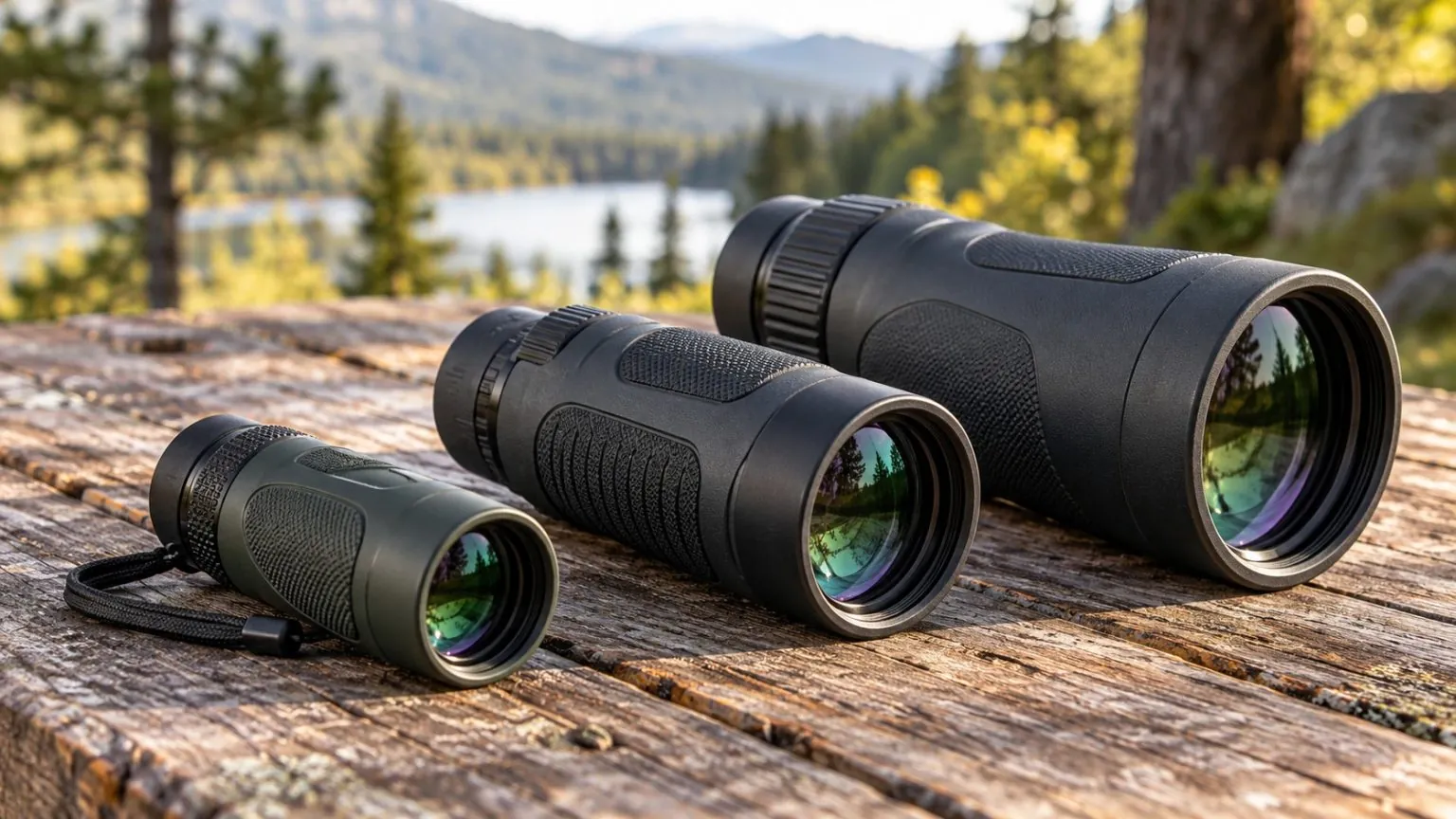
If you want monocular numbers explained without a wall of jargon, start with this: 8×32 means 8-power magnification and a 32 mm objective lens. The first number describes how large the subject appears. The second describes the diameter of the front lens. Neither number, by itself, tells you whether the view will be sharp, comfortable or steady.
Those two figures are still useful. They help you sort pocket optics from larger models and calculate a third measurement, exit pupil, that affects how easily your eye receives the view. Here is how to read them together before comparing features or prices.
What the first number means
An 8× monocular makes a distant subject appear about eight times as large in angular terms as it does with the unaided eye. A useful approximation is that a subject 80 meters away appears the size it would from 10 meters without magnification. You have not moved closer, though: intervening branches, haze and an awkward viewing angle remain.
A 10× optic makes the subject appear larger than an 8× optic. The difference is 10 ÷ 8, or 25% greater apparent linear size. It does not mean 25% more usable detail in every situation. Hand movement and optical quality can prevent the extra image scale from helping.
Nikon’s explanation of magnification uses the same underlying optical principle. In a monocular, the practical question is whether you can hold that magnified view still enough to inspect it.
For a direct comparison of two common powers, see our guide to 8× vs 10× monoculars. This article focuses on decoding the specification rather than choosing a universal winner.
What the second number means
The objective is the lens at the end facing the subject. In an 8×32, its nominal diameter is 32 mm. In a 10×50, it is 50 mm.
A wider objective can collect more light, but it also has implications for carrying size. The size marked on the housing is not the length of the monocular, the eyepiece diameter or its focusing distance.
Nikon’s objective-diameter guide explains the connection between aperture and light collection. The area of a circular opening grows with the square of its diameter. A 50 mm opening has four times the area of a 25 mm opening, because 50² ÷ 25² = 4.
That calculation does not promise a scene that looks four times brighter. Magnification, transmission through the optics, your pupil size and the subject all matter. Treat aperture area as a physical comparison, not a brightness rating for the finished product.
Exit pupil: the useful number you calculate yourself
Exit pupil is the diameter of the light bundle leaving the eyepiece. For an ordinary monocular, calculate it as:
Exit pupil in millimeters = objective diameter in millimeters ÷ magnification.
An 8×32 therefore has a 4 mm exit pupil. A 10×25 has a 2.5 mm exit pupil. This relationship is also set out in Nikon’s exit-pupil explanation.
| Marked specification | Magnification | Objective diameter | Calculated exit pupil |
|---|---|---|---|
| 8×25 | 8× | 25 mm | 3.13 mm |
| 8×32 | 8× | 32 mm | 4.00 mm |
| 8×36 | 8× | 36 mm | 4.50 mm |
| 10×25 | 10× | 25 mm | 2.50 mm |
| 10×50 | 10× | 50 mm | 5.00 mm |
These are calculated dimensions, not results from testing five products.
A larger exit pupil can make eye placement more forgiving and can be useful when your eye’s pupil opens wider in dim conditions. In bright daylight, your pupil may be smaller than the exit pupil, so some of that available bundle does not enter the eye. The benefit is not constant throughout the day or identical for every observer.
There is no need to chase the largest possible figure for a short daytime walk. A compact optic that is easy to carry and easy to align may suit you better than a large model bought for a theoretical advantage you rarely use.
Exit pupil and eye relief are different
These measurements are easy to confuse because both concern the eyepiece.
Exit pupil describes a diameter. Eye relief describes the distance behind the eyepiece at which your eye should be positioned to see the intended field.
A monocular can have a generous exit pupil yet too little usable eye relief for your glasses. Conversely, long eye relief does not guarantee a large exit pupil. If the view is cut off around the edges, the relevant check may be the eyecup and eye position, not the size of the front lens.
Our guide to using a monocular with glasses explains that fit problem in more detail. When reading a specification sheet, keep the two measurements in separate columns.
What a range such as 10–30×50 means
When the manufacturer specifies 10–30×50 as an optical zoom range, magnification varies from 10× to 30× and the objective diameter is 50 mm. The exit pupil changes with the selected power:
- At 10×: 50 ÷ 10 = 5 mm.
- At 20×: 50 ÷ 20 = 2.5 mm.
- At 30×: 50 ÷ 30 ≈ 1.67 mm.
The view at the top setting is therefore not simply the low-power view made larger with every other quality preserved. Eye placement and steadiness can become more demanding, and the field may change. Check the model’s specifications at both ends of the range.
A single figure printed prominently in an advertisement may be a model name or a loosely presented claim. Find a specification table or manual that explicitly labels magnification and objective diameter. Do not multiply the two numbers together or interpret “8×32” as a zoom range from 8× to 32×.
Important details the main numbers leave out
Two 8×32 monoculars can behave quite differently. Before deciding that their views are equivalent, look for these additional specifications:
| Missing detail | Why it matters in use |
|---|---|
| Field of view | Determines how much of the scene fits across the view |
| Eye relief and eyecup adjustment | Affect whether you can see the full field comfortably |
| Minimum focusing distance | Determines whether nearby subjects can become sharp |
| Weight and external dimensions | Affect whether you will actually carry the optic |
| Weather protection | Describes protection of the instrument under stated conditions |
For example, a wide view can help you relocate a bird after lifting the monocular. A close-focusing model can reveal a butterfly beside the path. Neither advantage is encoded in “8×32.” Use our explanation of monocular field of view when comparing viewing widths in different units.
Coatings and optical construction matter too, but a list of impressive terms cannot establish how well a particular unit performs. Prefer clearly stated specifications, a useful return policy and a viewing check over a decision based on one large number.
A practical way to compare two labels
Imagine choosing between an 8×25 and an 8×32 for a daytime walk. They share the same nominal magnification. The 8×32 has the larger objective and calculated exit pupil; the 8×25 may offer a carrying advantage, depending on the actual design.
Next, compare their fields, eye relief, close focus and dimensions. If the 8×25 fits your pocket but its eyepiece never feels comfortable, its small size may not compensate. If the 8×32 is comfortable but stays at home because it is inconvenient to carry, its specification advantage is equally unhelpful.
Our monocular buying checklist brings those decisions together. When you are ready to compare products, start with the best monoculars under $100 or the monoculars selected for hiking, according to your budget and use.
Read the label in order: magnification, objective diameter, then the exit pupil you can calculate. After that, ask whether the rest of the specification fits the subjects, conditions and carrying habits that matter to you.

Elliot Vantage is an optics enthusiast and the editor behind Optic Horizon, covering monoculars, binoculars, thermal optics, and related outdoor gear. He researches manufacturer documentation, optical specifications, product features, pricing, and use-case differences to help readers understand their options and choose equipment that fits their needs.