
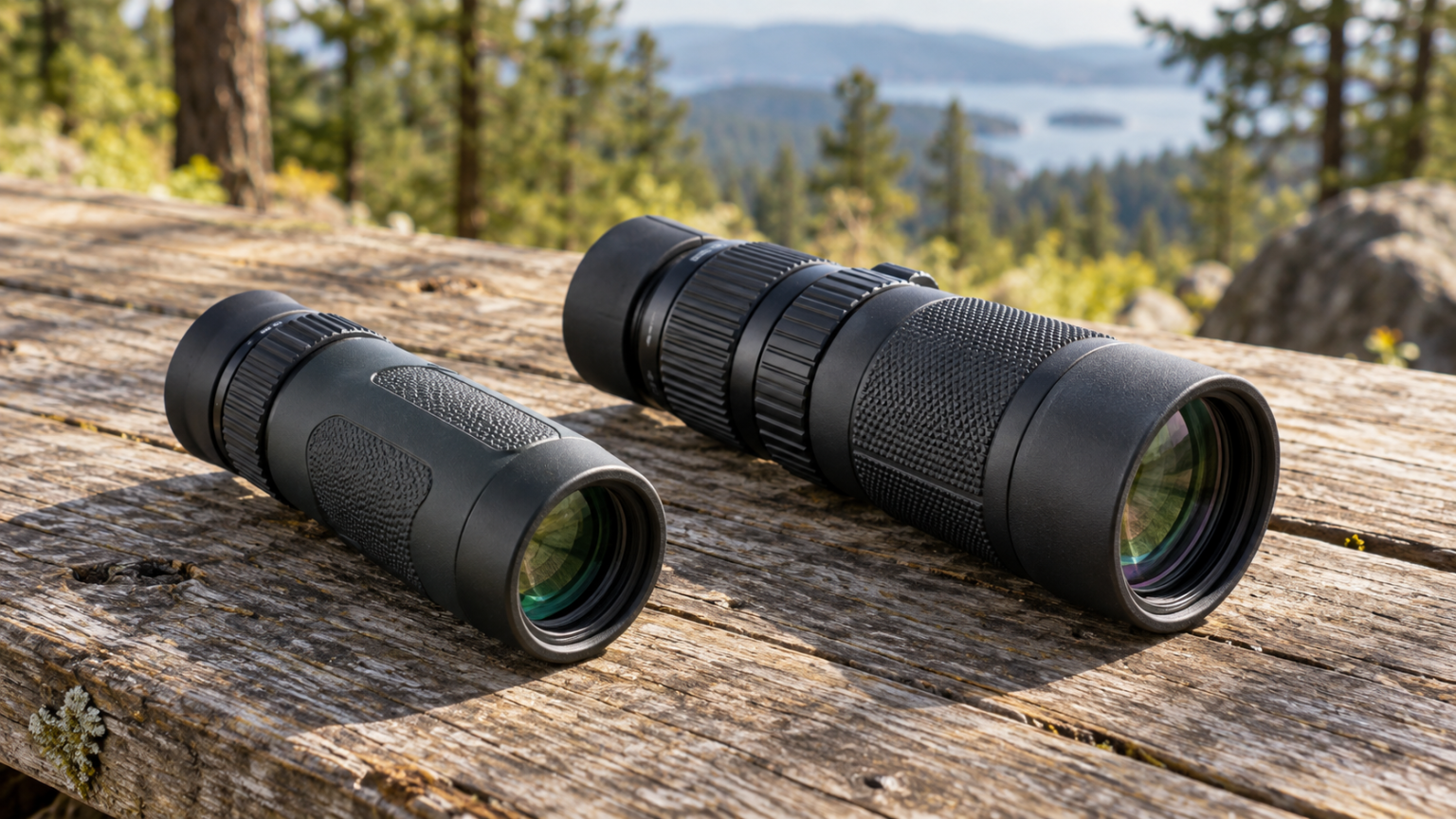
When comparing fixed vs zoom monoculars, start with how you observe. A fixed-power monocular gives you one familiar view every time you raise it. A true zoom monocular lets you change optical magnification, which can help when a distant subject stays still long enough for a closer look. The useful question is whether that extra adjustment improves the views you actually take.
For quick trail stops and moving wildlife, a comfortable fixed-power model is a sensible starting point. For deliberate observation from a supported position, variable magnification can be useful. Neither design wins simply because its specification contains the larger number.
First, establish whether the monocular really zooms
A label such as 8×32 describes a fixed 8× monocular with a 32 mm objective. A label such as 8–25×25 describes a magnification range, from 8× to 25×, with a 25 mm objective. If these labels are unfamiliar, our guide to monocular numbers and exit pupil explains the notation.
Product names can be misleading when read without the specifications. The Nocs Zoom Tube 8×32 is specified at 8×; the word “Zoom” in its name does not make it a variable-power optic. By comparison, the Bresser Zoomar 8–25×25 has a zoom adjustment and a stated magnification range.
Also distinguish optical zoom from digital enlargement. Changing a conventional optical zoom changes the magnification produced by the optics. Enlarging a phone image or a thermal display digitally does not give the optical system extra captured detail. A seller calling both functions “zoom” has not made them equivalent.
What changes when you increase magnification?
The subject looks larger, and movement becomes more obvious
Higher power can make an already resolved feature easier to examine. It also magnifies the apparent movement caused by your hands. If you cannot keep the subject still in the view, the extra image scale may make observing harder.
Imagine reading a distant trail sign. At low power, you find the sign and frame it. With the monocular braced against a suitable support, you increase power until the lettering is easier to inspect. That is a useful zoom task. Trying to follow a small bird jumping between nearby branches at the highest setting is a different proposition.
The same handling tradeoff appears in our 8× vs 10× monocular comparison, even though the difference between those fixed powers is much smaller.
Exit pupil becomes smaller
For the nominal objective diameter, exit pupil is objective diameter divided by magnification. Using an 8–25×25 monocular as an example:
| Setting | Calculation | Nominal exit pupil |
|---|---|---|
| 8× | 25 ÷ 8 | About 3.13 mm |
| 15× | 25 ÷ 15 | About 1.67 mm |
| 25× | 25 ÷ 25 | 1.00 mm |
A small exit pupil demands more precise positioning of your eye. It can also become a limitation in dim conditions when your own pupil is larger. This calculation does not, by itself, predict the brightness of every real scene: light levels, your eye and the complete optical system also matter.
The practical lesson is to evaluate the top setting in the conditions where you intend to use it. A specification that looks attractive at midday may be less comfortable during a shaded woodland stop.
Field of view and focus need another look
Zoom specifications should state field of view at identifiable magnification settings. Compare those values rather than assuming two zoom monoculars show the same width at their lowest power. Our field-of-view guide helps put different units on a common scale.
Do not assume that an affordable zoom remains perfectly focused as you change power. The Bresser Zoomar instruction manual tells users to focus at the lowest magnification, increase zoom, then adjust sharpness again. That is a model-specific instruction and a useful reminder to check the manual for your own optic.
Compare the designs by the job
| Your usual observation | Fixed power makes sense when… | Zoom makes sense when… |
|---|---|---|
| Short stops while hiking | You want to raise, focus and put away the optic quickly | You often stop for longer views and can support it |
| Birds moving through vegetation | A familiar view helps you reacquire the bird | You mostly observe settled birds and can return to low power quickly |
| Distant scenery or signs | The chosen power gives enough detail without extra controls | You want to inspect part of a scene after locating it |
| Casual phone photography | A repeatable magnification simplifies alignment | You are willing to realign and refocus when the framing changes |
These are ways to choose a design, not guarantees about particular products. A well-made zoom can be preferable to a poor fixed-power monocular. A comfortable fixed-power optic can be more useful than a zoom whose highest setting you rarely enjoy.
What to check before paying for a zoom range
Start with the lowest setting. Is it easy to find a subject and position your eye? If the view is awkward before you touch the zoom control, the large maximum number is unlikely to rescue the experience.
Next, turn the zoom through the range while observing a stationary subject. Check how much refocusing is required, whether the control moves comfortably, and whether it interferes with the focus ring or your grip. Test the eyecup position you actually need, including with glasses if you wear them.
Then use the highest power with the support you could realistically carry. A shop counter or solid window ledge can make a magnification appear convenient that becomes frustrating when you stand unsupported on a trail. Judge the complete setup, including its mounting provision if support is essential.
Finally, inspect the specification beyond magnification: close focus, eye relief, weather protection, weight and warranty information. A zoom range says nothing on its own about the quality of the glass or coatings; our explanation of ED glass and lens coatings separates those claims.
Does zoom help smartphone photography?
It can help frame a cooperative subject, but it also adds another adjustment to an already sensitive alignment. Start with the monocular at low power, secure the phone, and establish a clean image before increasing magnification. Check the result after each change rather than assuming the camera remains aligned.
For a casual record of a bird or distant landmark, fixed power can be pleasantly repeatable. The priority is a steady, focused image, not using the entire advertised zoom range. Our smartphone photography setup covers alignment and the dark circular edges that often appear around the picture.
Choose the setting you will use most
Think back to your last few outings. Were your views brief and handheld, or did you spend several minutes studying distant subjects from one spot? Choose around that ordinary use, and treat occasional maximum-power viewing as an extra requirement.
If cost is the main constraint, compare the handling and specifications in our guide to the best monoculars under $100. If you mainly carry an optic along trails, use the hiking monocular guide to balance size, comfort and useful field performance. The better purchase is the monocular whose view you can find, hold and enjoy repeatedly.

Elliot Vantage is an optics enthusiast and the editor behind Optic Horizon, covering monoculars, binoculars, thermal optics, and related outdoor gear. He researches manufacturer documentation, optical specifications, product features, pricing, and use-case differences to help readers understand their options and choose equipment that fits their needs.