
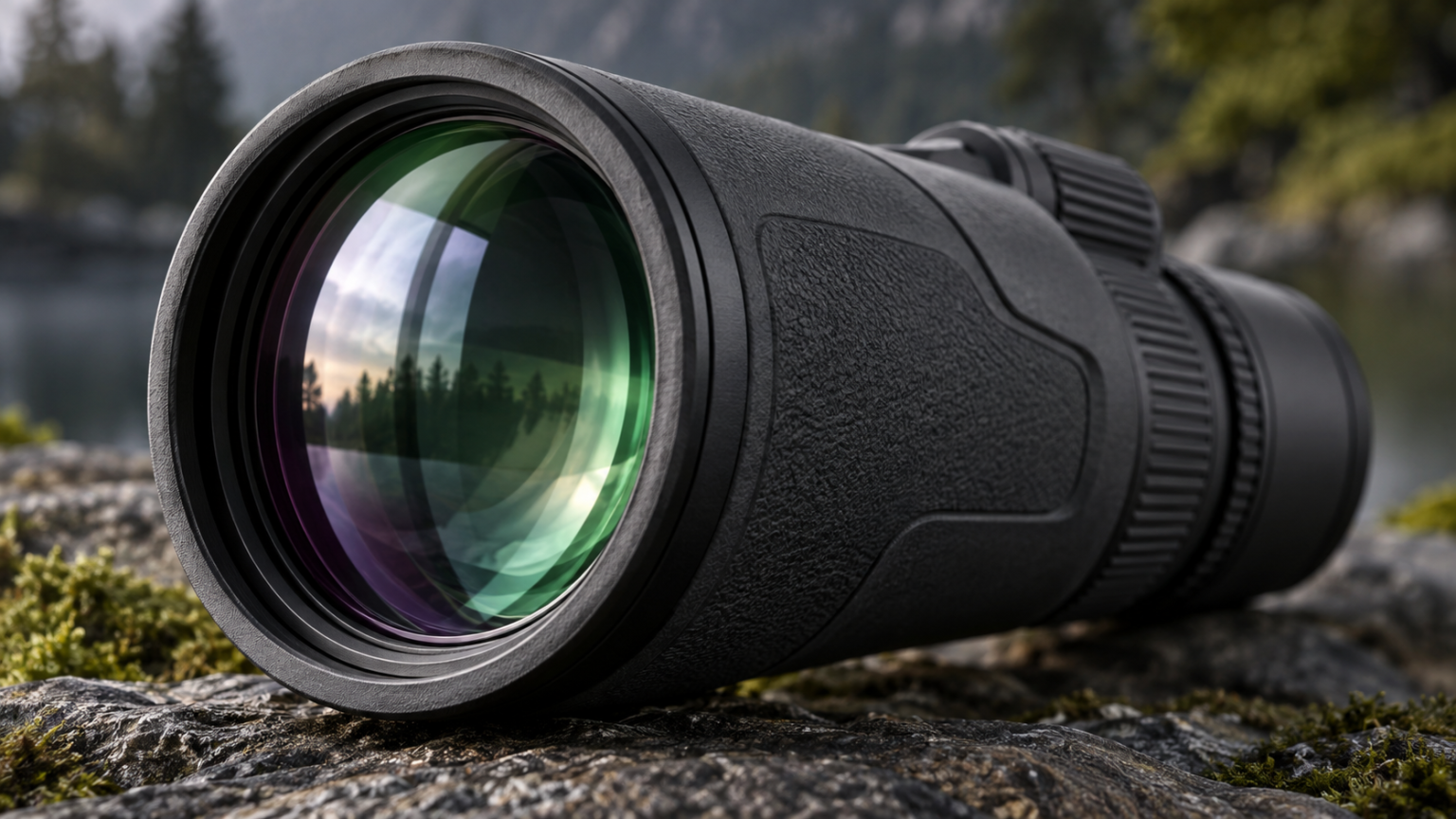
Monocular ED glass and lens coatings address different parts of image quality. ED glass helps an optical design control color fringing. Anti-reflective coatings reduce unwanted reflections at optical surfaces. Both can be useful, but neither label tells you whether a monocular will feel comfortable, focus well or suit the subjects you watch.
Read the specifications as a description of the design, then evaluate the complete view. A long list of optical terms is less helpful than knowing which problem a feature is intended to solve and whether you notice that problem in normal use.
What ED glass does
ED means extra-low dispersion. Visible light contains different wavelengths, and a lens can bring them to slightly different focus positions or image scales. One visible consequence is a colored fringe along a high-contrast edge.
Nikon’s explanation of chromatic aberration describes how ED glass, used with other optical elements, helps reduce this color error. A conventional nature-viewing example is a dark branch or bird outlined against a bright sky: fringing can make the edge look purple, green or otherwise tinted.
The useful word is “helps.” ED is one material choice within a complete optical design. It does not certify that every part of the view will be sharp, that all color fringing disappears or that one ED monocular outperforms every model without that label.
When that improvement may matter to you
If you often inspect birds against bright backgrounds, pay attention to distracting edge color during a comparison. Try to judge the feature you care about—a bill edge, an eye line or the outline of a distant object—rather than looking only for the most dramatic test scene.
If your usual views are brief looks at landscapes during a walk, you may place more value on easy handling and a generous view. That is a buying priority, not a claim that your eyes cannot benefit from better color correction. Spend for an improvement you can appreciate in the way you actually observe.
What anti-reflective lens coatings do
Some light reflects at a lens surface instead of continuing through the optical system. Those reflections can reduce transmission and contribute to flare or ghost images. Nikon’s lens-coating guide explains why anti-reflective coatings are applied and how multilayer coatings can reduce reflections over a broader range than a single layer.
This is a different job from correcting chromatic aberration. A monocular can have coated lenses without ED glass, and an ED element does not remove the need for good surface treatments.
Do not judge the whole optic by the color reflected from its front lens. A green, purple or reddish reflection is not a field test of transmission, contrast or resolution. Ask what surfaces are treated and then examine the image under comparable conditions.
Read coating labels as questions to investigate
The familiar progression from “coated” to “fully multi-coated” is useful only when you know what the manufacturer means for the particular product. Look for an explicit description of the treatment and its coverage rather than filling in missing detail yourself.
| Listing term | What to establish before comparing |
|---|---|
| Coated | Which optical surfaces are treated, and with what type of coating? |
| Multi-coated | Are multiple layers specified, and on which surfaces? |
| Fully multi-coated | Does the maker explicitly describe multilayer treatment across the relevant air-to-glass surfaces? |
| Water-repellent or protective coating | What surface is protected, and what care instructions apply? |
| HD or a proprietary optical label | What specific materials, treatments or measured properties does the maker identify? |
A missing detail is a reason to ask a question, not proof that the optic is poor. Equally, an impressive label is not a substitute for a usable specification or a meaningful comparison.
Roof-prism coatings are another separate subject
If a monocular uses a roof-prism system, its specification may mention phase correction or a reflective prism coating. These are not alternative names for ED glass.
Nikon’s roof-prism coating explanation distinguishes phase correction, which addresses phase-related image degradation at roof surfaces, from coatings used to improve reflection at applicable prism surfaces. The relevance depends on the prism design; do not demand a particular roof-prism feature from an optic built around a different arrangement.
For shopping purposes, keep three questions separate: how the design controls color error, how it limits unwanted reflections, and how its prism arrangement is treated. Combining all three into one vague “premium glass” score conceals the differences you are trying to understand.
Compare the whole image under the same conditions
Use the same subject, similar light and comparable magnification. Clean the external lenses appropriately, set the focus carefully and position your eye correctly before making a judgment. A fingerprint, poor focus or a badly placed eyecup can overwhelm a subtle optical difference.
Then make a short set of observations:
- Examine a detailed subject near the center. Can you find a clear, repeatable focus position?
- Check a high-contrast edge for distracting color without aiming near the sun.
- Move your attention toward the edge of the view. Record what changes rather than assuming ED guarantees sharp edges.
- Observe a scene with bright areas outside your main subject. Notice whether washed-out contrast makes details difficult to inspect.
- Lower the monocular and raise it again. Check whether obtaining the same comfortable view is easy.
This is a practical comparison routine, not a laboratory transmission or resolution test. If you cannot try the optics together, prioritize clear manufacturer specifications and independent evidence that explains its method.
Comfort can decide the better purchase
A technically attractive optic is a poor match if you cannot see the full field while wearing your glasses. Check eye relief and eyecup position before paying extra for an optical label.
Likewise, more magnification can make a view harder to steady, while a short close-focus distance may be essential for nearby nature. Use our monocular selection guide to establish those requirements first. If variable power is part of the decision, the fixed vs zoom guide explains the handling tradeoffs.
Think about maintenance too. Coatings do not make a lens immune to abrasive grit or unsuitable cleaning fluid. Follow the cleaning and storage routine and the instructions for the exact model rather than treating a protective coating as permission to wipe carelessly.
Put the premium where it helps your viewing
If two monoculars meet your handling, focus and weather requirements, better control of fringing or reflections may justify paying more. If the premium model is awkward to carry or uncomfortable at the eyepiece, revisit the comparison before buying it for the label alone.
For a trail optic, our best monoculars for hiking guide brings those priorities together. With a tighter spending limit, compare the monoculars under $100 on their documented specifications. Choose a complete viewing experience you can explain, rather than a collection of abbreviations you have to take on trust.

Elliot Vantage is an optics enthusiast and the editor behind Optic Horizon, covering monoculars, binoculars, thermal optics, and related outdoor gear. He researches manufacturer documentation, optical specifications, product features, pricing, and use-case differences to help readers understand their options and choose equipment that fits their needs.