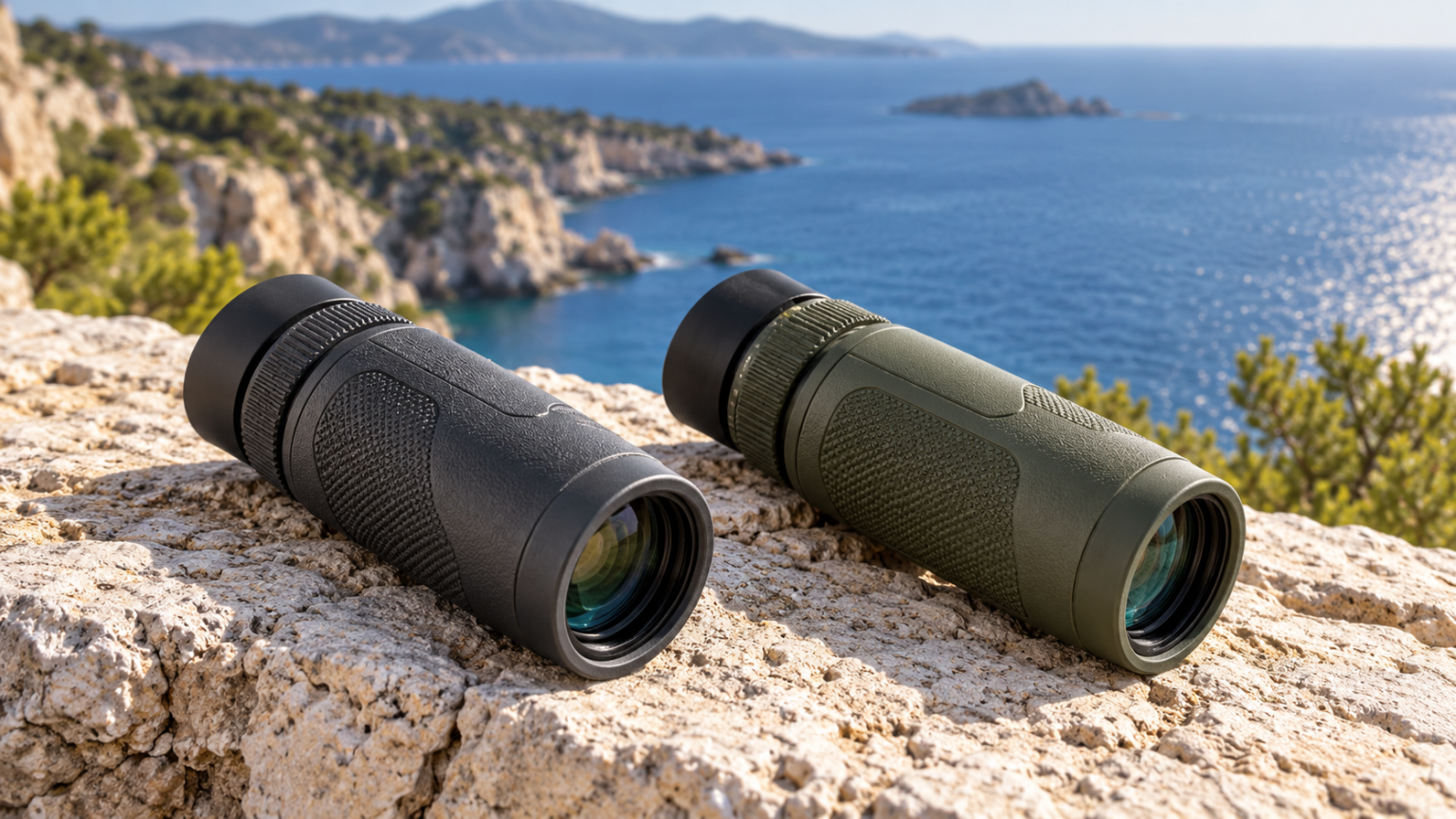
The Vortex Solo 10×25 vs Celestron Nature 10×25 choice is between two compact conventional monoculars with the same nominal magnification and objective size. The Solo has a slightly wider published field, a slightly shorter minimum focus and a lower listed weight. Those differences are modest. Fit, focusing comfort, seller availability and the actual price deserve more attention than declaring a dramatic optical winner from the specification sheet.
This comparison uses manufacturer documentation, not a hands-on test. It concerns the Solo 10×25 and Celestron Nature 10×25 model 71210, rather than the larger Solo models or Celestron’s other similarly sized monoculars.
The documented differences at a glance
The figures below come from the Vortex Solo 10×25 page and Celestron Nature 10×25 page. Field widths are kept in the same units and at the same reference distance.
| Specification | Vortex Solo 10×25 | Celestron Nature 10×25 |
|---|---|---|
| Magnification / objective | 10× / 25 mm | 10× / 25 mm |
| Angular field of view | 6.0° | 5.8° |
| Linear field of view | 315 ft at 1,000 yd | 304 ft at 1,000 yd |
| Close focus | 16.4 ft | 18 ft |
| Eye relief | 14.5 mm | 14 mm |
| Listed weight | 5.6 oz | 6 oz |
| Lens-coating description | Fully multi-coated | Multi-coated |
These are published specifications. They do not measure which model looks sharper, controls flare better or fits your glasses more comfortably. A specification comparison can narrow a shortlist without settling those questions.
Both give the same nominal image scale
Neither instrument has a magnification advantage on paper: both are fixed 10× monoculars. They also share a nominal 2.5 mm exit pupil, calculated as 25 ÷ 10. That does not establish identical transmission or contrast, because the complete optical systems can differ.
If 10× is difficult for you to hold steady, switching between these two models will not change that basic magnification choice. Revisit the 8× vs 10× comparison before treating the brand decision as the only one that matters.
For brief looks at trail signs, scenery or a settled bird, either configuration can be a practical size. For following active nearby wildlife, establish whether the narrow pocket-optic format suits your viewing style at all.
The Solo’s viewing-width advantage is small
The published width differs by 11 ft at 1,000 yd, or about 3.6% relative to the Nature’s 304 ft. That is a real documented difference, but it is not a transformation from a narrow view into an expansive one.
For finding a subject, a slightly wider field can help. Your ability to raise the optic toward the correct point, position your eye and focus quickly may have a larger practical effect. Our monocular-use routine addresses those skills.
Do not mix feet at 1,000 yards with meters at 1,000 meters when comparing another candidate. Use the field-of-view guide if a retailer switches units or leaves the reference distance unclear.
Neither is designed around very close subjects
The stated minimum focus is about 5 m for the Solo and about 5.5 m for the Nature after converting the published feet values. The Solo reaches a little nearer, but both may miss subjects close beside a path.
Imagine a butterfly on a plant two meters away. Neither listed minimum focus fits that observation. Moving a little farther back may be possible in some situations, but that should not become your substitute for choosing a suitable optic when close observation is a priority.
Our close-focus guide explains that requirement. If nearby nature is central to your use, the Opticron Explorer vs Nocs Field Tube comparison examines a different pair of configurations with shorter specified minimum distances.
Eye relief needs a real fit check
The numerical difference is only half a millimeter. It would be unreasonable to treat 14.5 mm versus 14 mm as proof that one model works with every pair of glasses while the other does not.
Your lenses, frames, eye position and eyecup adjustment affect the usable view. Check whether you can see the full field without blackouts and whether returning to that position is easy. If trying before buying is difficult, understand the applicable seller’s return arrangements.
The monocular-with-glasses guide gives a practical fitting sequence. It is more useful here than assigning a comfort winner from the eye-relief row alone.
Compare coating claims without inventing a test result
Vortex describes the Solo as fully multi-coated, while Celestron describes the Nature as multi-coated. That difference in the documented claim is worth recording, but it does not supply measured transmission, resolution or contrast for a direct comparison.
Look through both at the same subject and under comparable light if you can. Check focus, distracting reflections and how easily you find a comfortable view. Keep your observations separate from the manufacturer’s terminology.
Our explanation of ED glass and lens coatings covers what coating labels can establish. Neither a reflected lens color nor a promotional photograph proves superior image quality.
Handling and carrying deserve their own decision
The published weight difference is 0.4 oz, approximately 11 g. That can be a small tie-breaker for a carefully pared-down kit, but include the strap and case you actually carry before treating either number as your complete load.
Try the focus control with your usual hand and check whether the grip stays comfortable. A smooth, predictable adjustment matters more than a description of one-handed use if your own fingers struggle to operate the device.
Both manufacturers describe weather-protected designs. Follow the exact care and exposure guidance instead of assuming the two products share identical water-test limits. The waterproof vs fogproof explanation helps interpret those claims.
Check availability before choosing by price
During the October 16, 2026 review, Celestron’s direct-store Nature 71210 variant was unavailable. This does not establish that the model is discontinued everywhere. Availability and seller terms need checking in your own market, especially for remaining or imported stock.
Do not assume either model currently costs less than $100 because it appears in an affordable-optics discussion. Check the delivered price, exact model, seller and applicable warranty terms rather than comparing a manufacturer’s suggested price with an unrelated sale listing.
Which belongs on your shortlist?
The Solo is the more straightforward specification-based choice if you value its small advantages in viewing width, minimum focus and listed weight and can obtain it on suitable terms. The Nature remains worth considering when a reliable seller has the correct model at an appealing price and its handling fits you.
If the differences do not solve your main problem, change the configuration rather than overanalyzing this pair. Use the monoculars under $100 guide to compare the broader options and the high-power claims checklist when an alternative listing promises much more without clearer documentation.

Elliot Vantage is an optics enthusiast and the editor behind Optic Horizon, covering monoculars, binoculars, thermal optics, and related outdoor gear. He researches manufacturer documentation, optical specifications, product features, pricing, and use-case differences to help readers understand their options and choose equipment that fits their needs.