
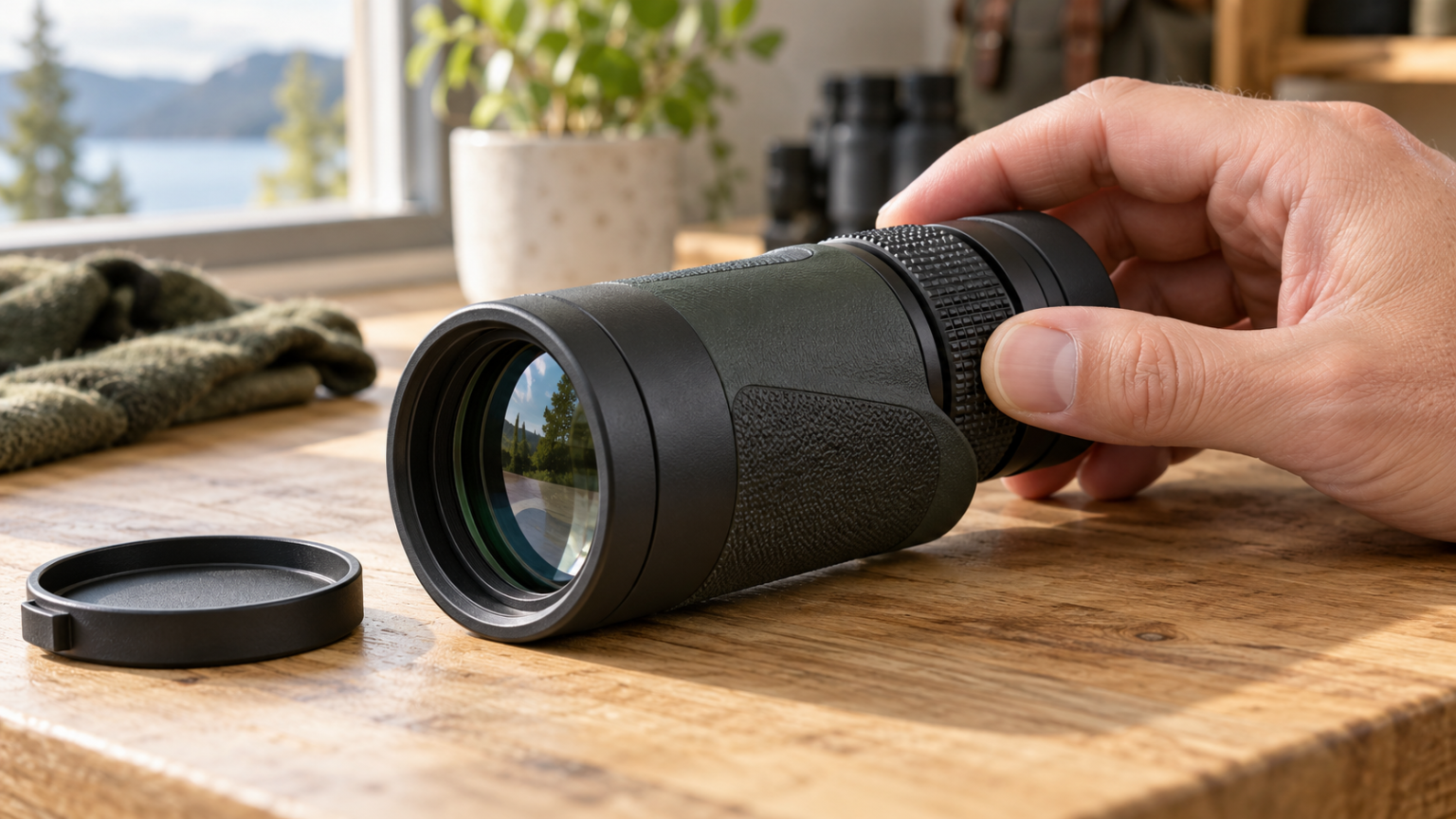
High-power monocular claims deserve a closer look when the headline promises far more magnification than the specifications explain. A label such as “80×100” is useful only if the manufacturer tells you what both numbers mean and supplies consistent information about the actual optic. Treat an unexplained label as a question to investigate, rather than proof of exceptional reach or proof of dishonesty.
The best check is to follow the claim through the listing, manual and exact model identification. If those sources disagree, pause the purchase until the seller or manufacturer resolves the difference in writing.
Establish what the numbers are supposed to describe
In conventional optical notation, the first number describes magnification and the second describes objective diameter in millimeters. Nikon’s explanations of magnification and effective objective diameter distinguish those two properties.
If “80×100” genuinely follows that convention, it describes 80× magnification and a 100 mm effective objective. That would be a very different proposition from a compact 8× or 10× pocket monocular. Do not silently reinterpret the label as 8× merely because the product looks small: ask what the maker actually specifies.
Our monocular numbers guide covers the normal notation in detail. Here, the task is checking whether a particular sales claim follows that notation consistently.
Look for a specification trail, not one large number
A credible listing should let you identify the product and find a usable set of specifications. Start with the model name or SKU, then compare the seller’s title with the manufacturer’s page and manual.
Look for magnification, effective objective diameter, field of view with its reference distance, minimum focus, eye relief, dimensions and weight. A long accessory list or a photograph of a phone adapter does not answer these optical questions.
The Celestron Outland X 10–30×50 provides a documented example of variable optical power: the product identifies a magnification range and a separate objective size. This example illustrates clearer specification practice; it is not a claim that every other label is inaccurate.
Use physical consistency as a screening check
A claimed effective objective has to fit within the front of the instrument. A product described as having a 100 mm objective therefore needs a front assembly capable of accommodating that clear aperture. The outside housing diameter and the effective optical diameter are different measurements.
Check a dimensioned manufacturer drawing if one exists. Product photographs alone are weak measuring tools because perspective, cropping and scale references can be misleading. A large decorative front rim does not establish the diameter of the clear opening inside it.
If the published dimensions appear incompatible with the claimed aperture, send the maker the two conflicting specifications and ask for clarification. Record the answer instead of resolving the discrepancy by guessing which number the seller meant.
Check whether the stated power is optical or digital
A conventional fixed-power monocular does not acquire variable optical magnification because a phone can enlarge its photograph. Optical magnification, a phone’s camera selection and a digital crop are separate parts of the viewing chain.
Likewise, a listing may combine a model designation, an accessory claim and a magnification number in one title. Ask which number describes the view through the monocular alone. If it is a zoom model, establish the lowest and highest optical settings and the control that changes between them.
Our fixed vs zoom comparison explains the practical tradeoffs. The smartphone photography guide addresses what attaching a phone can and cannot add.
Calculate one useful cross-check
For a conventional optic, nominal exit pupil is objective diameter divided by magnification. Nikon’s exit-pupil explanation describes this relationship.
For a literal 80×100 specification, the calculation is 100 ÷ 80 = 1.25 mm. That result does not authenticate the product. It tells you something about the eye positioning and viewing conditions the claimed design would involve.
Be careful with the reverse argument too. A bright-looking demonstration video is not a measurement of exit pupil, optical transmission or genuine magnification. Recording exposure, scene brightness and image processing can change how convincing a demonstration looks.
Treat distance claims as separate claims
“See for miles” does not specify what detail you can resolve. Seeing a mountain several miles away and reading a small sign at the same distance are different observations.
Ask what the demonstration actually shows, at what distance and under which conditions. Can you identify the target’s size? Is the footage recorded through the supplied monocular? Has it been cropped or enlarged? A comparison with an unaided view is helpful only when the recording method is explained.
The same caution applies to “night vision.” Establish whether the item is a conventional optic, an electronic night-vision device or a thermal imager. A conventional monocular needs visible light; a marketing phrase about low-light viewing does not specify an electronic imaging system.
A checklist for an ambiguous listing
| Claim or omission | Ask for | Why it matters |
|---|---|---|
| An unexplained “80×100” label | Actual optical magnification and effective objective diameter | Establishes what the numbers mean |
| “Zoom” without a stated range | Minimum and maximum optical settings | Separates optical adjustment from digital enlargement |
| A field-of-view number without units | Degrees, or width at a stated distance | Makes comparison possible |
| Dramatic distance footage | Target size, distance and recording method | Connects the demonstration to a real observation |
| No exact model or manual | Manufacturer identification and documentation | Allows the remaining claims to be checked |
One missing field is not a verdict on the entire product. Several unresolved contradictions are a good reason to choose an option with clearer documentation.
Write a question the seller can answer precisely
Try this: “Please confirm the monocular’s actual optical magnification, effective objective diameter in millimeters and field of view. Is the headline number an optical specification or a model label? Please send the manual for this exact model.”
A response that repeats the headline without answering those questions has not resolved your uncertainty. Keep screenshots or a written specification for your purchase records, and check the seller’s applicable return terms before ordering.
Choose around an observation you can describe
For hiking and ordinary wildlife watching, begin with the view you can find and hold steadily. Our 8× vs 10× guide explains that familiar decision without assuming higher power always helps.
Compare documented options in the monoculars under $100 guide, or examine the specific tradeoffs in our Opticron Explorer vs Nocs Field Tube comparison. For a compact fixed-power example, our Vortex Solo 10×25 vs Celestron Nature 10×25 comparison works through documented specifications rather than an unexplained headline number. A useful specification explains the instrument you will receive and the task it can reasonably serve.

Elliot Vantage is an optics enthusiast and the editor behind Optic Horizon, covering monoculars, binoculars, thermal optics, and related outdoor gear. He researches manufacturer documentation, optical specifications, product features, pricing, and use-case differences to help readers understand their options and choose equipment that fits their needs.