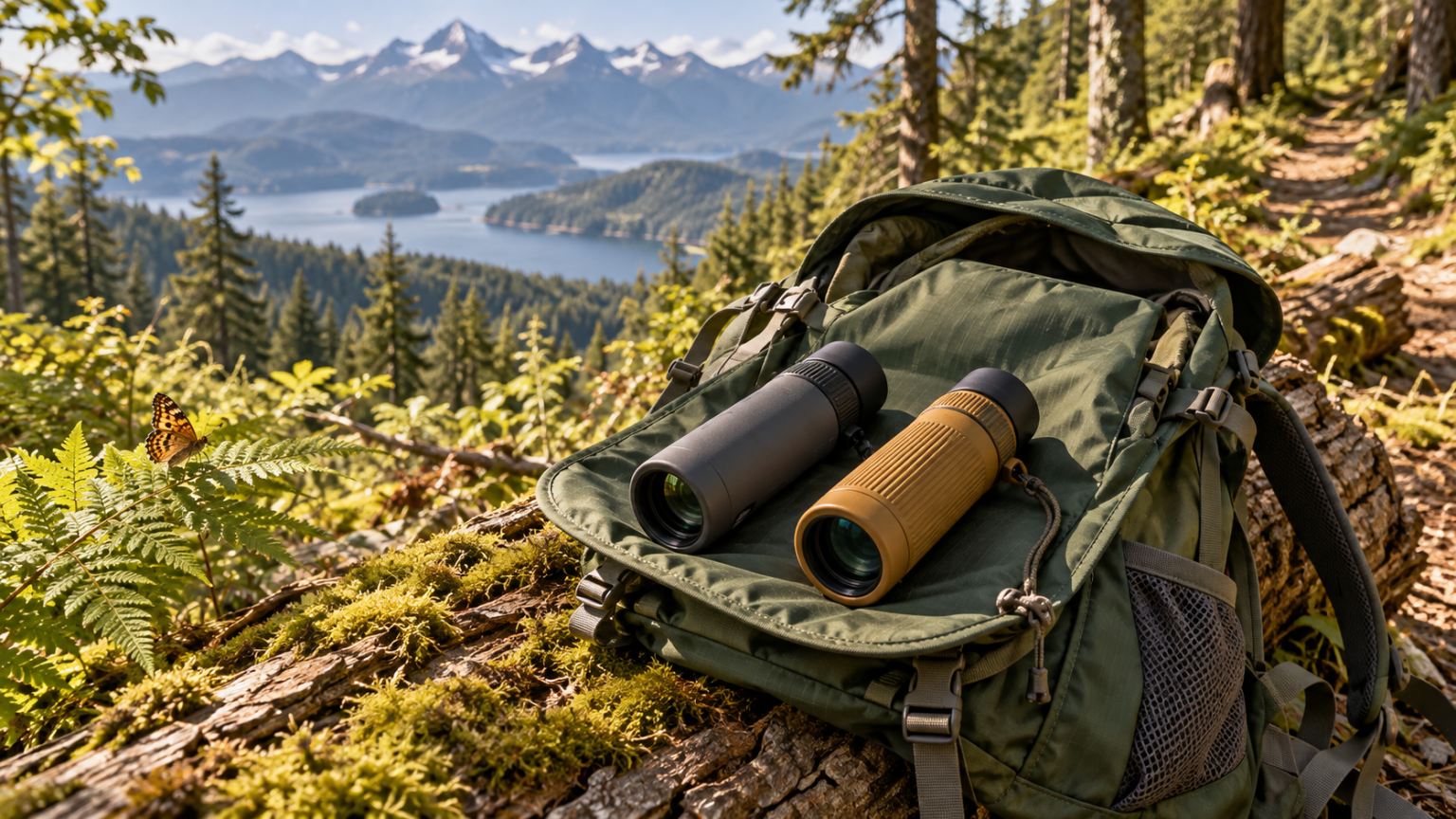
The Opticron Explorer vs Nocs Field Tube decision is particularly close when you compare the correct 8×32 monoculars. Their published viewing widths are almost identical. The more useful differences are the Opticron’s shorter minimum focus and longer listed eye relief, the Nocs’s lower listed weight, and how each instrument fits your hand and intended outings.
This is a documentation-based comparison of the Opticron Explorer WA ED-R 8×32 monocular, product code 30784, and Nocs Field Tube 8×32. It does not compare Opticron’s similarly named binoculars, the Nocs Zoom Tube or the 10×32 Field Tube.
Start with the exact specification columns
The Opticron monocular specification and Nocs Field Tube page provide the following figures. On Nocs’s shared table, use the 8×32 column.
| Specification | Opticron Explorer WA ED-R 8×32 | Nocs Field Tube 8×32 |
|---|---|---|
| Magnification / objective | 8× / 32 mm | 8× / 32 mm |
| Field of view | 136 m at 1,000 m | 135 m at 1,000 m |
| Angular field | 7.8° | 7.7° |
| Minimum focus | 2 m | 3 m |
| Eye relief | 18 mm | 16.5 mm |
| Listed weight | 260 g | 240 g |
| Lens specification | ED objective; fully multi-coated optics | HiFi fully multi-coated optics |
| Weather description | Waterproof, nitrogen filled | IPX7, nitrogen filled |
The manufacturers’ figures describe the instruments; they do not establish a tested image-quality winner. In particular, the two coating descriptions are not directly comparable laboratory measurements.
Viewing width is effectively a tie for this decision
One meter of difference across a scene 1,000 m away is a very small distinction. Avoid choosing the Opticron mainly because 136 is larger than 135, or assuming the Nocs creates a meaningfully restricted search view.
Both are nominally 8× instruments with 32 mm objectives. Their calculated exit pupils are 4 mm. This shared configuration does not prove identical images, but it means the buying decision is not primarily about choosing different magnification or aperture.
If you are still deciding between 8× and 10×, use our magnification comparison first. The field-of-view explanation helps when a different retailer presents the same coverage in feet or another reference distance.
The Opticron’s closer focus can matter on a trail
The difference between 2 m and 3 m is more relevant than the small gap in viewing width if you enjoy nearby birds, butterflies or other trailside details. A subject 2.5 m away lies inside the Nocs’s stated minimum distance but beyond the Opticron’s stated minimum.
That example is a specification-based suitability check, not a promise about the visibility of a particular insect. Your viewing angle, the subject’s size and movement still affect the observation.
Think about the distances you actually use. If almost every view is of a distant ridge or a bird across a clearing, the closer minimum may add little. If you regularly stop beside plants and hedges, it can be a more meaningful reason to shortlist the Opticron. Our close-focus guide develops that decision.
Glasses users should try both eyepieces
Opticron lists 18 mm of eye relief and Nocs lists 16.5 mm for the 8×32. The extra stated distance can be relevant, but it does not prove that every glasses wearer will obtain a full view through one and struggle with the other.
Set the eyecup for your own glasses and check the complete field. Lower and raise the monocular several times to see whether the position is repeatable. A view that looks comfortable once on a counter may take more care when you lift the optic quickly outdoors.
Use the glasses and eye-relief routine to assess fit. For non-glasses use, check whether the eyecup helps you hold your eye at a stable distance without pressing uncomfortably.
ED glass is a specific feature, not a complete verdict
Opticron explicitly identifies an ED objective in this model. The reviewed Nocs specification emphasizes its fully multi-coated optical system without giving this Field Tube the same ED designation.
That difference is relevant when comparing documented design features. It does not demonstrate how much color fringing you will see, whether one optic is sharper at the edge or which view you prefer in difficult light.
Our ED glass and coatings guide separates those concepts. If you can compare the instruments, use the same detailed subject, accurate focus and similar light. Avoid turning a materials label into an experience you have not actually tested.
A 20 g difference needs context
Nocs lists 240 g and Opticron 260 g. Twenty grams is a modest difference: worth recording for a very light kit, but small enough that straps, caps, cases and mounting accessories can influence the complete carried load.
More importantly, test the grip and focusing action. Check whether your fingers naturally reach the focus control, whether using it disturbs the view and how comfortably the instrument sits in a pocket or accessible pouch.
If phone photography matters, verify the exact adapter and mounting arrangement rather than assuming any 32 mm monocular accepts the same clamp. The smartphone-through-monocular guide explains what needs to align and where compatibility can fail.
Read the weather claims at their stated level
Both manufacturers describe sealed, nitrogen-filled designs. Nocs also states an IPX7 rating and its associated exposure claim. Do not assign the same tested depth or duration to the Opticron merely because both pages use the word waterproof.
For either model, use the actual manual and service guidance when deciding what exposure is permitted. Weather protection also does not remove the need to dry a wet strap and case before storage. Our weather-claim explanation and cleaning guide cover those practical distinctions.
Check the seller and exact variant
The similar names create several opportunities to order the wrong instrument. Confirm that the Opticron listing says monocular and product code 30784. For Nocs, confirm 8×32 rather than relying on the color photograph or a shared 8×/10× product description.
Compare current delivered prices and applicable seller terms in the same market. Nocs color availability can vary by variant; a photograph of a preferred color does not establish that it is currently orderable. Neither this comparison nor a product page guarantees future stock.
Which one fits your use better?
Shortlist the Opticron when closer focusing and its longer listed eye relief address a real need, while treating the ED objective as a documented feature to assess. Shortlist the Nocs when its handling, available variant and slightly lower listed weight fit your kit and the 3 m minimum focus is sufficient.
If you are happy with both eyepieces and usually observe farther away, the almost identical field widths leave price, grip and carrying preference to decide. Compare the broader options in our hiking monocular buying guide instead of expecting one number to settle every aspect of the purchase.

Elliot Vantage is an optics enthusiast and the editor behind Optic Horizon, covering monoculars, binoculars, thermal optics, and related outdoor gear. He researches manufacturer documentation, optical specifications, product features, pricing, and use-case differences to help readers understand their options and choose equipment that fits their needs.