
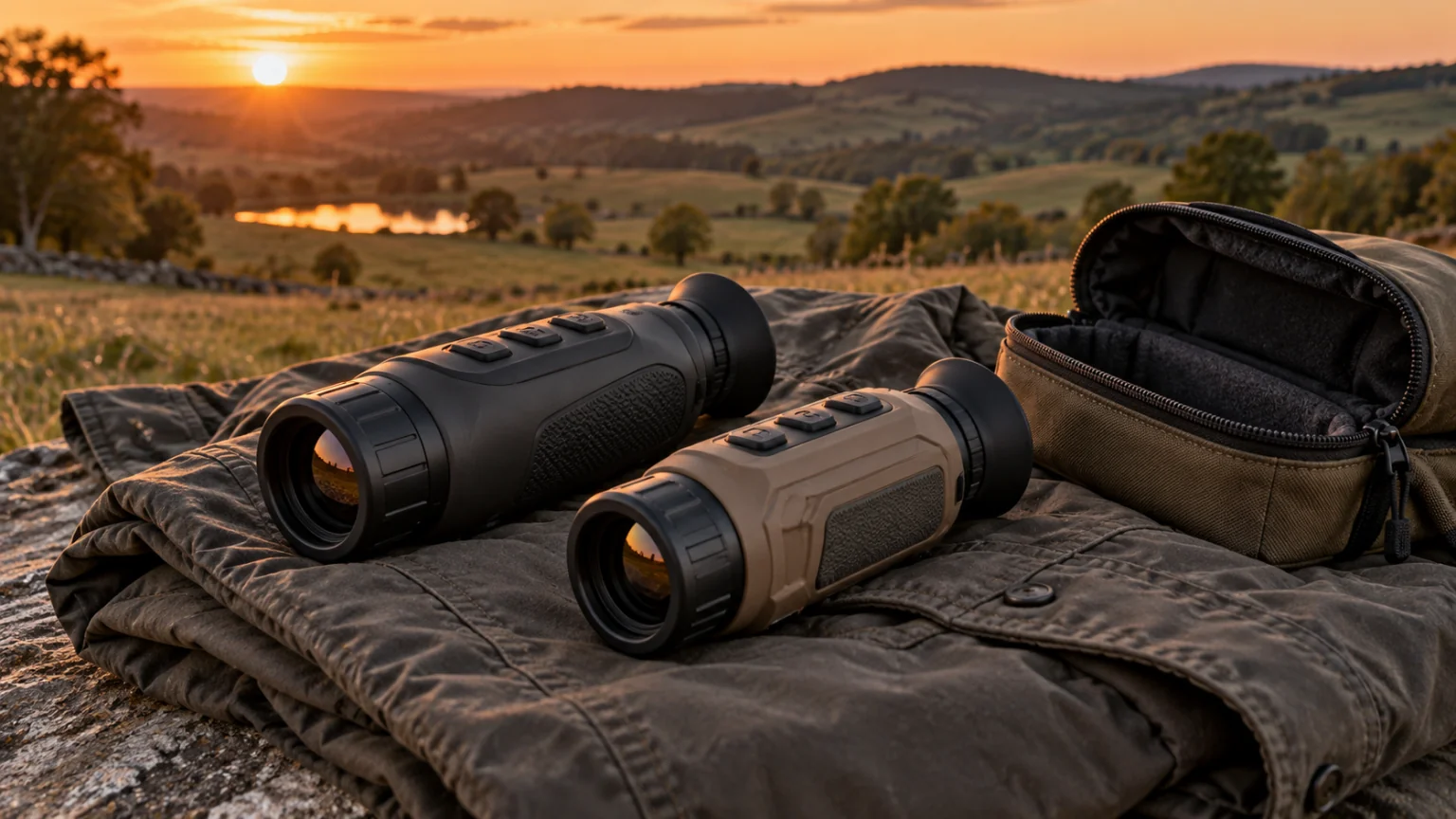
The AGM Taipan V2 10-256 vs RIX Pocket K2 comparison starts with a tie in native detector dimensions: both use 256×192 thermal sensors. The more useful differences are their viewing coverage, display specifications, handling and ownership requirements. Neither becomes a higher-resolution thermal detector because its screen has more pixels or its image processing enlarges the view.
Before buying or using a Pocket K2, check RIX’s battery recall notice. Certain earlier K2 and K3 units are included. If yours is affected, stop using the battery and follow RIX’s replacement instructions. An in-stock listing does not establish that a particular unit has been cleared.
Compare the correct Taipan generation
This article concerns the Taipan V2 10-256, not the older Taipan TM10-256 or another lens size in the V2 range. For RIX, it concerns the Pocket K2 rather than the K3. Similar names can conceal a different detector, optical configuration or control arrangement.
The following values come from AGM’s current product page, its manufacturer-authored manual and RIX’s current Pocket documentation. This is a specification-based comparison without hands-on performance measurements.
| Specification | AGM Taipan V2 10-256 | RIX Pocket K2 |
|---|---|---|
| Native detector | 256×192 | 256×192 |
| Pixel pitch | 12 µm | 12 µm |
| Objective focal length | 10 mm | 9 mm |
| Horizontal field of view | 17.5° | 19.4° |
| Stated thermal frame rate | 50 Hz | 50 Hz |
| Display | 1280×960 LCOS | 800×600 OLED |
| Built-in storage | 16 GB | 8 GB |
| Water-protection claim | IP67 | IP67 |
RIX’s Pocket K2 page and Pocket Series V3 manual identify the K2’s native sensor separately from its display and recording dimensions.
An AGM magnification discrepancy needs clarification
AGM’s reviewed store page contains a 1.0× base-magnification field while also giving a 1.5×–12× magnification range. The AGM-authored Taipan V2 manual hosted by B&H lists the 10-256’s sequence as 1.5×, 3×, 6× and 12×.
Those published labels are inconsistent. Confirm the supplied unit’s magnification and documentation with AGM or the seller before ordering on that basis. The comparison here uses the documented field of view and native detector figures rather than silently choosing one conflicting headline value.
Do not confuse either sequence with continuously variable optical zoom. Our thermal field-of-view guide explains why the optical view and digital enlargement belong in separate columns.
The K2 gives a slightly broader search view
The K2’s published horizontal angle is 19.4°, compared with 17.5° for the AGM. That favors a broader initial search view for the K2. The AGM places the same number of horizontal detector samples across a somewhat narrower angle.
These differences describe coverage and sampling, not a measured identification-distance advantage. Vegetation, focus behavior, weather and the subject still affect the observation. A wide view of an unresolved spot does not establish what animal it is.
For searching a nearby hedge or moving along a path with observation stops, consider how easily you can find the relevant part of the scene. For examining a specific distant opening, check whether either 256-class configuration provides enough useful information. The thermal range explanation separates detection from identification.
The larger AGM display does not settle image quality
AGM lists a higher-pixel-count display, while RIX uses an OLED display. Those specifications concern presentation. Both instruments still begin with a 256×192 detector.
An enlarged thermal outline can become easier to inspect on a screen without containing additional native anatomy or field marks. Check menu legibility, comfortable brightness and the eyepiece view if you can try the instruments. Avoid treating a screen-resolution ratio as a thermal-detail ratio.
Our resolution guide explains this distinction. It is particularly important when a product description discusses processing or simulated pixels beside the detector specification.
Sensitivity numbers need matching conditions
The reviewed AGM page advertises sub-35 mK NETD; the current RIX Pocket documentation lists below 25 mK. Those are manufacturer claims, not results from one controlled side-by-side test.
Without comparable measurement conditions and a complete system comparison, they do not prove a universal low-contrast winner. Use them as documented specifications alongside the optics and task, with the limits explained in our NETD guide.
Likewise, both state 50 Hz. That does not establish identical latency, processing or recordings. The refresh-rate guide explains what that shared figure can and cannot decide.
Compare the complete field setup
Handle each device with the battery and strap you will actually use. Check access to its power, menu and enlargement controls, and whether you can obtain a comfortable eyepiece position with your usual glasses.
Read the actual focusing instructions. A fixed-focus configuration and an adjustable objective do not ask the user to do the same thing, and a generic “focus” control may concern the display eyepiece. Do not assume every thermal monocular follows one control sequence.
For power planning, check the approved battery arrangement, charging requirements and the conditions behind any runtime figure. Avoid substituting a random cell because it has the same broad battery-family name. The battery-life guide provides the comparison framework; the current manufacturer instructions control compatibility.
Does the extra storage matter to you?
AGM’s stated 16 GB and RIX’s 8 GB are useful distinctions if you record frequently, but capacity alone does not predict recording time without file size, format and settings. Check how files are transferred and whether you can complete the process without the phone connection becoming awkward.
For occasional bird records, preserve context and behavior rather than maximizing digital enlargement. Our thermal bird-recording guide explains a repeatable capture and review routine.
Which should you consider?
The Taipan V2 deserves consideration when its viewing coverage, interface and larger stated storage fit your routine, after resolving its magnification labels. The K2 is a candidate when a broader search view and its pocket format suit you, with the particular unit’s battery-recall status resolved first.
If you already own a K2 and want more native samples, changing to another 256×192 detector is not a detector-resolution upgrade. The Pocket K2 vs K3 comparison addresses a different step. For the wider shortlist, compare the best budget thermal monoculars using current seller terms and the task you actually need to complete.

Elliot Vantage is an optics enthusiast and the editor behind Optic Horizon, covering monoculars, binoculars, thermal optics, and related outdoor gear. He researches manufacturer documentation, optical specifications, product features, pricing, and use-case differences to help readers understand their options and choose equipment that fits their needs.