
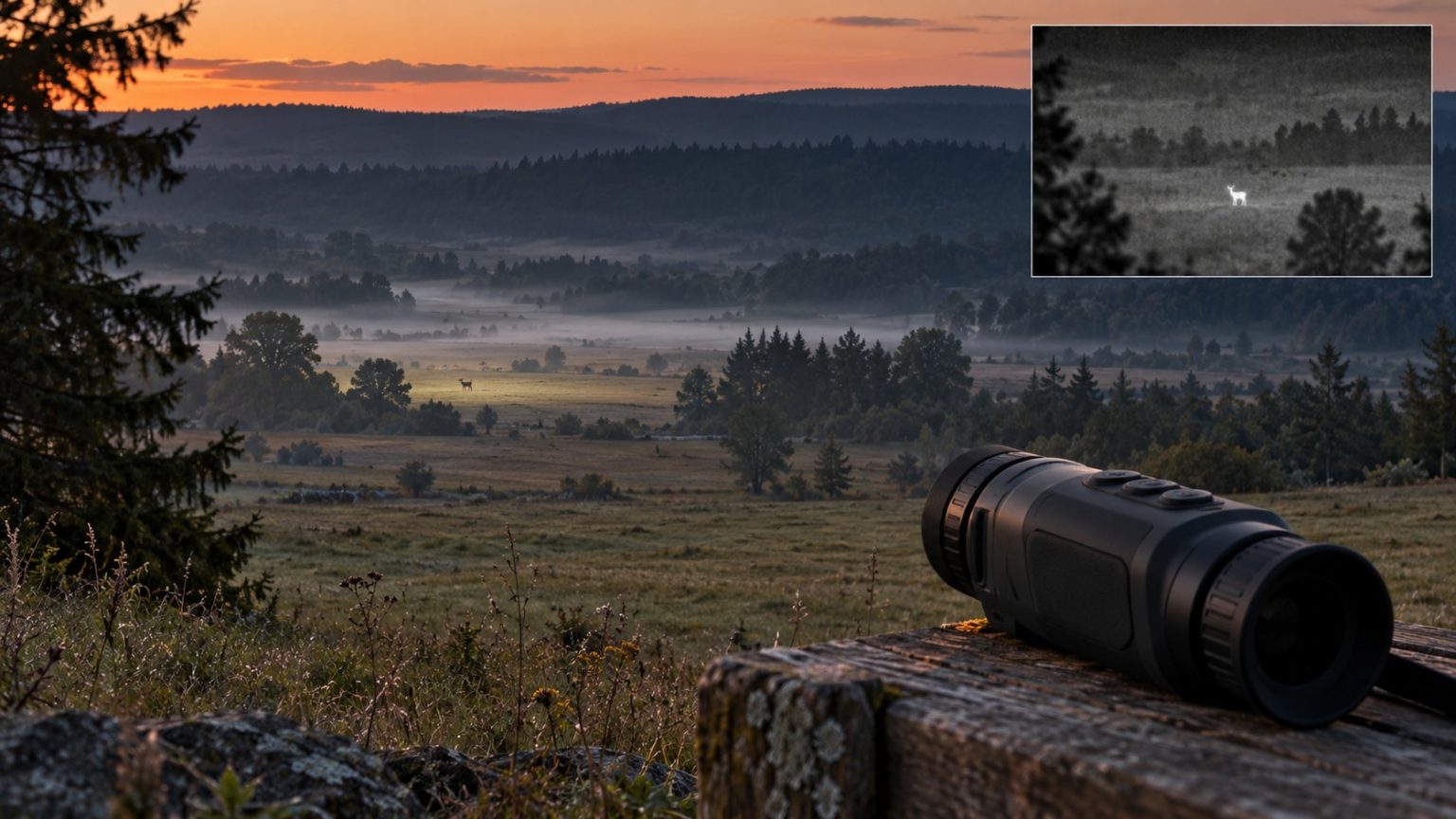
How far can a thermal monocular see? There is no single useful answer without knowing the target and what you need to learn about it. A device may reveal a distant heat signature while showing too little detail to tell you which animal produced it. Detection range is the distance at which a target can be noticed under stated conditions; identification requires considerably more information.
That distinction matters more than the largest range number on a product page. If your aim is to find wildlife, a small thermal spot may be useful. If you need to distinguish a coyote from a dog, the same spot leaves the important question unanswered. Our guide to interpreting animal shapes in thermal images explains why a familiar-looking silhouette needs closer assessment.
Here is how to read thermal range claims, compare devices and set expectations for your own observations.
Detection, recognition and identification answer different questions
Manufacturers and engineers use detection, recognition and identification—often shortened to DRI—to describe different imaging tasks. The precise task definition matters: identifying a vehicle type in a technical model does not establish a reliable wildlife-species identification distance.
| Task | Question being answered | Wildlife example | What remains uncertain |
|---|---|---|---|
| Detection | Is a target present? | A small thermal feature appears in an opening | Whether it is an animal and which species it might be |
| Recognition | What general kind of target is it? | Movement and shape suggest a four-legged animal | Whether it is a dog, coyote or something else |
| Identification | Are the relevant distinguishing details visible? | Enough diagnostic information supports the required identification | Anything the image still cannot establish |
Teledyne FLIR’s explanation of DRI separates detecting a target from classifying it and identifying it within a defined target set. These are performance tasks, rather than three interchangeable descriptions of seeing something.
For wildlife, use the strictest task that matches your purpose. A device that finds a heat signature successfully has not necessarily failed because it cannot identify it. You may simply be asking it to do a harder job.
What an advertised detection distance actually tells you
A range claim is only meaningful alongside its assumptions. Before comparing two numbers, look for the following information:
- Target size: a person-sized or vehicle-sized target is not equivalent to a small bird.
- Task: detection, recognition and identification must be kept separate.
- Contrast: a target standing out strongly from its background is easier to detect than one with little thermal contrast.
- Conditions: atmosphere, obstructions and viewing geometry affect the result.
- Method: a calculated estimate, a manufacturer demonstration and an independent controlled test provide different kinds of evidence.
If those details are missing, treat the number as a limited specification rather than a promise. A claim of 1,000 meters does not mean every exposed animal can be identified at that distance.
There is also no dependable rule that converts a detection specification into an identification distance. Dividing every manufacturer’s figure by three, for example, would ignore differences in targets, optics and success criteria.
Why viewing width changes the amount of detail on an animal
A detector has a finite number of native pixels. The lens distributes those pixels across a scene. If two devices have the same horizontal detector count, the one showing a narrower scene puts more samples across the same distant target.
Consider a hypothetical one-meter-wide target centered in a 12° horizontal view. The following are rounded geometric estimates, not tested animal-identification results.
| Distance | Approximate scene width | Target width on a 384-pixel-wide detector | Target width on a 640-pixel-wide detector |
|---|---|---|---|
| 100 m | 21.0 m | 18 pixels | 30 pixels |
| 200 m | 42.0 m | 9 pixels | 15 pixels |
| 400 m | 84.1 m | 5 pixels | 8 pixels |
The calculation uses scene width = 2 × distance × tan(horizontal field of view ÷ 2), then estimates target samples from target width ÷ scene width × horizontal detector pixels. It assumes an unobstructed target, a conventional rectilinear view and no additional cropping. Optical blur and processing are not modeled.
Notice how quickly the target becomes a small part of the captured image. That is why a large eyepiece display or a high digital-zoom setting cannot, by itself, establish identification range. Our thermal resolution guide explains how native detector information differs from display and recording resolution.
More resolution can help, but compare the complete view
At the same field of view, additional detector pixels offer more spatial samples across a target. However, a higher-resolution model may use those pixels to show more ground rather than provide a proportionally larger target image.
Compare three specifications together:
- Native horizontal detector resolution.
- Horizontal field of view at the setting being compared.
- Lens and pixel-pitch information, where provided.
Our explanation of thermal field of view and base magnification works through those relationships. It also explains why the base magnification printed on two devices is not a complete comparison of the scene they capture.
For actual buying decisions, our thermal monoculars for coyote hunting guide compares models with different scanning widths and detector configurations. The useful choice depends on whether you need broad coverage or a more concentrated view.
What can reduce useful range outdoors?
Weak thermal contrast
An animal can be present without standing out strongly. Its visible thermal appearance depends on the radiation reaching the detector from its surface and surroundings, rather than simply its internal body temperature.
Fur, posture, background conditions and the portion of the animal exposed to the optic all matter. A warm shape against a cool, uncomplicated background may be easier to notice than the same-sized shape among competing features.
Weather and the air between you and the target
Fog, precipitation and atmospheric humidity can reduce useful thermal performance. The effect varies with conditions and distance; it cannot be captured by a single percentage deducted from every specification. Pulsar discusses these limitations in its guide to weather and thermal imaging.
A waterproof housing protects the equipment within its documented limits. It does not make the atmosphere transparent or guarantee a clear view through rain.
Obstruction
Thermal imaging does not remove an opaque barrier. You might detect an exposed portion of an animal through a gap while missing the head, legs or other details needed to interpret it. Moving vegetation can also change which parts become visible.
An unclear partial outline is not a reason to assume the hidden parts match your first impression.
Focus and excessive enlargement
An unfocused target loses usable information before you enlarge it. Adjust the eyepiece for a clear display, then focus the scene if your model has an adjustable objective. Follow the device’s instructions for calibration.
Use digital enlargement to inspect captured information. If enlargement only makes the blur larger, return to the wider view and reassess the conditions.
A practical way to compare range before buying
Start with a real task rather than an ambitious distance. “Locate wildlife in nearby openings” is different from “distinguish small animals across a large field.”
Ask a retailer or demonstrator for evidence that matches your task. Useful footage identifies the exact model, target distance, conditions and zoom setting. Two attractive clips recorded on different evenings do not form a controlled comparison.
During a demonstration, note the distance at which you can first notice a target and the shorter distance at which the distinguishing features become convincing. Keep those observations separate. Use known landmarks or appropriate independent distance measurements instead of estimating distance from how large the thermal image appears.
If cost is the main constraint, compare the compromises in our budget thermal monocular guide. For small subjects, our thermal birding comparison explains why locating a bird and confirming its species are separate jobs.
Frequently asked questions
Can a thermal monocular see 1,000 yards?
Some devices may detect suitable targets at that distance under favorable conditions. That does not establish a universal identification distance. Check the exact target, task and assumptions behind the claim.
Does 640-class resolution always see farther than 384-class resolution?
No. Resolution must be considered alongside viewing width, optics, sensitivity and conditions. At a comparable field of view, more native pixels can support additional detail, but the resolution label alone does not determine useful range.
Does a laser rangefinder improve the thermal image?
A rangefinder measures distance when it obtains a suitable return. Its maximum ranging specification is separate from thermal detection and identification performance. It does not add missing image detail.
Can digital zoom turn detection into identification?
It may make existing information easier to inspect. It cannot guarantee that the detector captured enough distinguishing information in the first place.
Choose for the question you need answered
A useful thermal monocular is one that supplies enough information at your normal observation distances. Read range claims with the target and task attached, compare scene coverage alongside resolution, and keep uncertainty explicit. When a heat signature remains ambiguous, the accurate conclusion is that something is present—not that its identity has been established.

Elliot Vantage is an optics enthusiast and the editor behind Optic Horizon, covering monoculars, binoculars, thermal optics, and related outdoor gear. He researches manufacturer documentation, optical specifications, product features, pricing, and use-case differences to help readers understand their options and choose equipment that fits their needs.