
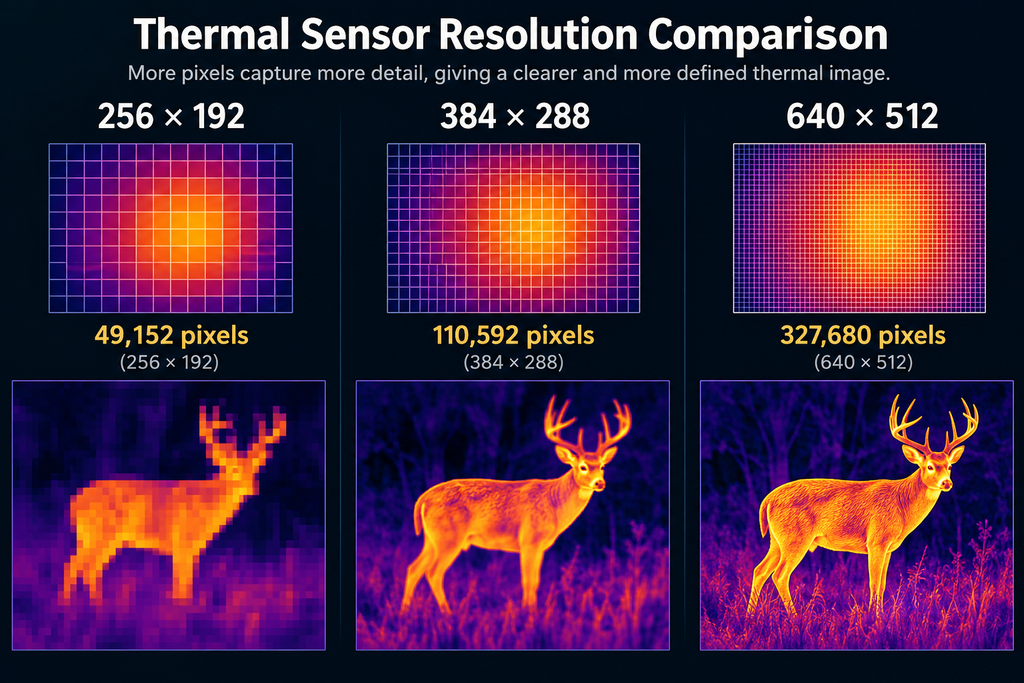
Thermal monocular resolution tells you how many detector pixels are available to capture the thermal scene. Common formats include 256×192, 384×288 and 640×512—but choosing between them takes more than comparing the largest number.
For general scanning, a well-matched 256×192 monocular may be sufficient. Higher-resolution detectors can provide more detail at a comparable field of view, making them worth considering when you need to interpret smaller targets or use digital zoom.
The important qualification is field of view. More detector pixels can provide finer detail, a wider view, or a combination of both, depending on the lens and sensor design.
This guide explains the differences, what resolution cannot tell you, and how to choose a suitable thermal monocular without paying for specifications you do not need.
Thermal Resolution at a Glance
| Detector resolution | Total detector pixels | Pixel count relative to 256×192 | Main consideration |
|---|---|---|---|
| 256×192 | 49,152 | 1× | Can suit affordable scanning and detection when targets occupy enough pixels |
| 384×288 | 110,592 | 2.25× | Offers additional capacity for target detail or scene coverage |
| 640×512 | 327,680 | About 6.67× | Offers substantially more pixels, with benefits determined by the optics and viewing conditions |
A 640×512 detector contains approximately 2.96 times as many pixels as a 384×288 detector.
These are total pixel-count comparisons. They do not mean a device is 6.67 times sharper, sees 6.67 times farther, or identifies an animal at a proportionally greater distance.
What Does Thermal Monocular Resolution Mean?
A thermal detector consists of an array of elements that respond to infrared radiation reaching them. The resolution describes the number of elements across the array and down it.
For example, a 384×288 detector has 384 pixels horizontally and 288 vertically:
384 × 288 = 110,592 detector pixels.
The device processes the detector signals into an image that you view through its display and eyepiece. This does not mean every thermal monocular provides calibrated temperature measurements.
If you want a broader explanation of the technology, our guide to how thermal monoculars work covers the detector, optics, image processing and practical limitations.
Sensor Resolution Is Different From Display Resolution
A monocular can have a 256×192 thermal detector and an 800×600 display. These specifications describe different components.
The detector captures the thermal information. The display presents the processed image, menus and other on-screen information.
A higher-resolution display can improve how the image is presented, but it does not turn a 256×192 detector into an 800×600 thermal sensor.
When comparing products, look specifically for native detector resolution. Do not substitute display resolution, recording resolution or an enhanced output-image size for that figure.
Why Field of View Changes the Comparison
A higher-resolution detector does not automatically capture more detail on the same distant animal.
There are two useful ways to compare systems.
Same Field of View: More Pixels Across the Target
When two devices show the same horizontal field of view, the detector with more horizontal pixels can place more samples across a target.
For example, 384 pixels across the same view provide 1.5 times as many horizontal samples as 256 pixels. That can help preserve smaller features, provided the optics, focus, sensitivity and processing support the additional detail.
Notice the distinction: 384×288 has 2.25 times the total pixels of 256×192, but only 1.5 times as many pixels in each direction.
Same Pixel Pitch and Lens Focal Length: A Wider Scene
If pixel pitch and lens focal length remain the same, adding detector pixels increases the size of the area being captured. The larger array mainly provides a wider field of view.
The same distant target does not automatically cover more detector pixels simply because the array is larger.
Teledyne FLIR explains this resolution trade-off: additional pixels can increase target detail at the same field of view or increase scene coverage while maintaining target detail.
For a buying decision, compare resolution alongside field of view, lens focal length and pixel pitch.
When Is 256×192 Thermal Resolution Enough?
A 256×192 detector can be useful when your main task is locating a thermal target rather than examining fine features.
Possible applications include:
- Scanning a field or tree line for animals.
- Checking a property for visible heat signatures.
- Finding wildlife before observing it with another suitable optic.
- Learning how thermal imaging behaves in different conditions.
Performance depends on how many pixels the target occupies and how clearly it stands out from the background. A nearby animal can occupy plenty of pixels even on a lower-resolution detector.
The limitations become more apparent when targets are small in the image or when you enlarge a small portion of the scene. You may detect an object without having enough information to identify it confidently.
A 256×192 device is therefore worth considering when cost and general scanning are priorities. Our best budget thermal monoculars guide compares options alongside their field of view, sensitivity, battery systems and other features.
What Does 384×288 Add?
A 384×288 detector contains 110,592 pixels—125% more total pixels than 256×192.
At a comparable field of view, that additional sampling can make shapes and boundaries easier to interpret. It also provides more image data to work with when cropping for digital zoom.
This resolution class is worth considering if you frequently find yourself wanting more information than basic detection provides.
However, a 384×288 specification alone does not establish that a device will outperform a particular 256×192 monocular. A wider lens may spread the additional pixels over more terrain, while differences in sensitivity, optical quality or processing can also affect the result.
Think of 384×288 as additional imaging capacity. Check how the manufacturer uses that capacity before deciding whether the upgrade suits your needs.
When Is 640×512 Worth Considering?
A 640×512 detector provides 327,680 pixels, substantially more than either of the smaller formats.
At a comparable field of view, the additional pixels can help preserve finer target features. Alternatively, a manufacturer can use the larger array to offer a wider scanning view while retaining useful target detail.
Reasons to consider a 640×512 system include:
- You need more detail on targets that occupy a small part of the scene.
- You want wider scene coverage without giving up as much target sampling.
- You frequently use digital zoom.
- You can justify the price of the complete device for your intended use.
It is still possible to choose an unsuitable 640×512 monocular. A narrow field of view may be inconvenient for close woodland scanning, while an extremely wide view may not put enough pixels on a small, distant target.
Choose the optical configuration along with the sensor format.
256×192 vs 384×288: Should You Upgrade?
Consider the task your current or proposed device needs to perform.
If you mainly want to locate animals and scan familiar terrain, a suitable 256×192 system may meet your needs.
If you regularly detect something but cannot interpret its shape well enough, a 384×288 system with an appropriate field of view may offer a useful improvement.
Before upgrading, compare:
| Question | Why it matters |
|---|---|
| Is the field of view similar? | A wider view can use extra pixels for scene coverage instead of finer target detail |
| What are the lens focal length and pixel pitch? | Together, they influence how much of the scene each pixel covers |
| Are sensitivity specifications comparable? | Thermal contrast can matter as much as spatial sampling |
| Is the target properly focused? | More pixels cannot compensate for poor focus |
| What does credible sample footage show? | Comparable footage can reveal differences that specifications alone cannot establish |
For footage comparisons, look for the same target distance, similar weather and clearly stated zoom settings. Separate recordings taken under different conditions are not a controlled comparison.
384×288 vs 640×512: What Are You Paying For?
The move to 640×512 provides nearly three times the total detector pixels of 384×288.
That gives the system more flexibility to capture detail, cover a wider scene, or balance the two. Whether the difference justifies the cost depends on the complete devices being compared.
A useful question is: what will the more expensive model let you do that the other one cannot?
If both devices provide sufficient information at your normal viewing distances, battery design, weight, controls and field of view may matter more than another increase in resolution.
If you need finer detail at a similar field of view, additional native detector pixels become a stronger reason to upgrade.
How Digital Zoom Affects Thermal Resolution
Conventional digital zoom crops part of the captured image and enlarges it for viewing. It does not change the lens focal length or create additional native detector samples.
The following calculation illustrates what a simple central crop retains:
| Native detector | Source area retained at 2× digital zoom | Source area retained at 4× digital zoom |
|---|---|---|
| 256×192 | 128×96 = 12,288 pixels | 64×48 = 3,072 pixels |
| 384×288 | 192×144 = 27,648 pixels | 96×72 = 6,912 pixels |
| 640×512 | 320×256 = 81,920 pixels | 160×128 = 20,480 pixels |
This is a mathematical illustration of simple cropping, not a measured comparison of monoculars. It assumes the digital zoom factor applies equally to image width and height.
The displayed or recorded image may still have a much larger pixel count because the device scales the crop up. Interpolation can smooth its appearance, but the enlarged output is not equivalent to capturing that scene with a higher-resolution detector.
Also, equal digital zoom settings do not guarantee equal views across devices. Their starting fields of view may be different.
Higher Resolution Does Not Guarantee Longer Detection Range
Detection, recognition and identification require different levels of information.
| Task | What you are trying to establish |
|---|---|
| Detection | A target is present |
| Recognition | The general type of target |
| Identification | Enough specific detail to distinguish the target for the task |
A device may detect a distant object while showing too little detail to identify it.
Useful range depends on target size, field of view, pixel pitch, optics, thermal contrast, weather, focus, processing and the criteria used to define success.
A lower-resolution device with narrower viewing geometry can place more pixels on a particular distant target than a higher-resolution device designed for broad scanning. Manufacturer detection distances therefore cannot be interpreted from resolution alone.
For hunting applications, our explanation of why hunters use thermal monoculars discusses the practical benefits and limitations of thermal observation.
Resolution, NETD and Pixel Pitch: What Is the Difference?
These specifications describe different aspects of the imaging system.
Resolution: How Many Detector Pixels Are Available
Resolution describes the dimensions of the detector array. Its effect on target detail depends on the view those pixels cover.
NETD: Sensitivity to Small Thermal Differences
NETD stands for Noise Equivalent Temperature Difference. It is commonly expressed in millikelvin, or mK.
Lower NETD generally indicates greater sensitivity under comparable measurement conditions. This can help when a target and its surroundings produce relatively little thermal contrast.
However, compare the test conditions as well as the number. Test temperature, lens aperture and measurement method can affect published figures.
FLIR’s thermal sensitivity explanation discusses why resolution alone does not determine thermal image quality.
Pixel Pitch: Spacing Between Detector Elements
Pixel pitch is the centre-to-centre spacing between adjacent detector elements, usually given in micrometres, such as 12 μm or 17 μm.
Together with lens focal length, it influences the angular area covered by each pixel. Alongside the number of detector pixels, it also helps determine the overall field of view.
Smaller pixel pitch is not a standalone guarantee of a better monocular. The optics, sensitivity and processing must support the design.
Which Thermal Monocular Resolution Should You Choose?
Start with your normal viewing task, then compare complete devices.
| Your priority | What to consider |
|---|---|
| Affordable scanning and locating heat sources | A suitable 256×192 device may be sufficient |
| More target detail at a comparable field of view | Compare 384×288 and higher-resolution systems |
| Wider coverage while maintaining useful target sampling | Examine higher-resolution models with an appropriate lens |
| Frequent digital zoom | More native pixels can provide additional cropping flexibility |
| Observing small or distant targets | Prioritize pixels on target, optics and contrast—not resolution alone |
| Close woodland scanning | Pay particular attention to field of view and handling |
There is no universal distance at which 256×192 stops being useful or 640×512 becomes necessary. The target, environment and optical configuration determine that.
Frequently Asked Questions
Is 256×192 thermal resolution good?
It can be useful for scanning and detection when the target occupies enough pixels and has sufficient thermal contrast. It provides less flexibility for fine detail and heavy cropping than higher-resolution formats at a comparable field of view.
Is 384×288 twice as good as 256×192?
It has 2.25 times the total detector pixels, but that is not an overall image-quality score. At the same horizontal field of view, it provides 1.5 times as many horizontal samples. Optics, sensitivity and viewing conditions influence the practical improvement.
Is 640×512 worth the extra money?
It can be when the complete system provides additional detail or coverage that you need. If a less expensive device already meets your observation requirements, the extra resolution may offer less practical value.
Can a high-resolution display compensate for a low-resolution thermal sensor?
It can improve presentation, but it cannot replace missing native detector information. Compare sensor and display specifications separately.
Does digital zoom help identify animals?
Enlargement can make existing information easier to inspect, but it cannot guarantee identification. If the captured image lacks the necessary detail, making it larger does not solve that limitation.
Final Verdict
A 256×192 thermal monocular can be a practical starting point for scanning and detection. A 384×288 or 640×512 system provides more detector pixels that can support finer detail, wider coverage or both.
The deciding factor is how those pixels are used. Compare field of view, lens focal length, pixel pitch and sensitivity alongside resolution, and keep detection separate from identification.
If affordability is your priority, start with our budget thermal monocular comparison, then use these principles to decide whether a higher-resolution alternative would meaningfully improve your intended use.

Elliot Vantage is an optics enthusiast and the editor behind Optic Horizon, covering monoculars, binoculars, thermal optics, and related outdoor gear. He researches manufacturer documentation, optical specifications, product features, pricing, and use-case differences to help readers understand their options and choose equipment that fits their needs.