
Thermal monoculars do not need visible light to create an image. Instead, they detect infrared radiation coming from a scene and convert differences in that detected energy into an electronic image. This is why a thermal monocular can reveal people, animals, vehicles, and other objects even in complete darkness.
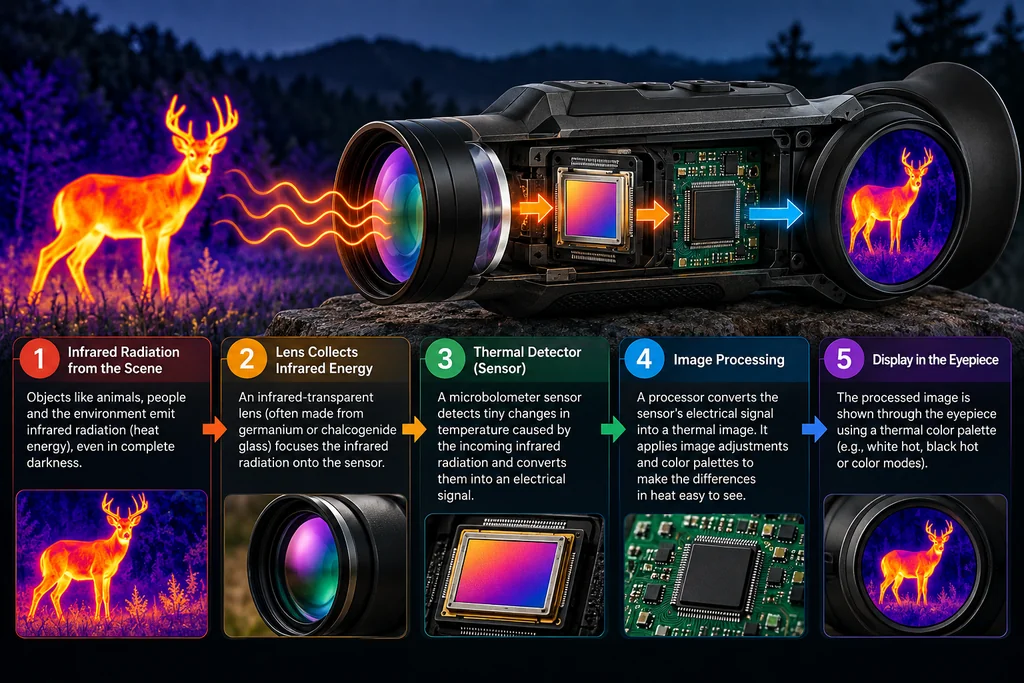
A typical handheld thermal monocular combines an infrared-transparent lens, a thermal detector, processing electronics, a display, and an eyepiece. The lens focuses infrared energy onto the detector, the electronics process the signal, and the display presents the result using grayscale or color palettes.
But thermal performance depends on much more than one specification. Sensor resolution, thermal sensitivity, pixel pitch, lens focal length, field of view, refresh rate, atmospheric conditions, target size, and thermal contrast can all affect what you can actually detect and distinguish.
In this guide, we’ll explain how thermal monoculars work, what their major specifications mean, how they differ from digital night vision, and where thermal imaging reaches its limits.
Table of Contents
What Is a Thermal Monocular?
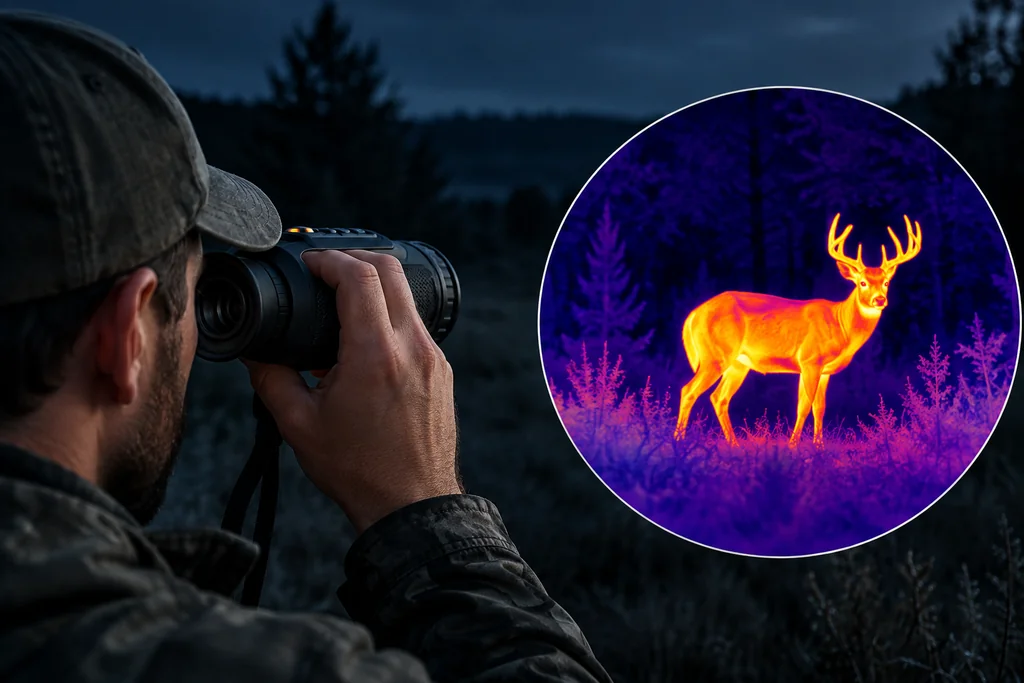
A thermal monocular is a handheld, one-eye viewing device that uses a thermal imaging sensor rather than a conventional visible-light optical system as its primary imaging technology.
Traditional optical monoculars magnify visible light through lenses and prisms. Digital night-vision devices electronically create an image and may use near-infrared illumination. Thermal monoculars work differently: they detect thermal infrared radiation and electronically turn that information into an image.
If you want to see how conventional optical monoculars developed alongside newer electronic designs, read our history of monocular technology.
Thermal imaging is useful because objects can emit infrared radiation even when there is no visible light available. NASA’s overview of infrared waves explains that humans and animals emit infrared wavelengths that our eyes cannot see but infrared-sensitive instruments can detect.
What Does a Thermal Monocular Actually Detect?
A thermal monocular does not simply “see temperature” in the same way a thermometer measures it.
Its detector responds to infrared radiation reaching the sensor. The amount of radiation received can be influenced by the temperature of a surface, but also by properties such as emissivity, reflected infrared energy, atmospheric transmission, and the characteristics of the camera itself.
For an observation monocular, the important result is usually thermal contrast: differences in detected infrared energy that allow one object to stand out from its surroundings.
For example, an animal may appear brighter or darker than the surrounding vegetation depending on the palette and conditions. The display is a processed representation of infrared differences, not a normal visible-light photograph.
Some specialized radiometric thermal cameras are designed to estimate surface temperatures, but not every thermal monocular is a calibrated temperature-measurement instrument. If temperature measurement matters, check the manufacturer’s specifications rather than assuming every thermal device provides accurate temperature readings.
How Does a Thermal Monocular Work? Step by Step
1. The Lens Collects Infrared Radiation
The process starts with the thermal lens. Unlike an ordinary camera lens designed mainly for visible light, a thermal imaging lens must transmit the infrared wavelengths used by the detector.
The lens focuses infrared energy from the scene onto the sensor. Its focal length and optical design help determine the monocular’s field of view and how much detail a target occupies on the detector.
2. The Thermal Detector Responds to the Incoming Energy
The focused infrared energy reaches a detector made up of many individual sensing elements, or pixels.
Uncooled microbolometer arrays are widely used in handheld long-wave thermal imagers, although thermal detector technology is not limited to one design. Each detector element responds to incoming infrared energy, creating an electrical signal that can be processed by the device.
Teledyne FLIR’s thermal imaging overview describes the core system as a lens, thermal sensor, processing electronics, and mechanical housing.
3. Electronics Process the Detector Data
The raw detector signal is not yet the finished image seen through the eyepiece. Processing electronics correct and interpret the sensor output, manage image uniformity, and convert the data into a usable image.
Image-processing methods vary by manufacturer and model. Many devices also apply contrast enhancement, sharpening, noise reduction, or scene-based adjustments to make thermal differences easier to interpret.
4. The Device Maps the Data Into an Image
The processed signal is mapped to shades or colors. Common display palettes include white hot, black hot, and various false-color modes.
The palette does not change what the detector physically receives. It changes how the processed thermal information is presented to the user.
5. The Image Appears on an Electronic Display
Finally, the thermal image is shown on a small internal display viewed through the eyepiece. Unlike a conventional optical monocular, you are not looking directly through the device at the target. You are looking at an electronically generated image.
Main Parts of a Thermal Monocular
| Component | What It Does |
|---|---|
| Thermal lens | Focuses infrared radiation onto the detector |
| Thermal detector | Responds to incoming infrared energy across an array of pixels |
| Processing electronics | Convert and process detector signals into image data |
| Display | Shows the processed thermal image |
| Eyepiece | Lets the user comfortably view the display with one eye |
| Battery and controls | Power the electronics and control palettes, zoom, recording, brightness, and other functions |
Thermal Sensor Resolution
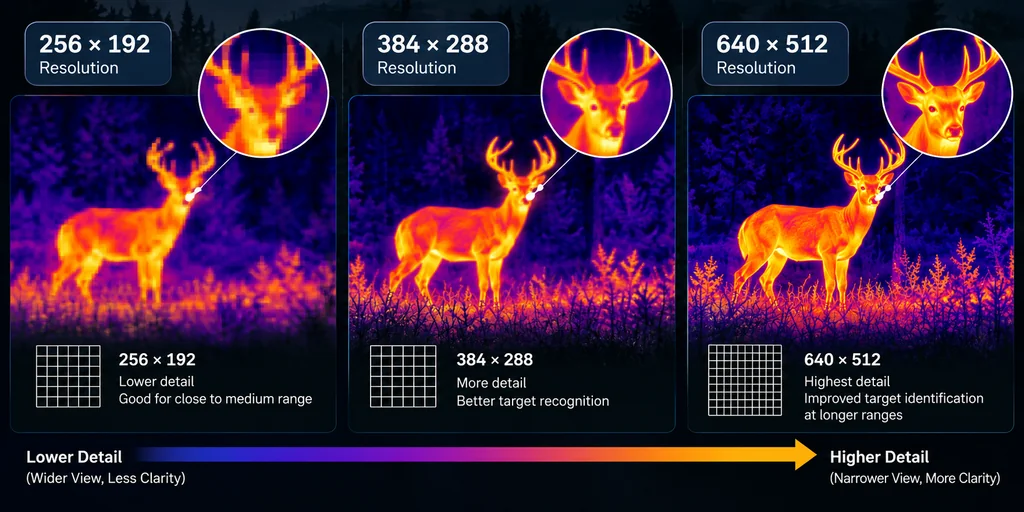
Thermal resolution tells you how many detector pixels make up the thermal image. Examples might include 256×192, 320×240, 384×288, or 640×512, depending on the product.
All else being equal, a higher-resolution detector can provide more spatial detail because more sensing elements cover the scene. That can make it easier to distinguish target shape and features, particularly when the target occupies only part of the image.
Resolution should not be judged in isolation, however. Lens choice, field of view, sensor sensitivity, processing, focus, display quality, atmospheric conditions, and target size can all influence what the user can actually resolve.
FLIR’s explanation of how thermal cameras work notes that detector resolution is the pixel configuration of the thermal sensor and that thermal detectors typically have fewer pixels than visible-light image sensors of a similar physical size.
What Does NETD Mean?
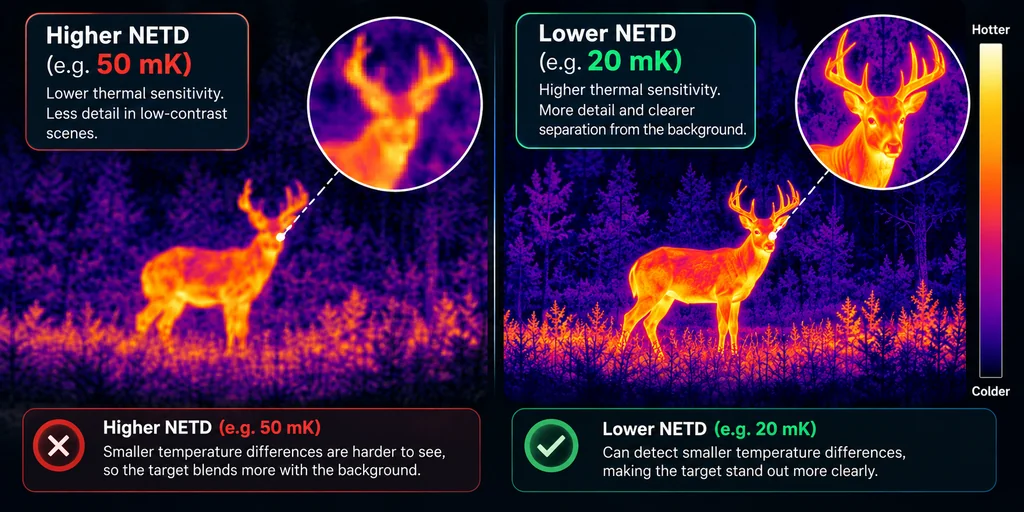
NETD stands for Noise Equivalent Temperature Difference. It is commonly expressed in millikelvin, or mK, and is a measure of thermal sensitivity.
In simplified terms, NETD describes how small a thermal difference the imaging system can distinguish from its own noise. A lower NETD value generally indicates better thermal sensitivity under the specified test conditions.
This matters when a target and its background have only a small thermal difference. A more sensitive system may preserve subtle detail that is harder to distinguish in a noisier image.
However, NETD values should be compared carefully because performance is affected by factors including lens f-number, measurement conditions, detector behavior, and image processing.
What Is Pixel Pitch?
Pixel pitch is the center-to-center spacing between detector pixels, usually stated in micrometers, such as 12 µm or 17 µm.
It is tempting to assume that a smaller pixel pitch is automatically better, but pixel pitch cannot be evaluated by itself. Detector size, resolution, lens focal length, aperture, sensitivity, optical quality, and the number of pixels covering the target all interact.
The practical question is not simply “Which device has the smallest pixels?” It is whether the complete optical and detector system provides enough detail, sensitivity, and field of view for the intended use.
Lens Focal Length and Field of View
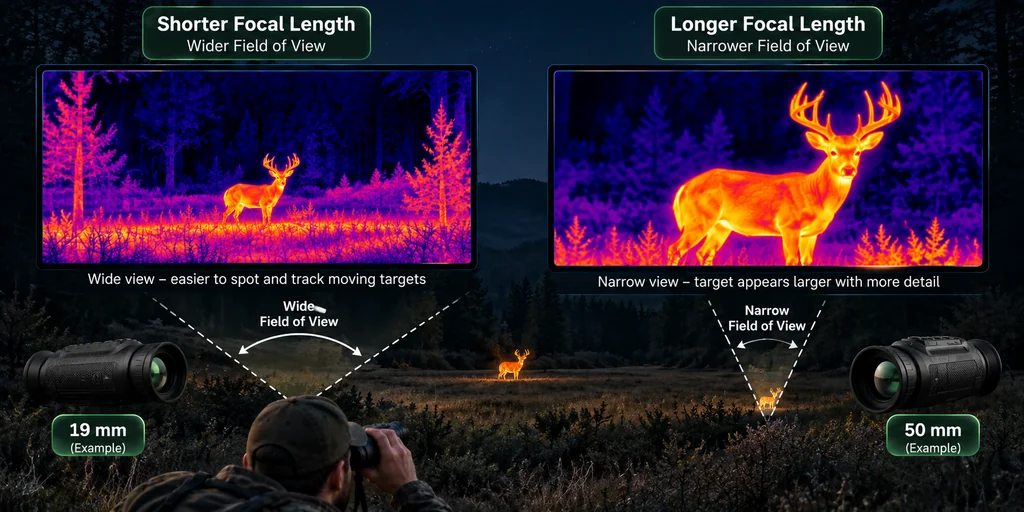
Lens focal length has a major effect on how a thermal monocular sees the scene.
A shorter focal length generally provides a wider field of view, which can make scanning large areas easier. A longer focal length generally narrows the field of view and makes a distant target occupy more of the image.
This is why two thermal monoculars using similar detectors can feel very different in real use. One may be better for close-range scanning and navigation, while another may be optimized for observing smaller targets at greater distances.
Do not judge a thermal monocular by lens diameter or focal length alone. The sensor format and pixel pitch also influence field of view and target sampling.
Refresh Rate: What Does 50 Hz or 60 Hz Mean?
Refresh rate, or frame rate, describes how frequently the thermal imaging system produces a new image.
A 9 Hz device produces nine thermal frames per second, while a 60 Hz device produces 60. FLIR explains this distinction in its frame-rate explanation.
Higher frame rates generally make motion appear smoother, which can be useful when panning quickly or following a moving subject. Frame rate does not by itself determine image sharpness, detection range, or thermal sensitivity.
Digital Zoom Does Not Add Sensor Detail
Many thermal monoculars offer 2×, 4×, or higher digital zoom.
Digital zoom enlarges a portion of the existing thermal image. It can make a target easier to view on the display, but it does not create new detector pixels or recover detail that the sensor never captured.
For long-distance observation, native sensor resolution and the optical system are therefore more important than a large digital-zoom number by itself.
Detection vs Recognition vs Identification
Thermal manufacturers often publish detection ranges, but a detection number does not mean you will clearly identify a target at that distance.
These are different tasks:
- Detection: determining that an object or target is present.
- Recognition: classifying the general type of target.
- Identification: resolving enough information to distinguish the specific target or relevant details.
Detection generally requires less image detail than recognition, while identification requires more detail again. Teledyne FLIR explains that detection, recognition, and identification are separate imaging tasks and that modeled range depends on target and system conditions.
This is why a statement such as “1,000-yard detection range” should never be interpreted as “you can identify any animal at 1,000 yards.”
What Determines Thermal Detection Range?
There is no single universal distance at which a thermal monocular will work.
Real-world range depends on a combination of factors, including:
- target size
- target-to-background thermal contrast
- sensor resolution
- thermal sensitivity
- lens focal length and field of view
- focus and image processing
- humidity and atmospheric transmission
- fog, rain, snow, and other precipitation
- background clutter
- the level of detail required: detection, recognition, or identification
Manufacturer range figures are therefore best treated as estimates under stated assumptions rather than guarantees for every environment. Teledyne FLIR notes that DRI range can vary with humidity, temperature, solar loading, precipitation, background clutter, camera sensitivity, setup, and operator factors.
Can Thermal Monoculars See in Complete Darkness?
Yes. A thermal monocular does not require visible illumination in order to detect thermal infrared radiation from a scene.
That means darkness by itself does not prevent the sensor from creating a thermal image. Unlike active digital night vision, a thermal monocular also does not need an infrared illuminator simply to work in darkness.
This does not mean conditions are always identical between day and night. Thermal contrast between targets and backgrounds can change with weather, sunlight, season, surface materials, and time of day.
How Do Fog, Rain, Humidity, and Snow Affect Thermal Imaging?
Thermal imaging often performs better than visible-light observation in some low-visibility conditions, but claims that thermal devices work perfectly “through any fog” or “rain or shine” are misleading.
Water droplets and atmospheric moisture can reduce the transmission of infrared radiation. Dense fog and rain can therefore shorten effective range and reduce contrast.
FLIR’s guide to thermal imaging in fog and rain explains that humidity, fog, and precipitation can attenuate infrared signals and reduce the distance at which a thermal system can operate effectively.
So the practical answer is: thermal imaging can remain useful in difficult weather, but its range and image quality are not immune to atmospheric conditions.
Can Thermal Monoculars See Through Smoke?
Thermal imaging can often reveal warm objects through smoke more effectively than ordinary visible-light cameras because some thermal infrared wavelengths can pass through smoke that blocks visible light.
This capability is one reason thermal imagers are used in firefighting and search applications.
However, performance still depends on the type and density of smoke, the target, the sensor, and other environmental conditions. It should not be interpreted as the ability to see perfectly through every obscurant.
Can Thermal Monoculars See Through Walls?
No. Thermal monoculars do not provide movie-style vision through solid walls.
The device normally detects infrared radiation from the surface facing the camera. A warm or cold object behind a wall may sometimes affect the wall’s surface temperature enough to create a visible thermal pattern, but the camera is not directly seeing the hidden object.
FLIR addresses this directly in its explanation of what thermal cameras can and cannot see through.
Can a Thermal Monocular See Through Glass?
Ordinary glass is another common misconception.
Long-wave thermal imagers generally do not see through normal window glass the way a visible-light camera does. Instead, the glass can reflect thermal infrared radiation and show the thermal characteristics of the glass surface and reflected surroundings.
That is why pointing a thermal monocular through a closed window is usually not a reliable way to observe outdoor targets.
Thermal Monocular vs Digital Night Vision
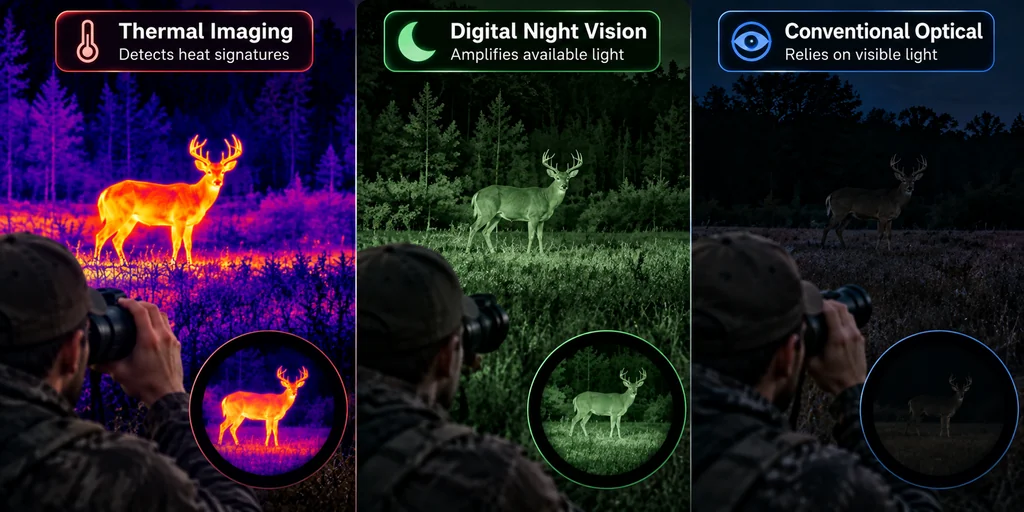
Thermal imaging and digital night vision are both electronic technologies, but they create images differently.
| Feature | Thermal Monocular | Digital Night Vision |
|---|---|---|
| Primary input | Thermal infrared radiation | Visible and/or near-infrared light |
| Works in complete darkness | Yes, without visible illumination | Often yes when paired with an IR illuminator |
| Image appearance | Thermal contrast displayed in grayscale or color palettes | Camera-like electronic image |
| Main strength | Finding thermal contrast and detecting warm targets | Showing scene details using reflected light or active IR illumination |
| Can see through normal glass | Generally no | Often yes, depending on lighting and IR behavior |
Neither technology is universally better. Thermal imaging is often stronger for detecting a warm target against its surroundings, while digital night vision can provide more familiar visual detail when enough visible or near-infrared illumination reaches the sensor.
Thermal Monocular vs Conventional Optical Monocular
A conventional optical monocular works with visible light and provides a direct optical view without a thermal detector or electronic image-processing system.
That makes conventional monoculars simpler, lighter in many cases, and usable without batteries. They are well suited to daytime wildlife observation, hiking, sporting events, travel, and birding.
Thermal monoculars serve a different purpose: they help reveal thermal contrast, particularly when visible light is absent or when a warm target is difficult to distinguish visually.
If your priority is ordinary daytime magnification rather than thermal detection, see our guide to the best monoculars under $100.
What Specifications Matter Most When Comparing Thermal Monoculars?
When comparing models, focus on the complete imaging system rather than one headline number.
- Thermal resolution: influences how much spatial detail the sensor can capture.
- NETD: indicates thermal sensitivity; lower values generally indicate better ability to distinguish small thermal differences under specified conditions.
- Pixel pitch: one part of the detector and optical design, but not a standalone measure of image quality.
- Focal length: strongly influences field of view and how large distant targets appear in the image.
- Field of view: determines how much of the scene is visible at once.
- Refresh rate: affects how smoothly motion is displayed.
- Native magnification: affects target scale before digital zoom is applied.
- Digital zoom: enlarges the existing image but does not add native sensor detail.
- Focus system: influences whether targets at different distances can be rendered sharply.
- Battery life: matters for extended field use.
- Weather resistance: matters for outdoor observation, but it should not be confused with the sensor’s ability to see through heavy rain or fog.
Common Uses for Thermal Monoculars
Thermal monoculars are used anywhere detecting thermal contrast can be more useful than relying only on visible light.
Common applications include wildlife observation, property inspection, search and rescue, security, locating animals in darkness, and certain hunting-related activities where their use is legal.
Local laws and regulations can restrict how thermal devices are used for hunting or wildlife activities, so users should check the rules that apply to their location and activity before relying on a thermal monocular in the field.
Frequently Asked Questions
Do thermal monoculars work during the day?
Yes. Thermal imaging does not depend on darkness. A thermal monocular can operate during daylight because it detects thermal infrared radiation rather than relying on visible light.
However, direct sunlight can heat surfaces and change thermal contrast, so the image may look very different at midday than it does before sunrise or after sunset.
Do thermal monoculars need an IR illuminator?
No. Thermal monoculars detect naturally occurring thermal infrared radiation from the scene and do not require a near-infrared illuminator to function in darkness.
This is different from many digital night-vision devices, which can use an active IR illuminator when there is not enough ambient light.
Can thermal monoculars identify animals at the full advertised detection range?
Not necessarily. Detection means noticing that a target is present. Recognition and identification require progressively more image detail.
Actual performance depends on the target, lens, sensor, thermal contrast, atmosphere, focus, processing, and viewing conditions. Treat detection range and identification range as different specifications.
Is higher thermal resolution always better?
Higher detector resolution can provide more spatial detail, but image quality and useful range also depend on the lens, field of view, thermal sensitivity, focus, processing, atmosphere, and target conditions.
A higher-resolution sensor paired with unsuitable optics is not automatically the best choice for every use.
Is a lower NETD number better?
Generally, yes. A lower NETD indicates greater thermal sensitivity under the specified measurement conditions. It can help preserve subtle thermal differences when the target and background are close in temperature.
NETD should still be considered alongside optics, resolution, image processing, and the conditions under which the specification was measured.
Can thermal monoculars see through trees or bushes?
Not directly through solid vegetation. Leaves, branches, and trunks can block thermal radiation from a target.
A thermal monocular may reveal parts of a person or animal through gaps in vegetation, or show thermal contrast where the target is only partially obscured, but it should not be treated as a device that sees through dense foliage.
Can a thermal monocular measure body temperature?
Do not assume so. Observation monoculars are designed primarily for imaging and target detection. Accurate temperature measurement requires a device designed and calibrated for radiometric measurement, along with appropriate measurement conditions.
Final Thoughts
So, how do thermal monoculars work?
They collect thermal infrared radiation with a specialized lens, focus that energy onto a detector, convert the detector response into electronic data, process that data, and display the resulting thermal image through an eyepiece.
The basic principle is straightforward, but real-world performance depends on the entire imaging system. Thermal resolution, NETD, pixel pitch, focal length, field of view, refresh rate, target size, atmosphere, and thermal contrast all play a role.
The most important distinction is that a thermal monocular is not simply a night-vision monocular with a different display. It uses fundamentally different sensing technology. It does not require visible light, it does not normally see through walls or window glass, and its effective range can change substantially with weather and target conditions.
Understanding those limits makes thermal specifications much easier to interpret—and helps separate useful performance information from exaggerated marketing claims.

Elliot Vantage is an optics enthusiast and the editor behind Optic Horizon, covering monoculars, binoculars, thermal optics, and related outdoor gear. He researches manufacturer documentation, optical specifications, product features, pricing, and use-case differences to help readers understand their options and choose equipment that fits their needs.