
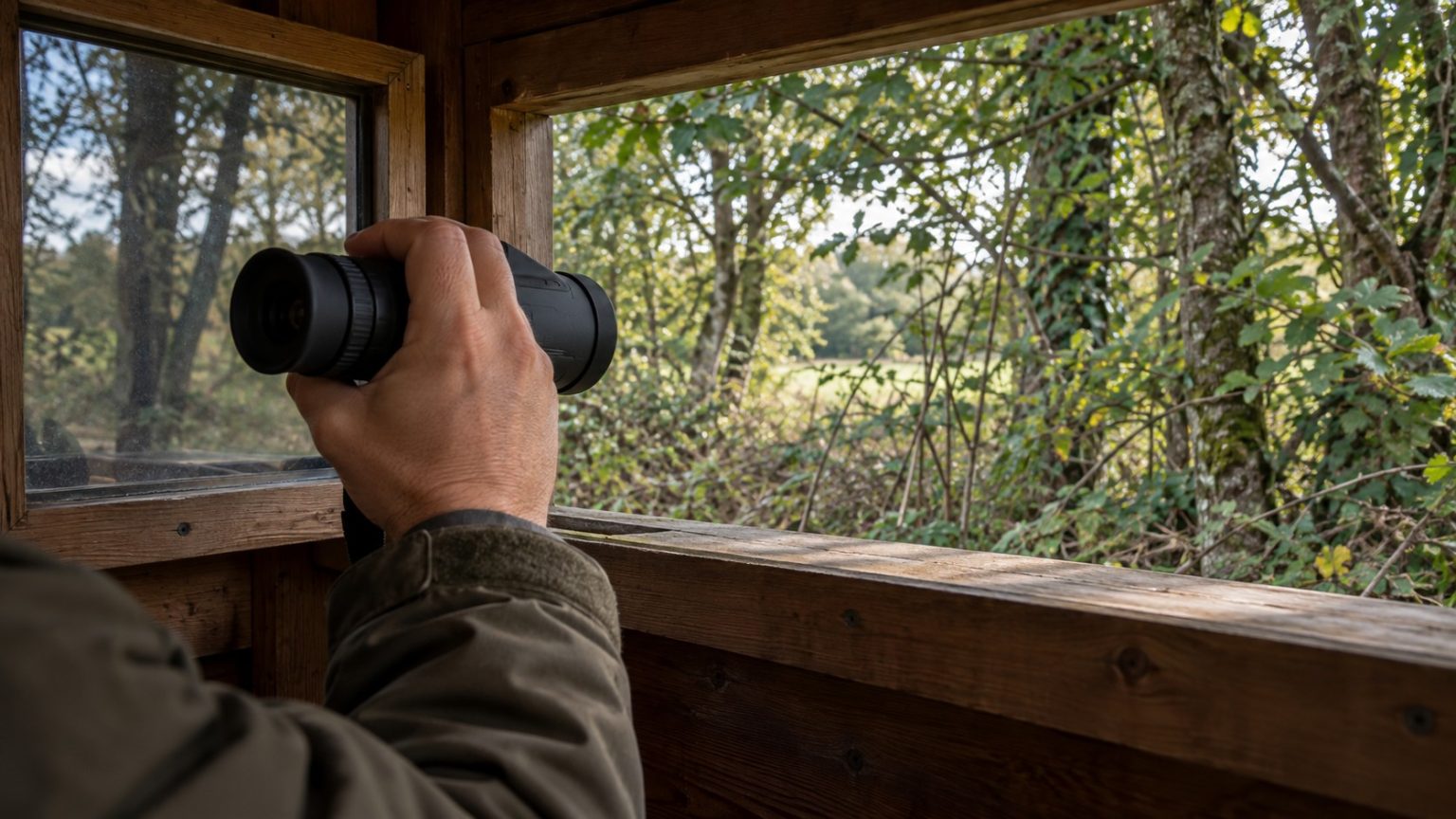
What can a thermal monocular see through? For the common long-wave infrared wildlife viewer, the useful answer is gaps in cover, rather than solid barriers such as ordinary window glass, walls or tree trunks. It records infrared energy reaching its detector. It does not produce an X-ray view of whatever happens to be behind an obstruction.
An animal partly visible between leaves may stand out strongly on the screen. That can create the impression that the device has looked through the entire bush. The distinction matters: a small exposed patch is evidence of a visible surface, not a complete image of the animal behind it.
Start with the surface in the line of sight
Imagine a line running from the objective to the part of the scene you are inspecting. Ask what surface that line reaches first. If it ends at a solid trunk, your viewer is receiving information about that trunk, not an unobstructed view of an animal behind it.
The thermal image can include energy emitted by a surface and energy reflected from elsewhere. Apparent brightness therefore needs interpretation; it is not automatically a direct temperature reading or proof of an animal.
Our explanation of how thermal monoculars work covers the underlying imaging process. For barrier questions, the essential habit is to identify what is actually exposed to the instrument.
A practical barrier guide
This table concerns ordinary handheld wildlife thermal imagers. Other infrared instruments can operate in different spectral bands, so “infrared” does not make every camera equivalent.
| Barrier or situation | What to expect from a typical wildlife thermal viewer |
|---|---|
| Ordinary closed window | The glass surface and reflections can dominate, rather than a normal thermal view through it |
| Solid wall | Surface patterns, not a direct view of an animal inside or behind it |
| Tree trunk or solid wooden panel | An obstruction to the animal behind it |
| Dense vegetation | Leaves and branches can obscure the subject |
| Open gaps between leaves | Exposed parts beyond the gaps may be visible |
| Polished metal surface | Reflections can be misleading; do not assume the apparent feature is behind the metal |
FLIR’s explanation of thermal imaging through common materials describes these distinctions. The practical result is that a promising thermal spot needs a clear line of sight and enough context before you can interpret it reliably.
Why ordinary glass causes confusion
You may be able to see a bird through a window with your eyes and a conventional monocular, yet fail to get the same view with thermal. There is no contradiction: visible light and the long-wave infrared used by typical wildlife viewers interact differently with the material.
The objective itself uses infrared-transmitting materials selected for its imaging band. FLIR’s article on infrared lens materials explains why materials such as germanium appear in these lenses. An ordinary window is not an equivalent infrared viewing port.
If a thermal image through a closed window looks strange, do not start by raising gain or digital zoom. From a safe stationary position, compare an unobstructed view if one is available. Avoid interpreting your reflection or a pattern on the glass as a distant animal.
Specialist infrared windows exist, but their existence does not change the limitations of an ordinary house or vehicle window. Check the exact material and imaging band if you are dealing with a purpose-built installation.
Brush: visible patches can be useful without revealing the whole animal
Consider a hypothetical bird perched behind a leafy branch. You see a small bright oval through one gap, but the head, tail and feet are hidden. Move to a different safe viewpoint and the oval disappears because a leaf now blocks the gap.
That change is a useful clue about visibility. It does not establish that the bird has moved, nor does the original spot show enough detail to name the species.
Or imagine a larger animal behind a fence and brush. One opening reveals a shoulder-sized patch, another a piece of the lower body. Connecting those fragments into a complete outline is an interpretation you are making. Some of the imagined connections may be wrong.
When the view is fragmented:
- Keep surrounding branches and fixed landmarks in the frame.
- Watch whether the exposed patches move together.
- Wait for a clearer view rather than filling in missing anatomy.
- Record the observation as partial when confirming features remain hidden.
Our guide to interpreting animals in thermal images explains why a suggestive shape can fall short of reliable identification. A barrier does not become irrelevant just because the exposed patch has strong contrast.
A wall pattern is not a picture of what is behind it
Heat transfer can sometimes affect a wall’s outer surface. As FLIR explains in its pest-detection guidance, that surface pattern is different from a direct image of an animal behind the wall. Construction and the relationship between the source and surface affect what appears.
For wildlife observation, do not turn a vague patch on a building into a claim that a specific animal is inside. The same image might not answer whether anything living is present at all. Looking for a warm surface pattern and seeing an animal directly are different kinds of observation.
If you are investigating an animal in a structure, thermal can be one clue among others. Do not use it alone to justify opening a wall or disturbing a possible nest or roost. This wildlife viewing guide is not a building-inspection method.
Weather is another kind of limitation
Fog and rain are not solid panels, but they can reduce the information arriving from a distant scene. The relationship varies with conditions and distance. “It can detect through light mist” should not turn into “it can see through anything that blocks visible light.”
The separate guide to thermal monoculars in fog, rain and humidity explains that atmospheric problem. Keep it separate from a leaf directly covering the subject or a drop sitting on the objective.
Digital zoom, a different palette and calibration each have legitimate uses. None removes a solid obstruction. If the image shows only one exposed patch, enlarging that patch still leaves the concealed parts unknown.
Make a partial detection useful
You can still gain something from a limited view. Note the location relative to a recognizable trunk or branch, keep a suitable distance, and wait. If another appropriate viewing position is available, lower the optic and move carefully before checking again.
For birding, use the location to guide a conventional view or other confirming evidence, as outlined in how to use a thermal monocular for birding. Avoid repeatedly approaching a hidden bird to force a full view.
Also distinguish a real viewing limitation from poor setup. A device with blurred menu icons or an out-of-focus objective needs adjustment before you judge a difficult scene. Our thermal focus and calibration guide provides that sequence.
Choose an optic for the view you can actually obtain
When comparing the best thermal monoculars for coyote hunting, thermal models for birding or budget thermal monoculars, look at field of view and usable detail rather than a vague claim about seeing through cover.
A better image can make exposed information easier to interpret. It does not guarantee that foliage, glass or structures will stop being barriers. Ask what surface is visible, how much of the subject is exposed, and what evidence is still missing before attaching an identity to the shape.

Elliot Vantage is an optics enthusiast and the editor behind Optic Horizon, covering monoculars, binoculars, thermal optics, and related outdoor gear. He researches manufacturer documentation, optical specifications, product features, pricing, and use-case differences to help readers understand their options and choose equipment that fits their needs.