
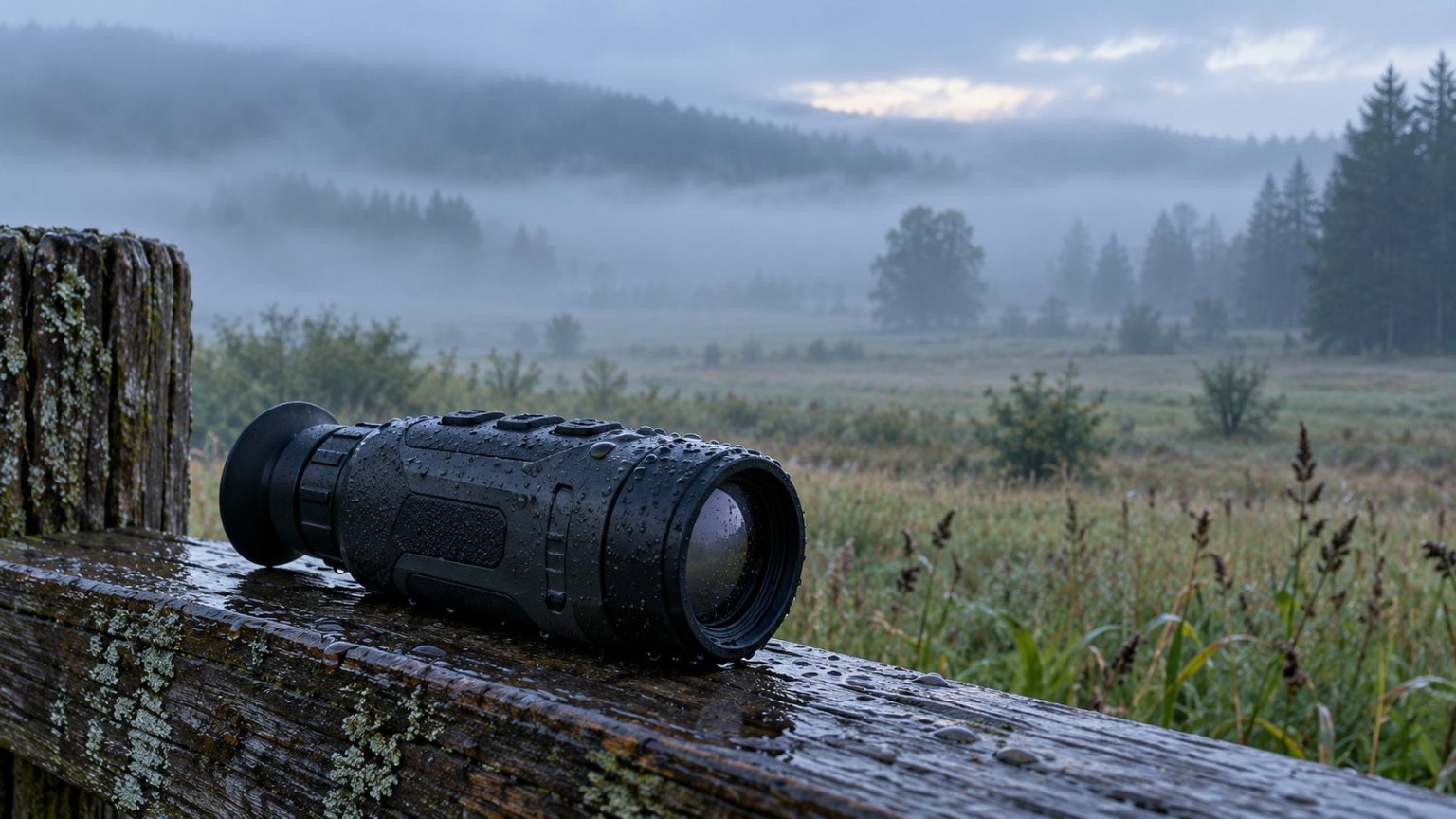
A thermal monocular in fog may still reveal an animal that is difficult to see with the unaided eye, but it cannot guarantee a clear view through poor weather. Fog, rain and humid conditions can affect the infrared signal reaching the detector and the contrast between the subject and its surroundings. Water on the lens adds another, separate problem.
The useful answer is therefore conditional: thermal can remain useful in bad weather, but useful detection distance and recognizable detail may change substantially. Waterproof construction protects the instrument under stated conditions; it does not make the atmosphere transparent.
Three different reasons the image can deteriorate
When a familiar scene suddenly looks flat or vague, separate these causes before changing settings.
| Cause | What may happen | What a setting can realistically do |
|---|---|---|
| Reduced transmission through the atmosphere | Less useful infrared information reaches the camera from a distant subject | Processing may improve presentation, but cannot recreate blocked information |
| Reduced target-to-background contrast | The subject is less distinct from nearby surfaces | Appropriate image settings may make remaining differences easier to inspect |
| Water or condensation on the objective | The exposed lens surface interferes with the view | The surface needs appropriate care; refocusing is not a substitute |
FLIR’s explanation of thermal imaging in fog and rain describes why atmospheric conditions matter. Thermal and visible imaging do not respond identically, so thermal can sometimes retain an advantage. That advantage is not a guarantee of performance in every fog bank or downpour.
Fog is not one consistent condition
Thin mist across a small field is different from dense fog over a long viewing path. Droplet characteristics and the amount of atmosphere between you and the subject affect the result.
This is why a video showing an animal clearly in one foggy scene cannot establish a general all-weather range. You may not know the distance, the density of the fog along the viewing path, or whether the recording has been processed.
Nearby objects can remain recognizable while more distant ones disappear. That does not necessarily indicate faulty focus. Check a familiar object at a shorter distance before concluding the device needs adjustment or repair.
If advertised range is part of your buying decision, read how far a thermal monocular can see. Its distinction between detection and identification becomes especially important when weather removes detail.
Rain affects more than the housing
A sealed monocular may tolerate the stated rain exposure while the view becomes less useful. Rain along the viewing path and water on exposed surfaces are not the same issue as water entering the instrument.
Shelter the objective between observations when practical. If drops are visible on the lens, follow the model’s cleaning and drying instructions. Do not use an unfamiliar solvent or rub grit across the surface in an effort to recover a clear image quickly.
Wet vegetation and ground can also change the scene’s thermal appearance. Pulsar’s discussion of weather and thermal observation describes weather as a factor in both transmission and contrast. The practical consequence is that an area you know well may look different after rain, even at the same time of day.
Compare recognizable landmarks rather than assuming every new bright or dark patch is an animal. A changing background is a reason to interpret cautiously, not a reason to increase confidence because the device still shows something.
Humidity is not a simple pass-or-fail number
A high relative-humidity reading does not, by itself, tell you whether a particular animal will be visible at a particular distance. Relative humidity is only one description of the conditions; temperature, the viewing path and the target-background situation also matter.
Avoid rules such as “thermal stops working above this humidity” or “this model loses exactly half its range in rain.” Those claims require a defined target, measurement method and conditions. They cannot be transferred casually from one outing to another.
A practical field note is more useful: record what you could recognize at known landmarks, along with the weather and settings. Over time, that tells you how your own observation area behaves without pretending to establish a universal range chart.
Can better sensitivity overcome poor weather?
A sensitive detector can help reveal small differences in an available signal. That is different from recovering information that never reaches the detector. A lower NETD figure is not a promise to see through dense fog or wet barriers.
Our guide to thermal monocular NETD explains sensitivity and its limits. Consider it alongside resolution, lens design and the actual scene, rather than using one specification as a weather-proofing score.
Likewise, digital zoom enlarges the displayed information; it does not restore obscured outlines. A vague spot can become a larger vague spot. If the body outline, movement or surrounding context is missing, do not treat enlargement as confirmation of identity.
A useful routine when the view goes flat
First, stop scanning and check a familiar stationary object at a manageable distance. Keep the settings simple enough to judge what has changed.
- Check that the objective is unobstructed and free of obvious droplets or condensation.
- Confirm that the eyepiece display is sharp and that the objective is focused, if adjustable.
- Run the manufacturer’s calibration procedure if required.
- Return to a familiar palette and moderate image settings.
- Compare a nearer landmark with a farther one.
Calibration and focus solve different problems. Neither is a command to remove atmospheric fog. If you are uncertain about the controls, follow the thermal focusing and calibration guide rather than repeatedly changing unrelated settings.
A second palette can help you inspect the remaining contrast, but changing palettes does not create a clearer optical path. Change one setting at a time so you can tell whether it actually helps.
Adjust the observation plan, too
If distant detail is unreliable, spend more attention on accessible areas within the useful view rather than insisting on the clear-weather distance. Keep enough surrounding scenery visible to understand where a detected shape is located; our explanation of thermal field of view covers that tradeoff.
Do not interpret a blank screen as proof that no animals are present. Weather, cover, distance and viewing angle can all conceal them. Nor should a partial warm shape support a species claim when identifying features are absent.
For birds, use thermal to locate a point of interest and seek appropriate confirming evidence, as described in thermal monocular birding techniques. For animals partly behind vegetation, the limitations in what thermal monoculars can see through still apply in any weather.
What to compare before buying
Look for a suitable combination of image performance, documented environmental protection and usable controls. Do not buy solely because a listing says “all weather.” Check how the device handles external power or spare batteries if your outings are long; thermal monocular battery planning covers those practical details.
Our coyote-hunting thermal monocular guide, budget thermal guide and thermal monoculars for birding provide starting points for different uses. Apply the same weather questions to every shortlist.
The aim is to recognize when the scene has become less informative and adjust your expectations accordingly. A working device, a protected housing and a reliable identification are three separate things.

Elliot Vantage is an optics enthusiast and the editor behind Optic Horizon, covering monoculars, binoculars, thermal optics, and related outdoor gear. He researches manufacturer documentation, optical specifications, product features, pricing, and use-case differences to help readers understand their options and choose equipment that fits their needs.