
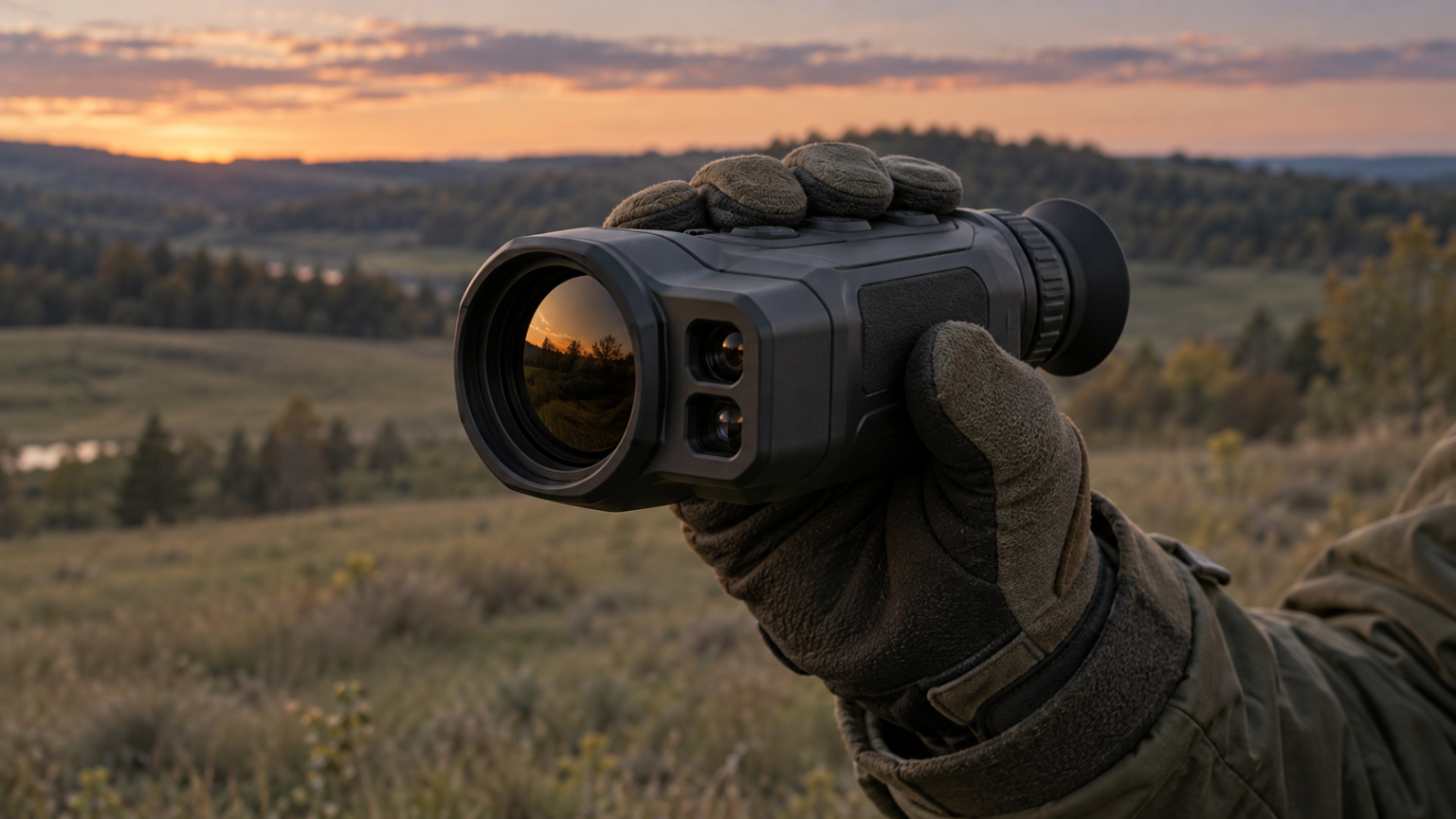
The two thermal monocular rangefinder types you are most likely to encounter are laser and stadiametric systems. A laser rangefinder measures a return from a surface. A stadiametric tool estimates distance by comparing the apparent size of an object with an assumed real size. Both can put a number on the display, but the number comes from a different process and needs a different level of confidence.
Before paying extra for rangefinding, decide how you will use the result. Recording the approximate distance to a known landmark is a different task from trying to range a small, partly obscured animal whose body size you cannot judge reliably.
How a laser rangefinder works
A common laser-ranging method sends out a pulse and measures the time taken for reflected light to return. Distance follows from that round trip. Nikon’s overview of optical position measurement describes this time-based principle.
In an integrated thermal monocular, you generally position a ranging reticle on the object and request a reading. Available modes, aiming indicators and controls vary. The Pulsar Telos LRF XQ35 manual provides one manufacturer example with single-measurement and continuous scan modes.
The return does not depend on choosing a preset animal height. It does depend on the rangefinder receiving a usable reflection from the surface you intend to measure. The apparent precision of the displayed number cannot tell you, by itself, whether that surface was the animal, a foreground obstruction or something beyond it.
Why the largest quoted range needs context
Manufacturers state range limits under particular conditions. Target characteristics and the environment affect the available return. Pulsar’s manual specifically notes the influence of surface properties, weather and target size, with larger objects generally easier to measure than smaller ones.
A long-range result on a large, favorable surface is not evidence of the same ranging performance on a small animal in vegetation. Read the rangefinder specification separately from the thermal detection distance. Our thermal viewing-range guide explains why a subject can be detected before it provides useful identification detail.
How a stadiametric estimate works
A stadiametric interface typically asks you to fit an object between marks or bars and select a reference size. A larger apparent object is interpreted as closer; a smaller one as farther away, given the same assumed real dimension.
The Pulsar Telos XQ35 manual describes its stadiametric function as estimating the distance to an object of known size. That condition is the important part. A preset icon is an assumed reference dimension, not a sensor measuring the actual height of the animal in view.
You may be able to make a reasonable estimate when the reference dimension is genuinely known and its full extent is visible. Confidence drops when the subject is crouched, partly hidden, differently sized from the preset or angled so that the chosen dimension is difficult to define.
A worked example of the size assumption
For small angles, a useful geometry relationship is:
Distance in meters ≈ 1,000 × object size in meters ÷ apparent angle in milliradians.
This is an explanatory calculation, not a button sequence for every monocular. Consider a hypothetical upright object that is 0.8 m tall and appears 2 milliradians high:
- With the correct height: 1,000 × 0.8 ÷ 2 = 400 m.
- If you assume it is 1.0 m tall: 1,000 × 1.0 ÷ 2 = 500 m.
- The estimated distance is then 25% too high.
The selected dimension must match what is measured on the display. If you bracket only an exposed section while assuming the full height, you introduce another error. No animal-height standard is implied by these numbers; the example simply shows how an incorrect size assumption changes the result.
Compare what each system actually contributes
| Question | Laser rangefinder | Stadiametric tool |
|---|---|---|
| Where does the distance come from? | A measured reflected signal | Apparent size and an assumed real dimension |
| Must you know the animal’s height? | No preset height is needed for the measurement | A suitable known or assumed size is essential |
| What can undermine confidence? | An unintended return, poor targeting or unsuitable measurement conditions | Wrong size, posture, obscured outline or imprecise bracketing |
| Does the result identify a species? | No | No |
| What should you verify? | The intended surface, units and measurement behavior | Reference size, full visible dimension and units |
Neither system turns a small thermal fragment into a complete description of the animal. Use the range reading alongside the image and the viewing conditions rather than allowing one number to settle every uncertainty.
Check the target before accepting the reading
Start with an unobstructed landmark of known position. Practice placing the reticle, obtaining a reading and checking whether you are using meters or yards. Learn the difference between a saved reading, a new measurement and a failed attempt in your model’s display.
When vegetation lies in front of a subject, consider whether the ranging line of sight is clear. Repeated readings can reveal instability, but a repeatable reading is not automatic proof that the intended subject produced it. A foreground object can remain in the same place too.
For stadiametric use, ask an equally direct question: can you defend the selected real dimension? If the subject is visible only from the shoulders upward, a full-body preset is a poor basis for a confident estimate.
Keep digital enlargement in perspective. It can make a reticle or outline easier to inspect on the display without making the original scene more detailed. The thermal field-of-view guide explains the optical context behind that presentation.
Integrated or separate rangefinding?
An integrated laser system lets you observe and range through one device, which may simplify a particular routine. It also needs to be assessed as part of the whole monocular: weight, grip, controls, power use and cost still matter.
If you already own a separate rangefinder, consider whether switching devices is manageable at your normal observation point. Do not assume a daylight-oriented rangefinder provides the same viewing or targeting experience in darkness as an integrated thermal system. Check the actual equipment you would use together.
Plan battery use around the functions you expect to run, using the maker’s documented conditions. Our thermal battery-life guide explains how to compare those footnotes without inventing a universal runtime penalty for rangefinding.
Choose the function for its real purpose
For occasional rough estimates where an object’s size is known, a stadiametric tool can be useful. When you need a direct distance measurement, look at laser-equipped models and their documented limitations. In both cases, follow the manufacturer’s laser and operating instructions for the exact device.
Use the thermal selection checklist to decide whether rangefinding deserves priority over other features. Then compare the coyote-hunting monocular guide or the budget thermal shortlist according to your task. A credible reading is one whose source and limitations you understand.

Elliot Vantage is an optics enthusiast and the editor behind Optic Horizon, covering monoculars, binoculars, thermal optics, and related outdoor gear. He researches manufacturer documentation, optical specifications, product features, pricing, and use-case differences to help readers understand their options and choose equipment that fits their needs.