
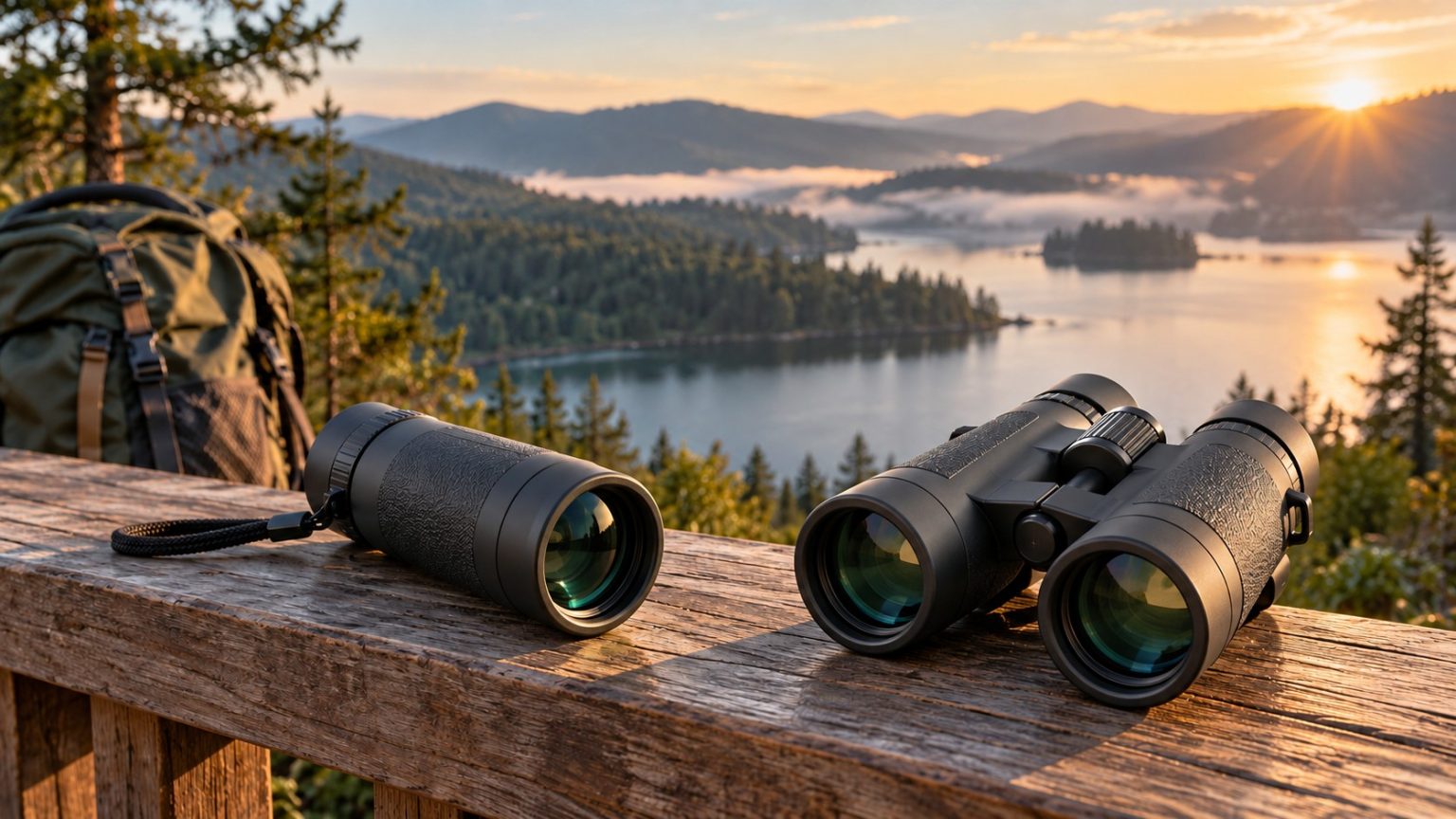
The monocular vs binoculars choice starts with the role an optic will play in your outing. A monocular can be a convenient companion for brief magnified views. Binoculars are often the better starting point when watching wildlife is the main activity and you expect to spend longer looking through the eyepieces.
Choose around carrying convenience, viewing comfort and how you observe—not simply the number of barrels. A large monocular can overlap compact binoculars in weight and bulk, so compare actual products rather than assuming a monocular is always half the size.
This comparison concerns conventional daytime optics. Thermal monoculars detect a different part of the spectrum; our guide to how thermal imaging works explains their separate role.
The practical differences at a glance
| Consideration | Conventional monocular | Conventional binoculars |
|---|---|---|
| Viewing arrangement | One eye looks through one optical channel | Both eyes view through separate optical channels |
| Typical appeal | Brief observations with a compact setup | Comfortable sustained observation for many users |
| Initial setup | Focus and eyecup adjustment, depending on model | Eyecups, spacing between barrels and usually diopter adjustment |
| Carrying size | Can be very compact, but varies considerably | Compact designs exist; larger objectives add bulk |
| Smartphone attachment | Possible with compatible equipment | Also possible with compatible equipment |
| Low-light suitability | Depends on configuration and optical quality | Depends on configuration and optical quality |
The table describes common reasons to compare the formats. It does not establish that every person will find binoculars more comfortable or every monocular easier to hold.
A monocular suits the “look, check and move on” routine
Picture a walk where you mostly enjoy the trail but occasionally want to inspect a distant feature. You stop, take a short look, return the optic to its pouch and continue.
In that routine, convenience matters. A small monocular may fit an accessible pocket or a modest pouch without requiring you to organize the rest of your kit around it.
The value is not that a monocular must provide the best possible observation experience. It is that it can be available when you want a little more detail.
Compare our monoculars for hiking if that describes your use. Check dimensions and the complete carrying setup alongside the stated weight.
Binoculars deserve attention when observation is the purpose
If you plan to watch birds along a wetland or spend an hour observing wildlife from a fixed position, looking comfort moves higher up the list.
Binoculars allow both eyes to participate in the magnified view. Nikon describes their two-channel arrangement and its comfort benefits in its introduction to binoculars. Individual preferences still matter, so try the equipment rather than assuming the format will suit you automatically.
During a longer demonstration, notice whether you relax into the view or keep readjusting your face and hands. A few seconds looking at a shop sign may not reveal the difference between an optic that fits and one that becomes tiring.
Weight and bulk: compare the complete kit
Do not use barrel count as a weight formula. Objective size, housing, armor, focus mechanisms and accessories all affect what you carry.
Compare these items for each candidate:
- The optic’s stated weight and whether that includes relevant accessories.
- Its dimensions when ready to carry.
- The case, strap or harness you will actually use.
- How quickly you can retrieve and put away the optic.
As a hypothetical example, a small monocular in a padded case may take up more usable pocket space than you expected. Meanwhile, compact binoculars carried comfortably on a strap may be more accessible than an optic buried in a bag.
Try the arrangement you intend to use. The most portable device on a specification sheet is not necessarily the most convenient one on your normal walk.
Magnification and field of view still matter in both formats
An 8× monocular and 8× binoculars both provide nominal eight-power magnification. The binocular view is not automatically twice as magnified because it uses two channels.
Similarly, neither format guarantees a wider field. Compare the actual viewing angle or width at the same stated distance.
When a subject is moving, finding and keeping it in the view can be more important than making it larger. Nikon’s first-time selection guidance emphasizes moderate handheld power and useful field of view. Those considerations also help when selecting a monocular.
For the magnification decision itself, see our 8× versus 10× comparison.
Low light cannot be judged by format alone
A large objective may be useful in reduced light, but magnification, transmission and exit pupil also affect the view. A small conventional optic does not become a night-vision device simply because the retailer calls it suitable for “low light.”
Be cautious with simplistic comparisons such as “two lenses collect twice the useful light.” Each optical channel serves an eye; the viewing experience involves more than adding the objective areas together.
Compare realistic configurations and try them in conditions relevant to you. If total darkness is the problem, a conventional monocular-versus-binocular choice will not solve it.
Glasses and facial fit can outweigh the format
For either device, you need to place your eye or eyes correctly to see the intended field.
With binoculars, the spacing between the barrels must suit your eyes. Eyecup position and diopter adjustment also deserve attention. Nikon’s binocular setup instructions show why these adjustments are separate from simply turning the main focus wheel.
A monocular removes the barrel-spacing adjustment, but still needs suitable eye relief and an eyecup you can position comfortably. If you wear glasses, our monocular eye-relief guide explains a practical fitting check.
If one arrangement is substantially easier for your normal viewing setup, take that seriously. Comfort is part of usable performance.
Which is better for different outings?
Hiking with occasional wildlife stops
Try a compact monocular when an optic is a useful extra rather than the main reason for the trip. Prioritize easy access and a view you can settle quickly.
Choose binoculars if you know those occasional stops regularly become extended observations. Carrying slightly more may be worthwhile when the viewing comfort is better for you.
Birdwatching as the main activity
Start by trying binoculars. Spend enough time with them to judge comfort, focusing and subject acquisition. Then compare a monocular if size is a firm constraint or you prefer viewing with one eye.
Neither format substitutes for field skills. Observing shape, behavior and context still matters when identifying a bird.
Travel and sightseeing
A monocular may suit intermittent views of buildings, scenery or distant features. Check that it is convenient to carry safely and accessible without repeated unpacking.
If you enjoy long sessions watching activity from a viewpoint, binoculars may be worth their space. Choose for the way you spend your time rather than buying the smallest product automatically.
Smartphone photography
Both formats can be used with suitable adapters. Compatibility, alignment and stability matter more than format alone. Check the exact eyepiece arrangement and do not assume an included clamp will fit every phone and case.
A simple way to make the decision
Borrow or try one reasonable example of each format. Use the same location and compare three tasks: find a small stationary feature, follow a naturally moving subject from a respectful distance, and observe continuously for several minutes.
Then put both away and retrieve them using your intended case or strap. Notice the whole routine, including the moment when you decide whether it is worth taking the optic out.
If you choose a monocular, our beginner’s selection guide will help you compare specifications. For a firm spending limit, see best monoculars under $100.
Frequently asked questions
Are binoculars always clearer than a monocular?
No. Optical quality and the exact configuration matter. Both-eye viewing may be more comfortable for you, but the format alone does not establish sharpness, contrast or edge quality.
Can I use a monocular with one hand?
Some designs allow convenient one-handed holding or control, but size, focusing arrangement and your grip affect the result. Check the exact model rather than assuming it will work that way.
Is a monocular better for beginners?
It may involve fewer fitting adjustments, but either format can suit a beginner. Choose the arrangement that fits your activity and feels straightforward to use.
Should I carry both?
Usually, start with the one that covers your main need. Carrying both conventional formats adds bulk unless you have a specific reason, such as different users or a dedicated photography setup.
Let the observation routine decide
A monocular is attractive when convenient short views matter most. Binoculars deserve the first trial when you expect sustained wildlife observation. Compare real carrying setups and comfortable viewing time, then choose the format you will enjoy using often.

Elliot Vantage is an optics enthusiast and the editor behind Optic Horizon, covering monoculars, binoculars, thermal optics, and related outdoor gear. He researches manufacturer documentation, optical specifications, product features, pricing, and use-case differences to help readers understand their options and choose equipment that fits their needs.