
Affiliate Disclosure: OpticHorizon.com is a participant in the Amazon Services LLC Associates Program. We may earn a small commission if you buy through our links — at no extra cost to you. This helps us keep the site running and continue producing free, independent buying guides. Our recommendations are based on research, specifications, and real-world considerations, never on commission rates.
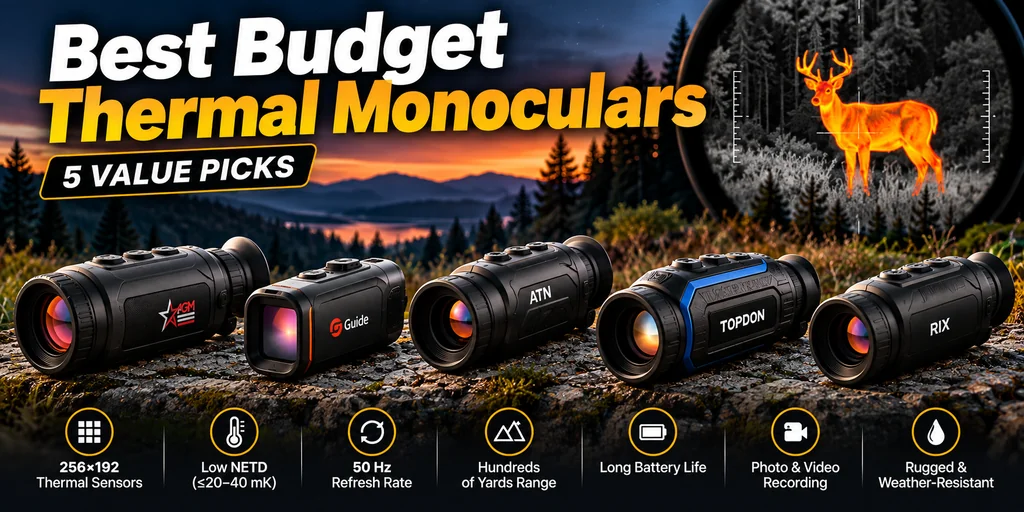
A good thermal monocular no longer has to cost four figures. Today’s entry-level models can offer 256×192 sensors, 50 Hz refresh rates, useful detection range, recording features, and weather-resistant construction at far more accessible prices.
For this guide, we compared five value-focused thermal monoculars from established brands, looking at the specs that matter most: thermal sensitivity, field of view, battery setup, weight, detection range, and overall usefulness.
Our top value pick is the AGM Taipan V2 10-256. It offers the most complete practical package. The RIX Pocket K2 is the closest alternative if you want lower weight and a traditional eyepiece while still keeping a replaceable battery. The other three models each win for more specific needs (compact size, widest FOV, or longest runtime).
We did not physically test every model in this guide, so our recommendations are based on verified manufacturer specifications, manuals, and product features rather than claimed hands-on experience.
In This Guide
Best Budget Thermal Monoculars at a Glance
| Model | Best For | Sensor | NETD | Field of View | Weight | Battery |
|---|---|---|---|---|---|---|
| AGM Taipan V2 10-256 | Our Top Value Pick | 256×192 | <35 mK | 17.5° × 13.1° | ~272 g | Replaceable 18650 |
| Guide TE211M | Compact Touchscreen | 256×192 | 30 mK | 13.1° × 13.1° | 205 g | Built-in |
| ATN BlazeSeeker 6 207 | Widest Field of View | 256×192 | ≤20 mK | 24° × 18° | ~270 g | Built-in |
| TOPDON TS004 | Longest Claimed Runtime | 256×192 | <40 mK | 13.5° × 10.1° | 310 g | Built-in |
| RIX Pocket K2 | Lightest Traditional Design | 256×192 | <25 mK | 19.4° × 14.6° | ~200 g | Replaceable 18650 |
Prices and availability change frequently. Use the Amazon links below to check current pricing.
Detection range is discussed within each review. A manufacturer’s detection figure should not be confused with the distance at which you can positively identify an animal or person.
How We Chose These Thermal Monoculars
We compared current manufacturer documentation for:
- Thermal resolution
- Pixel pitch
- NETD / thermal sensitivity
- Refresh rate
- Lens configuration
- Field of view
- Detection range
- Display
- Battery system
- Claimed runtime
- Recording and storage
- Weather resistance
- Weight
- Warranty and manufacturer support
We also wanted every product to have a clear reason for being here.
We looked for a clear use-case advantage for every pick, whether that was battery flexibility, compact size, scanning width, runtime, or low weight.
Manufacturer specifications cannot tell us everything about image processing, ergonomics, control feel, sample variation, or long-term durability. We therefore do not describe those factors as firsthand findings.
1. AGM Taipan V2 10-256 — Our Top Value Pick
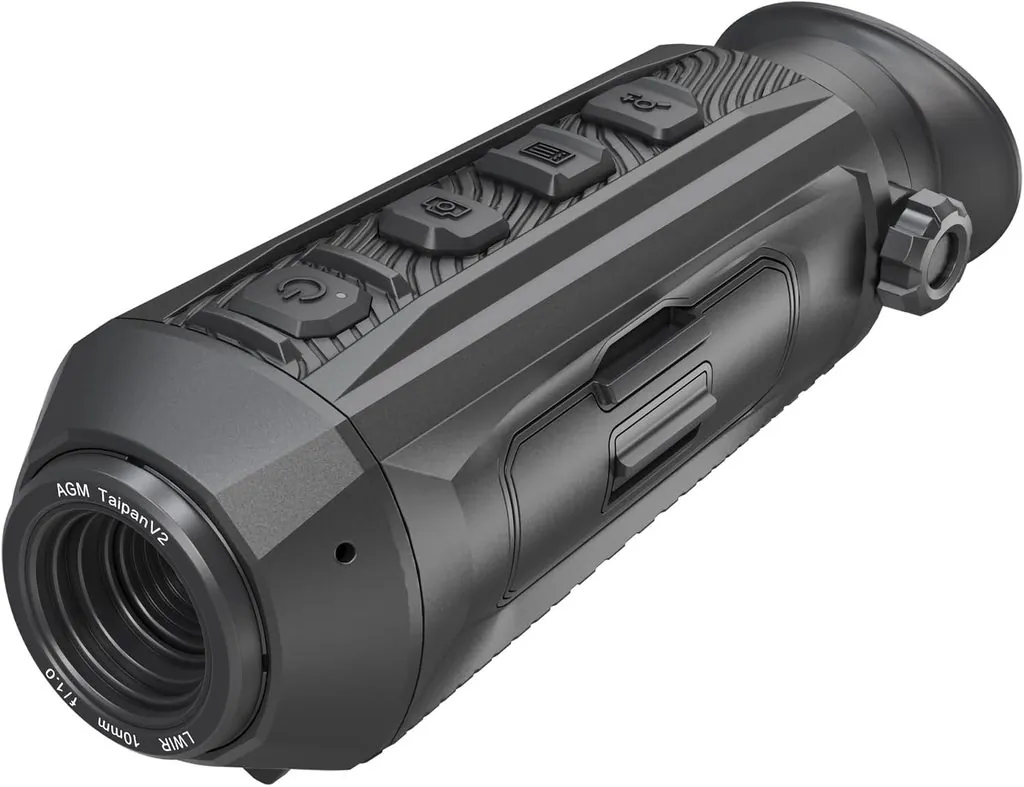
Quick verdict: The most complete and practical package in this group. Wide scanning FOV, replaceable batteries (two included), 50 Hz, IP67, and strong manufacturer support make it the most balanced all-round choice.
AGM uses a 256×192 VOx detector with 12 μm pixel pitch, a 50 Hz refresh rate, and NETD rated below 35 mK.
Its 10 mm F1.0 objective provides a broad 17.5° × 13.1° field of view, which is useful for handheld scanning.
AGM rates detection distance at 500 meters.
The Taipan’s strongest practical feature is its battery system. It runs on a removable rechargeable 18650 battery, and AGM includes two batteries plus a charger.
That means a depleted battery does not have to end an observation session—you can carry the spare and swap it in.
AGM also provides 16 GB of internal photo/video storage, IP67 protection, and a five-year transferable warranty.
Key Specifications
| Specification | AGM Taipan V2 10-256 |
|---|---|
| Sensor | 256×192, 12 μm |
| NETD | <35 mK |
| Refresh rate | 50 Hz |
| Lens | 10 mm F1.0 |
| Field of view | 17.5° × 13.1° |
| Detection range | 500 m |
| Display | 1280×960 LCOS |
| Storage | 16 GB |
| Battery | Replaceable 18650 |
| Runtime | Up to 7 hours |
| Protection | IP67 |
| Weight | ~0.60 lb / 272 g |
View the official AGM Taipan V2 10-256 specifications.
Pros
- Replaceable 18650 battery
- Two batteries included
- Wide scanning field of view
- 50 Hz refresh rate
- IP67 weather protection
- Five-year transferable warranty
Limitations
- 256×192 remains entry-level thermal resolution
- <35 mK NETD is not the lowest sensitivity figure in this comparison
Best for: Buyers who want a balanced first thermal monocular rather than a device optimized around one particular specification.
The RIX Pocket K2 is the closest alternative to the AGM in this comparison. It is lighter, has a wider stated field of view, and its <25 mK NETD is stronger on paper than the AGM’s <35 mK rating. Both use replaceable 18650 batteries.
The AGM remains our top value pick because it includes two batteries, offers a longer five-year transferable warranty, and provides a well-rounded feature set for first-time thermal buyers. If minimum weight and a wider scanning view matter more to you, the RIX Pocket K2 is a particularly strong alternative.
2. Guide TE211M — Best Compact Touchscreen Option
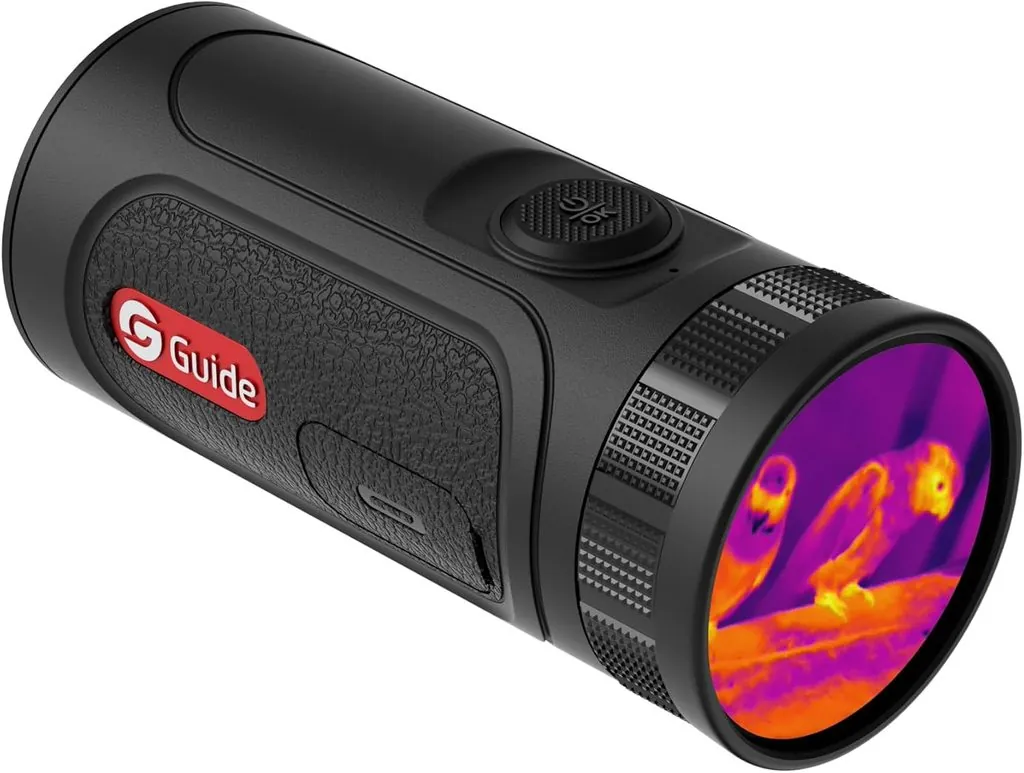
Quick verdict: The TE211M is the most interesting pick if minimum size and touchscreen operation matter more than a traditional eyepiece design.
Guide specifies a 256×192 sensor, 12 μm pixel pitch, 30 mK NETD, and 50 Hz refresh rate.
Its 10 mm F1.0 lens provides 1.2× starting magnification and a 13.1° × 13.1° field of view. Guide rates detection distance at 500 meters.
What separates the TE211M from the other models here is the form factor.
At only 205 g, it is exceptionally compact and uses a 1.43-inch 466×466 AMOLED touchscreen. It also includes Wi-Fi, Bluetooth, photo/video recording with audio, 16 GB of storage, and IP67 protection.
Key Specifications
| Specification | Guide TE211M |
|---|---|
| Sensor | 256×192, 12 μm |
| NETD | 30 mK |
| Refresh rate | 50 Hz |
| Lens | 10 mm F1.0 |
| Magnification | 1.2×–4.8× |
| Field of view | 13.1° × 13.1° |
| Detection range | 500 m |
| Display | 466×466 AMOLED touchscreen |
| Storage | 16 GB |
| Battery | Built-in |
| Runtime | Up to 6 hours |
| Protection | IP67 |
| Weight | 205 g |
View the official Guide TE211M specifications.
Pros
- Very compact
- Only 205 g
- AMOLED touchscreen
- 50 Hz refresh
- Photo/video recording with audio
- IP67 protection
Limitations
- Built-in battery cannot simply be swapped in the field
- Touchscreen viewing format may not suit users who prefer a traditional eyecup
Best for: Hiking, compact carry, property checks, and buyers attracted to a small touchscreen thermal device.
3. ATN BlazeSeeker 6 207 — Widest Field of View
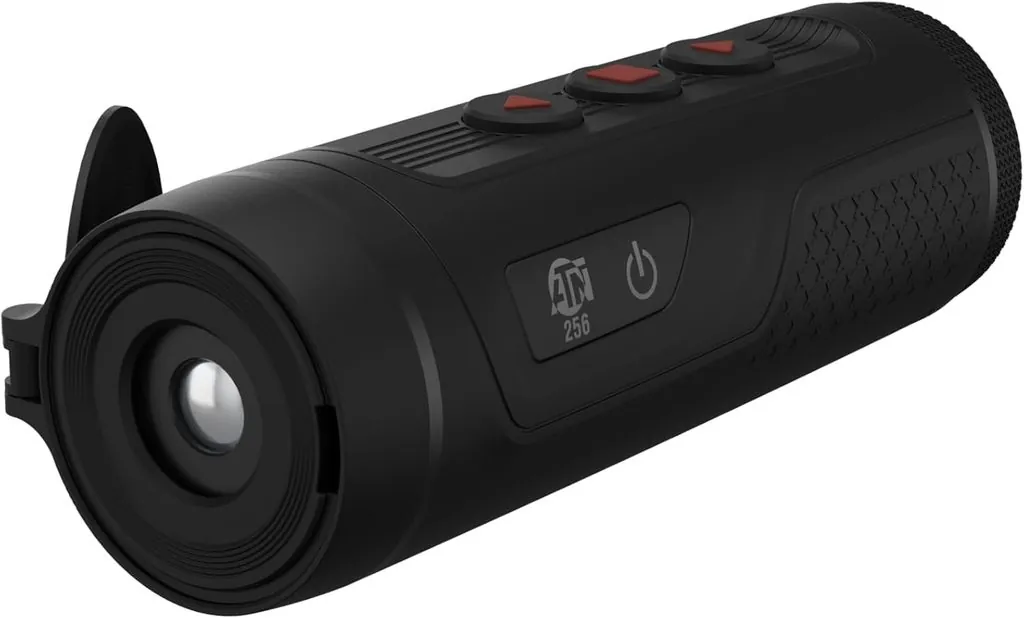
Quick verdict: The BlazeSeeker 6 207 is the strongest option here when seeing as much nearby terrain as possible matters more than starting with higher magnification.
Be careful when shopping for this model. ATN has also sold an older BlazeSeeker generation.
The product discussed here is the current BlazeSeeker 6 207.
Its current Gen 6 documentation specifies a 256×192 sensor, 12 μm pixel pitch, 50 Hz refresh rate, and thermal sensitivity of ≤20 mK.
The defining feature is its short 7 mm F1.0 lens, which creates a very wide 24° × 18° field of view.
That makes the BlazeSeeker particularly well suited to woods, trails, smaller fields, and property scanning, where quickly locating a heat source can be more important than making a distant target appear large.
ATN rates detection distance at 345 meters.
The monocular also includes an 800×600 OLED display, 32 GB of storage, image/video recording, Wi-Fi, and a built-in rechargeable battery rated for up to eight hours.
Key Specifications
| Specification | ATN BlazeSeeker 6 207 |
|---|---|
| Sensor | 256×192, 12 μm |
| NETD | ≤20 mK |
| Refresh rate | 50 Hz |
| Lens | 7 mm F1.0 |
| Magnification | 1.2×–9.6× |
| Field of view | 24° × 18° |
| Detection range | 345 m |
| Display | 800×600 OLED |
| Storage | 32 GB |
| Battery | Built-in |
| Runtime | Up to 8 hours |
| Weight | ~270 g |
View the official ATN BlazeSeeker 6 207 specifications.
Pros
- Widest field of view in this comparison
- Strong ≤20 mK manufacturer specification
- 50 Hz refresh rate
- 32 GB storage
- Photo/video recording
- Wi-Fi connectivity
Limitations
- Short 7 mm lens favors wide-area scanning over distant target size
- Built-in battery is less flexible than a removable 18650 system
Best for: Woodland, trails, closer fields, and property scanning.
4. TOPDON TS004 — Longest Claimed Battery Runtime
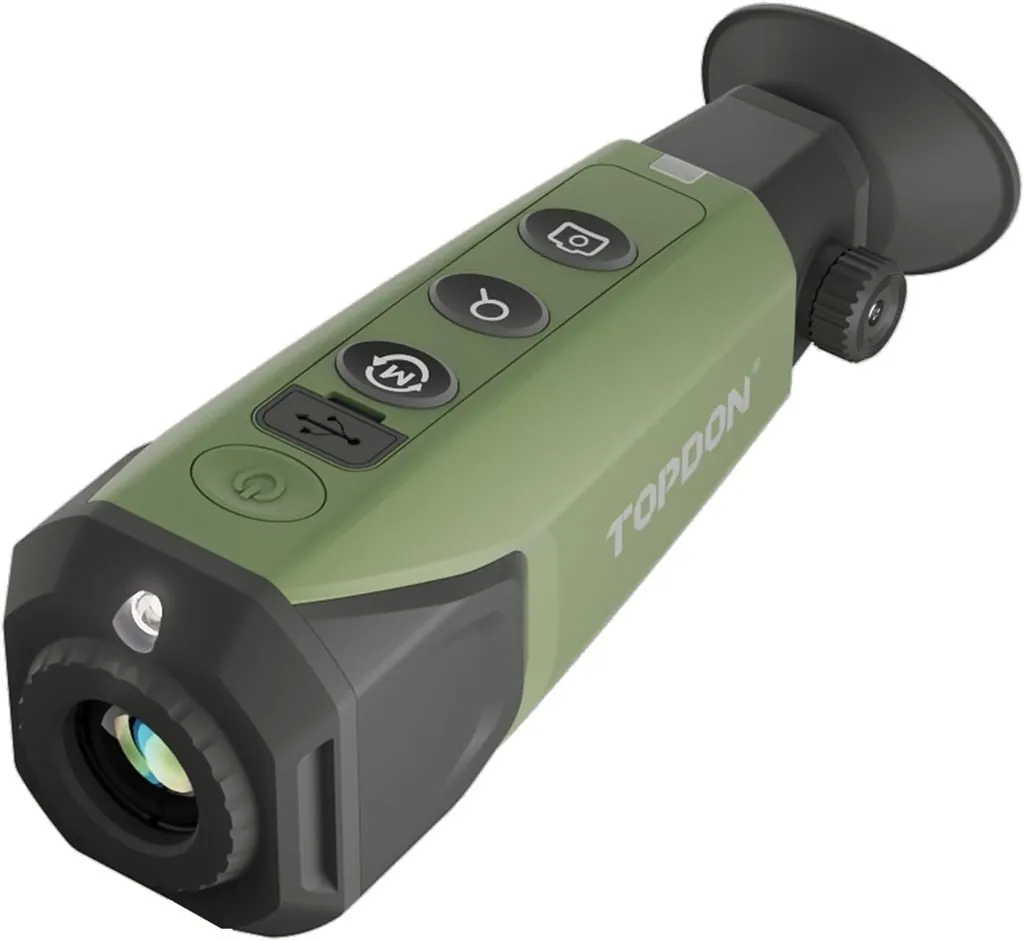
Quick verdict: The TS004 stands out for buyers who expect to keep their thermal monocular running for long sessions between charges.
TOPDON specifies a 256×192 sensor, 12 μm pixel pitch, 50 Hz refresh rate, and NETD below 40 mK.
The 13 mm lens gives it a 13.5° × 10.1° field of view, while TOPDON rates detection distance at up to 450 yards.
Its main advantage is battery endurance.
TOPDON uses a built-in 5,000 mAh battery and claims up to 11 hours of operating time.
The TS004 also offers a 640×480 LCOS display, 32 GB internal storage, photo/video recording, app connectivity, and IP67 protection.
Key Specifications
| Specification | TOPDON TS004 |
|---|---|
| Sensor | 256×192, 12 μm |
| NETD | <40 mK |
| Refresh rate | 50 Hz |
| Lens | 13 mm |
| Field of view | 13.5° × 10.1° |
| Detection range | 450 yd |
| Display | 640×480 LCOS |
| Storage | 32 GB |
| Battery | Built-in 5000 mAh |
| Runtime | Up to 11 hours |
| Protection | IP67 |
| Weight | 310 g |
View the official TOPDON TS004 specifications.
Pros
- Longest manufacturer-rated runtime here
- 50 Hz refresh rate
- 32 GB storage
- IP67 protection
- App connectivity
Limitations
- <40 mK is the highest NETD figure in this comparison
- Built-in battery cannot be swapped like an 18650
Best for: Long observation sessions, camping, wildlife monitoring, and users who prioritize runtime.
5. RIX Pocket K2 — Lightest Traditional Monocular
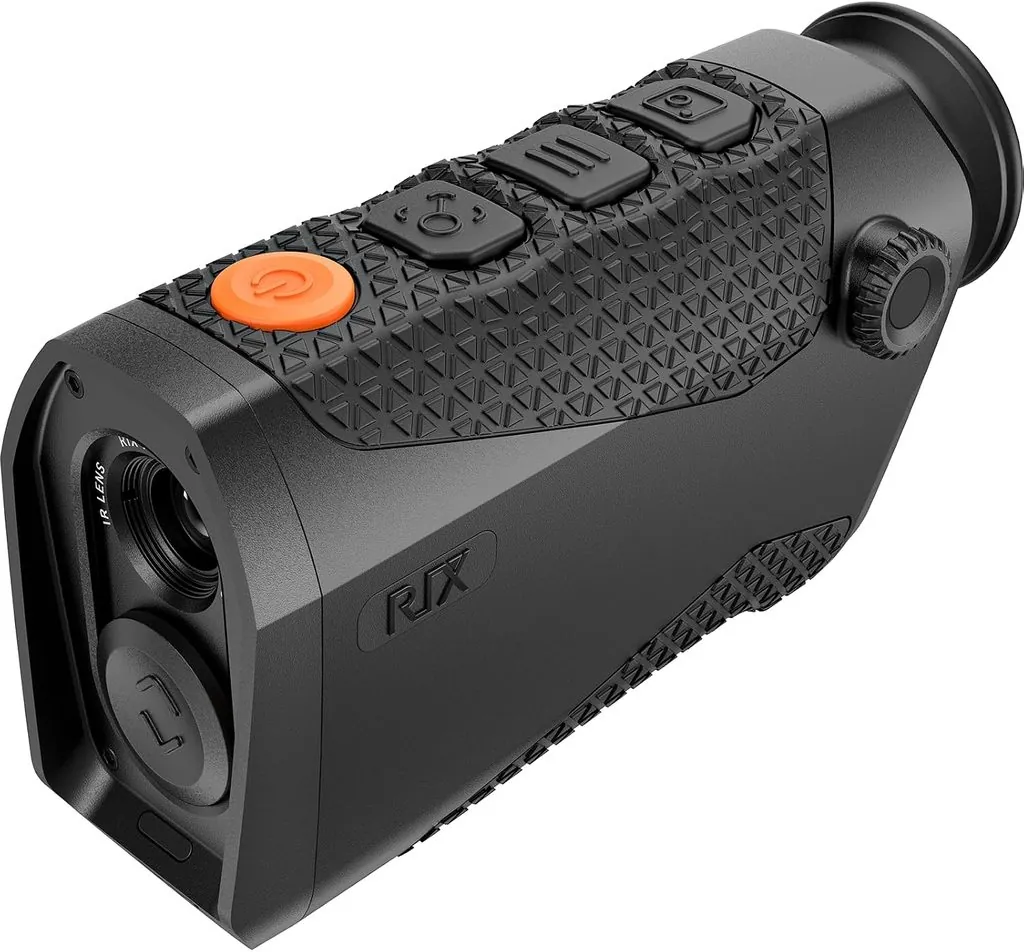
Quick verdict: Strong alternative to the AGM if you want lower weight and a traditional eyepiece while still keeping a replaceable battery.
RIX uses a 256×192 sensor, 12 μm pixel pitch, NETD below 25 mK, and a 50 Hz refresh rate.
Its 9 mm F1.0 objective provides 1.7× base magnification and a broad 19.4° × 14.6° field of view.
RIX rates maximum detection distance at 468 meters.
At approximately 0.44 lb / 200 g, it is the lightest traditional eyepiece-style monocular in this comparison.
Unlike many compact thermal units, the K2 also uses a replaceable 18650 battery.
Other features include an 800×600 OLED display, 32 GB internal storage, Wi-Fi, recording, and electronic image stabilization.
Key Specifications
| Specification | RIX Pocket K2 |
|---|---|
| Sensor | 256×192, 12 μm |
| NETD | <25 mK |
| Refresh rate | 50 Hz |
| Lens | 9 mm F1.0 |
| Base magnification | 1.7× |
| Field of view | 19.4° × 14.6° |
| Detection range | 468 m |
| Display | 800×600 OLED |
| Storage | 32 GB |
| Battery | Replaceable 18650 |
| Runtime | About 6 hours |
| Weight | ~200 g |
View the official RIX Pocket K2 specifications.
Pros
- Very light
- Replaceable 18650 battery
- <25 mK NETD
- Wide field of view
- 50 Hz refresh rate
- Conventional eyepiece
- Electronic image stabilization
Limitations
- 256×192 resolution limits fine detail at longer distances
- Buyers needing substantially more detail should compare 384×288 devices instead
Best for: Hunters, hikers, and wildlife observers who want a very compact traditional thermal monocular.
Which Budget Thermal Monocular Should You Buy?
If you want the most balanced all-round choice, start with the AGM Taipan V2 10-256. Its replaceable battery system, two included batteries, 50 Hz refresh rate, IP67 protection, and five-year transferable warranty make it our top value pick.
Choose the RIX Pocket K2 if lower weight, a wider stated field of view, and a traditional eyepiece matter more.
Choose the Guide TE211M if compact size and touchscreen operation are your priorities.
Choose the ATN BlazeSeeker 6 207 if you mainly scan woodland or closer terrain and want the widest field of view in this comparison.
Choose the TOPDON TS004 if battery endurance matters most.
| Your Priority | Best Match |
|---|---|
| Balanced overall value | AGM Taipan V2 10-256 |
| Smallest touchscreen design | Guide TE211M |
| Maximum scanning width | ATN BlazeSeeker 6 207 |
| Long battery runtime | TOPDON TS004 |
| Lightweight traditional design | RIX Pocket K2 |
What Matters Most When Buying a Budget Thermal Monocular?
Sensor Resolution
Every model in this guide uses a 256×192 sensor, which contains 49,152 thermal detector pixels.
A 384×288 sensor contains 110,592 pixels—more than twice as many.
That difference becomes increasingly useful when you need to distinguish shape and detail at distance instead of simply detecting a heat source.
A 256×192 device can still work well for:
- Scanning fields
- Locating wildlife
- Property observation
- Checking tree lines
- General nighttime heat detection
Its biggest limitation is detailed long-range identification.
NETD
NETD describes the detector’s sensitivity to small temperature differences.
Lower values are generally preferable, particularly when the target and background have relatively similar temperatures.
But don’t use NETD as a single overall image-quality score. Sensor resolution, optics, processing, display quality, and environmental conditions matter too.
Field of View
For handheld scanning, field of view can matter more than buyers expect.
A wide viewing angle allows you to search more terrain at once.
That is why the BlazeSeeker 6 207’s 24° × 18° field of view is notable even though its detection-range number is not the largest here.
Detection Is Not Identification
A 500-meter detection specification does not mean you can positively identify an animal at 500 meters.
Detection essentially tells you:
“A heat source is there.”
Identification asks:
“What exactly is it?”
The second task requires much more image detail.
Manufacturer detection figures may also use different target sizes and calculation methods, so don’t rank thermal monoculars solely by the largest advertised range.
What Does “Budget” Mean for a Thermal Monocular?
“Budget” means something different in thermal optics than it does with conventional monoculars. Even entry-level thermal models require a thermal sensor, infrared optics, image processing, a display, and a dedicated power system, which naturally makes them more expensive.
For this guide, we focused on the more affordable end of established thermal-monocular ranges while prioritizing useful specifications, practical features, weather protection, battery design, and overall usability.
The goal is not simply to find the cheapest option, but to identify models that offer a sensible balance of thermal performance, battery life, field of view, portability, and useful features.
If you actually need a conventional daytime optic instead, see our best monoculars under $100.
Can You Use a Thermal Monocular for Hunting?
Thermal monoculars can be useful for scanning fields, locating animals, observing heat signatures, and checking terrain when visible light is limited.
But laws governing thermal equipment vary by location, species, season, time of day, and whether the device is being used only for observation or in connection with taking game.
Always check the current rules issued by the relevant wildlife authority where you intend to hunt.
For more detail on practical applications and limitations, read Why Hunters Use Thermal Monoculars: Benefits & Limits.
You can also browse all of our thermal monocular guides.
Frequently Asked Questions
What is the best budget thermal monocular?
Based on the measurable specifications, battery system, features, manufacturer support, and overall positioning we compared, the AGM Taipan V2 10-256 is our top value pick.
This is a research-based recommendation rather than a claim that we physically tested all five units side by side.
Is 256×192 enough for a thermal monocular?
Yes, for general scanning, heat detection, wildlife observation, and many short-to-medium-range applications.
For detailed observation at longer distances, a 384×288 or 640×512 detector provides substantially more native thermal information.
Is lower NETD better?
Generally, yes. Lower NETD indicates greater sensitivity to small temperature differences under the manufacturer’s specified test conditions.
It should still be evaluated alongside resolution, optics, image processing, and environmental conditions.
Which model has the widest field of view?
The ATN BlazeSeeker 6 207 has the widest manufacturer-specified field of view in this comparison at 24° × 18°.
Which model has the longest claimed runtime?
TOPDON rates the TS004 for up to 11 hours of operation.
Actual runtime can vary with temperature, wireless use, display settings, recording, and other conditions.
Can thermal monoculars see through walls?
No.
Thermal monoculars detect infrared energy reaching the sensor. They cannot see through solid walls, tree trunks, or other opaque barriers.
Final Verdict
The AGM Taipan V2 10-256 is our top value pick. It offers the most complete practical package: useful scanning FOV, replaceable batteries (two included), 50 Hz, outdoor protection, and strong manufacturer support.
The RIX Pocket K2 is the strongest alternative if you want something lighter with a traditional eyepiece and still want a replaceable battery.
The Guide TE211M wins for pure compactness and touchscreen controls.
The ATN BlazeSeeker 6 207 has the widest viewing angle for scanning.
The TOPDON TS004 delivers the longest manufacturer-rated runtime.
All five are entry-level 256×192 thermal monoculars. If detailed long-range identification matters more than affordable scanning, a 384×288-class device is usually the better next step.

Elliot Vantage is an optics enthusiast and the editor behind Optic Horizon, covering monoculars, binoculars, thermal optics, and related outdoor gear. He researches manufacturer documentation, optical specifications, product features, pricing, and use-case differences to help readers understand their options and choose equipment that fits their needs.