
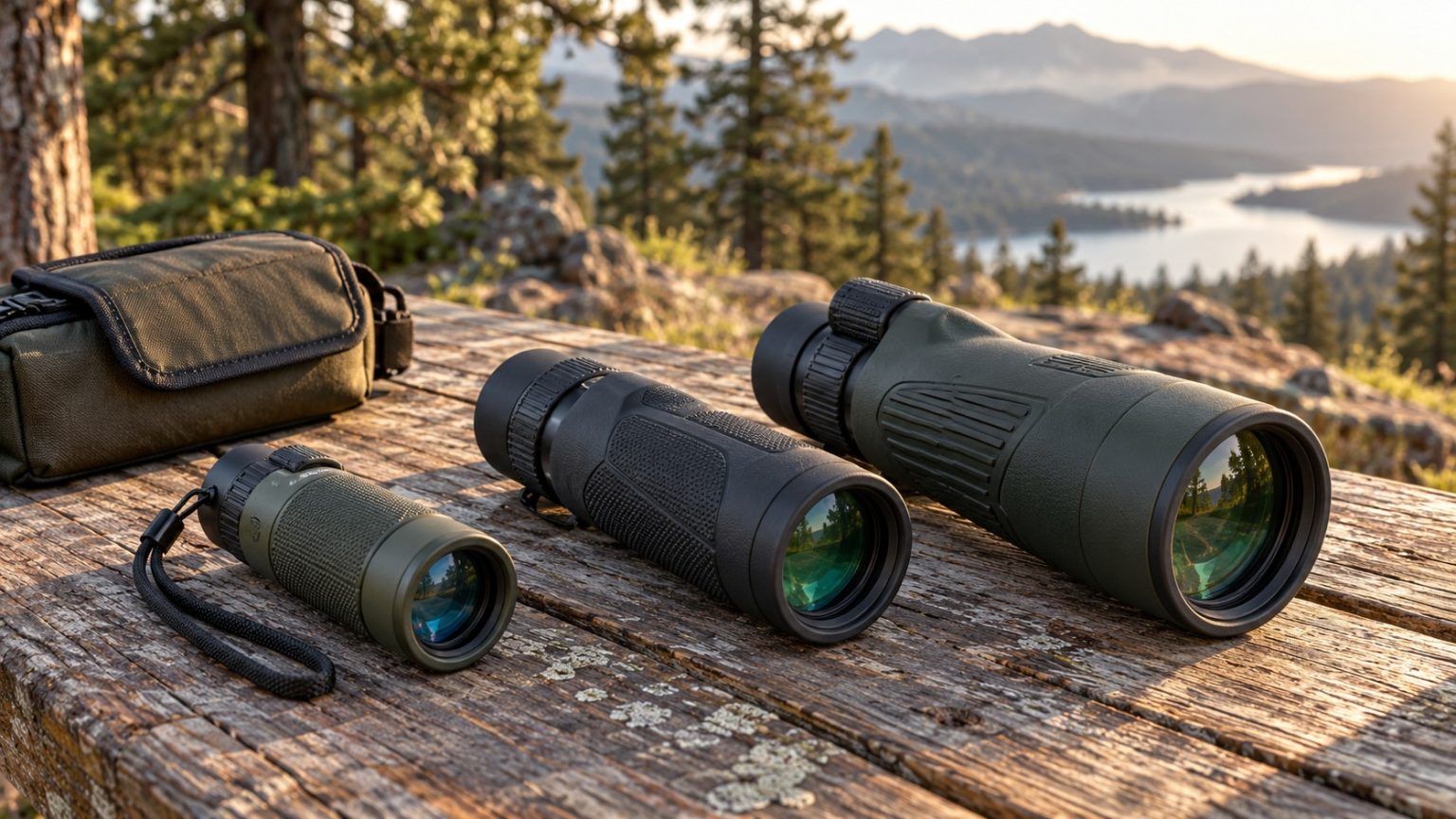
Learning how to choose a monocular starts with a simple question: what will you actually look at? For brief daytime views on a walk, carrying size and quick handling may matter most. For nearby birds, eye comfort, viewing width and close focus deserve more attention. The highest magnification on the shelf is rarely a complete answer.
Choose around your viewing routine, then compare magnification, objective size, field of view, eye relief and handling. A monocular is worthwhile when those features work together for the way you observe.
This guide covers conventional optical monoculars. If you want to locate wildlife without visible illumination, first read how thermal monoculars work; those electronic devices solve a different problem.
Start with the job, not the specification sheet
Write down the three situations in which you expect to use the optic most often. Be specific: a bird in a nearby tree, a distant landmark from a viewpoint, or an occasional look across a campsite.
| Your usual observation | Features worth prioritizing | A compromise to consider |
|---|---|---|
| Short stops during a walk | Convenient size, quick access and moderate magnification | A smaller objective favors carrying convenience |
| Moving wildlife | Useful field of view and easy focusing | More magnification may make acquisition harder |
| Nearby birds and insects | Short close-focus distance | Some compact optics cannot focus very close |
| Distant scenery from a fixed position | Magnification you can hold steadily | A support may be more useful than extra power |
| Viewing with glasses | Usable eye relief and suitable eyecups | A nominal eye-relief figure cannot guarantee fit |
| Regular low-light observation | Appropriate exit pupil and optical quality | The larger body may be less convenient to carry |
This prevents a common purchase mistake: optimizing for an impressive feature you rarely use while accepting a limitation you encounter every day.
For shortlisted products, our best monoculars under $100 guide focuses on budget choices. Our hiking monocular comparison gives more weight to trail use, portability and outdoor observation.
Understand the two numbers in 8×32 or 10×25
The first number is magnification. An 8× optic makes the subject’s angular size approximately eight times greater than viewing it unaided. The second number is the objective lens diameter in millimeters.
An 8×32 monocular therefore has 8× magnification and a 32 mm objective. Neither number is a complete quality rating.
An objective’s diameter describes its aperture, not its focal length. A larger aperture can collect more light, but brightness at your eye also depends on magnification, transmission, your pupil and the scene. Nikon’s explanation of effective objective diameter provides the underlying optical principle.
Choose magnification you can use comfortably
For a first handheld monocular, compare sensible 8× and 10× options before considering unusually high power. The best choice is the one that lets you find a subject, settle the image and inspect it without fighting the optic.
An 8× design is a useful starting point for mixed nature observation. A 10× design provides a larger apparent target, which can help when you can stop and hold it steadily. Actual viewing width and eye comfort depend on the exact model.
Try this simple comparison: look at a small, stationary feature, then find it again after lowering the optic. If the higher-powered model repeatedly makes the task slower or less comfortable, its larger image may not be worthwhile for you.
Our 8× versus 10× monocular guide explains the trade-off in more detail.
Use exit pupil to put objective size in context
Exit pupil is objective diameter divided by magnification. It describes the diameter of the light bundle emerging from the eyepiece.
| Configuration | Calculated exit pupil |
|---|---|
| 8×25 | 3.1 mm |
| 8×32 | 4.0 mm |
| 8×36 | 4.5 mm |
| 10×25 | 2.5 mm |
| 10×50 | 5.0 mm |
These values are arithmetic, rounded where appropriate. They are not measured brightness scores.
A larger exit pupil may help in dim conditions if your eye can accept the extra light. In bright daylight, carrying a larger optic may provide little brightness benefit when your pupil is already smaller than the emerging light bundle. Nikon’s exit-pupil explanation illustrates this relationship.
For occasional daytime use, a compact 25 mm model can be a reasonable trade. If you expect prolonged dawn or dusk observation, compare larger objectives while keeping weight and usable image quality in mind.
Compare field of view in matching units
Field of view tells you how much of the scene fits into one view. It is commonly listed as degrees or as a width at 1,000 yards or 1,000 meters.
Compare like with like. A width at 1,000 meters cannot be compared directly with a width at 1,000 yards without conversion.
A broader view can make it easier to find a bird among branches and keep track of movement. However, width does not establish edge sharpness or overall optical quality. Two 8× monoculars can have different viewing widths because their optical designs differ.
When trying an optic, look at both the central subject and the surrounding scene. Decide whether the available detail and viewing width suit your task rather than choosing by the widest published figure alone.
Check eye relief with your normal glasses
Glasses hold your eye farther from the eyepiece. A model with insufficient usable eye relief may show a reduced field even when the center looks sharp.
Start with longer-eye-relief candidates, then test the actual fit. Lower the eyecup as the manufacturer directs, keep the monocular centered, and look for the full circular field without pushing your glasses inward.
Eyepiece recess, frame shape and the position of your lenses affect the result. Our guide to using a monocular with glasses includes a practical fitting routine and ways to diagnose blackouts.
Do not overlook close focus
Close focus is the nearest distance at which the optic can focus. It can make a bigger difference than magnification if you enjoy observing insects or birds just a few steps away.
For a concrete example, Opticron’s T4 Trailfinder WP 8×25 documentation lists a short minimum focusing distance and a retractable eyecup. Those are useful specifications to inspect—not a claim that this particular model is best for everyone.
Before buying, compare the stated minimum distance with the subjects you actually encounter. An optic designed mainly for distant viewing may be perfectly capable yet unsuitable for nearby nature observation.
Read construction claims carefully
Waterproofing, internal gas filling and exterior armor describe different things. A protected housing may help outdoors, but a generic “waterproof” label does not establish a particular depth or duration unless the manufacturer supplies those limits.
Similarly, ED glass, prism-glass names and coating labels are clues about construction rather than complete performance rankings. Nikon explains that anti-reflective coatings reduce reflections and improve transmission. The quality of the whole optical system still matters.
Prioritize clear, model-specific documentation. If a retailer combines several magnifications under one listing, check that the specifications refer to the exact version you plan to order.
Judge the complete carrying and handling setup
A monocular that stays at home is not much use on a walk. Check body dimensions as well as weight, and include the case, strap and accessories in your carrying decision.
Try operating the focus control with the hand you expect to use. Check whether the grip feels secure, whether the lens caps are manageable, and whether the optic can be retrieved without emptying your bag.
For smartphone photography, confirm the adapter fits both the eyepiece and your phone arrangement. For supported viewing, check actual tripod compatibility rather than assuming an accessory will fit.
If you expect long wildlife-watching sessions, compare monoculars with binoculars. Using both eyes may suit you better even if the carrying setup is larger.
A short checklist before you order
- Identify your main subjects and usual light conditions.
- Compare exact 8× or 10× configurations you can hold comfortably.
- Check field of view, close focus and eye relief.
- Look for documented construction and weather-protection details.
- Check dimensions with the case or pouch you will carry.
- Confirm the exact model, seller, included accessories and return terms.
Frequently asked questions
Is 10× better than 8×?
It makes a subject appear larger, but may be less comfortable to hold steadily. Compare the whole optic and your viewing routine. Extra magnification is useful only when it improves the view you can actually use.
Can a conventional monocular see in total darkness?
No. It needs available light. A large objective does not turn a daytime monocular into a thermal or electronic night-vision device.
Is an expensive monocular always necessary?
No. Spend for features that solve a real limitation: better fit with glasses, more suitable close focus, documented protection or optical performance you can verify. Occasional daytime viewing may not justify a much larger budget.
Which feature should come first?
Your use comes first. After that, prioritize the limitation most likely to stop you enjoying the optic. For one person that is weight; for another it is eye relief or difficulty finding a moving subject.
A good choice should feel straightforward to use
Choose a monocular that matches your normal observations and is convenient enough to carry. Get the magnification, viewing width and eye position working together before paying for headline specifications. Then use the buying guide that fits your activity or budget to narrow the shortlist.

Elliot Vantage is an optics enthusiast and the editor behind Optic Horizon, covering monoculars, binoculars, thermal optics, and related outdoor gear. He researches manufacturer documentation, optical specifications, product features, pricing, and use-case differences to help readers understand their options and choose equipment that fits their needs.