
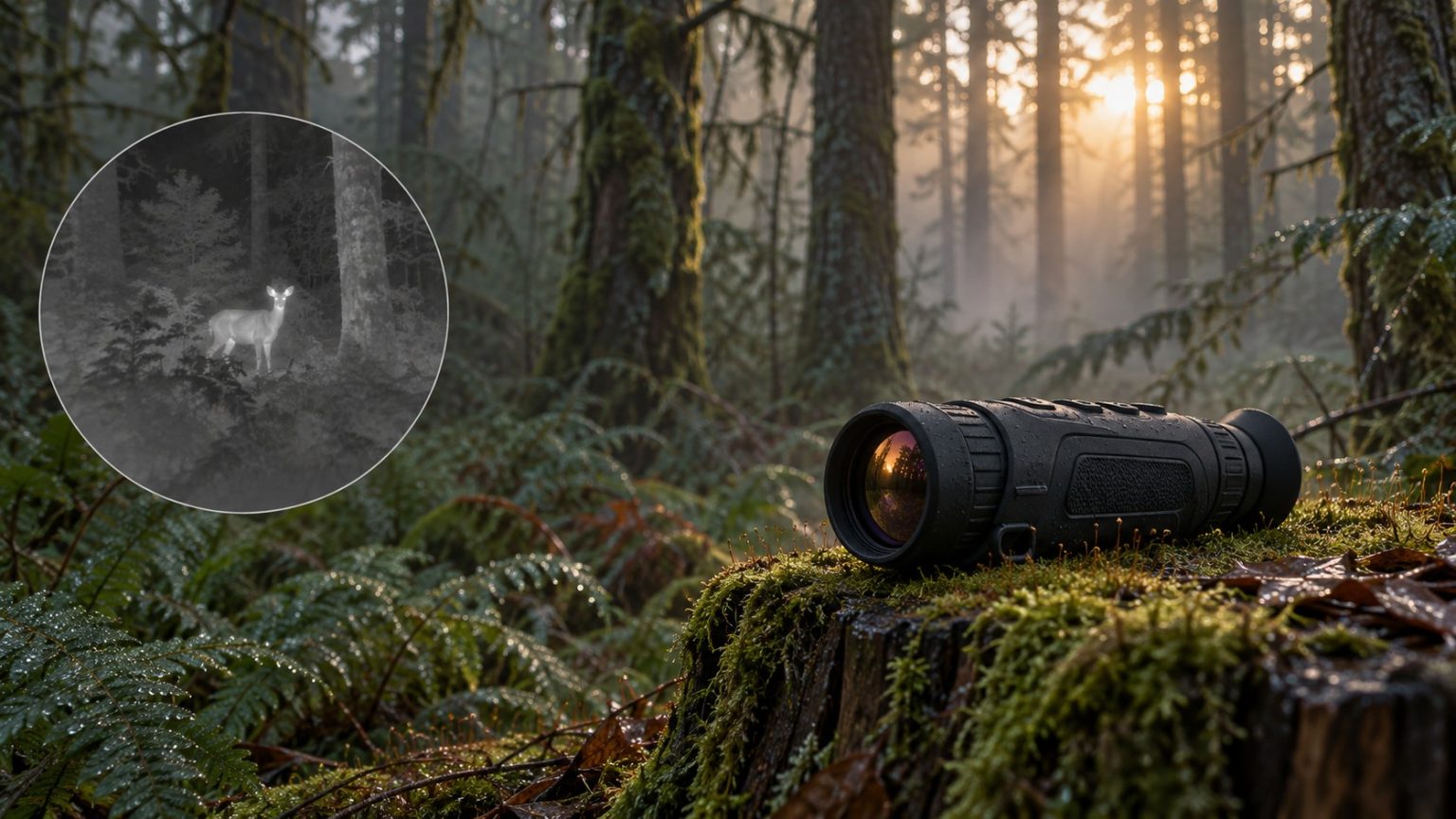
Thermal monocular NETD is a specification describing sensitivity to small differences in the thermal signal. It stands for Noise Equivalent Temperature Difference and is usually stated in millikelvin, or mK. A lower value generally indicates better sensitivity when the measurement conditions are comparable.
The important word is comparable. A 20 mK claim and a 35 mK claim do not provide a complete ranking of two monoculars, especially when their measurement methods, optics and image processing differ.
NETD is useful when you understand the question it answers: how much thermal contrast can the system distinguish relative to its noise? It does not tell you how many pixels describe an animal or how far away you can identify it.
NETD in plain language
Imagine two adjacent parts of a scene producing very similar thermal signals. As the difference becomes smaller, it becomes harder to distinguish that difference from noise. NETD expresses the temperature difference equivalent to the noise under the measurement conditions, corresponding to a signal-to-noise ratio of one. Camera manufacturer Sierra-Olympia explains this definition of NETD.
That makes it a sensitivity metric, rather than a guaranteed minimum visible feature in every outdoor scene.
Teledyne FLIR’s thermal sensitivity guide explains why lower NETD is helpful when scene contrast is weak. It also highlights the importance of knowing the temperature at which the sensitivity was specified.
The unit is small:
| Stated sensitivity | Equivalent temperature interval |
|---|---|
| 20 mK | 0.020 K, or a 0.020°C difference |
| 25 mK | 0.025 K, or a 0.025°C difference |
| 35 mK | 0.035 K, or a 0.035°C difference |
| 50 mK | 0.050 K, or a 0.050°C difference |
These are unit conversions. They do not mean a monocular will accurately measure an animal’s temperature to those tolerances.
Sensitivity is different from temperature accuracy
A device can be sensitive to small differences without being a calibrated thermometer. Many wildlife monoculars are designed to show useful thermal imagery rather than deliver traceable temperature measurements.
Three terms should remain separate:
- Sensitivity: how small a signal difference can be distinguished relative to noise under stated conditions.
- Resolution: how many spatial detector samples are available across the image.
- Temperature accuracy: how closely a measured temperature agrees with the actual value under specified measurement conditions.
Do not read “NETD <25 mK” as “temperature accuracy ±0.025°C.” Those claims describe different performance characteristics.
For the wider imaging process, our explanation of how thermal monoculars work covers the relationship between detector, optics, processing and display.
When lower NETD is worth paying attention to
Sensitivity deserves attention when the subject and its surroundings offer little thermal contrast. In that situation, the challenge is separating weak differences from the background, rather than simply making a strongly contrasting shape larger.
Think of these as two different hypothetical observations:
Scene one: strong separation. An exposed animal stands out clearly against an uncomplicated background. Both devices may show it readily. Extra sensitivity may not be the feature that changes your experience most.
Scene two: subtle separation. The subject blends into a more uniform thermal scene. Differences in sensitivity and processing may become more relevant, provided enough of the subject is visible and adequately sampled.
Those are examples of what to evaluate, not a promise about a particular model. Weather, surface conditions and the background all affect what reaches the detector. Lower NETD cannot restore a view blocked by an opaque object.
NETD versus resolution: which matters more?
They address different limitations. Resolution describes the spatial sampling available; NETD describes sensitivity relative to noise. Either can be a bottleneck.
| What is limiting the observation? | What to examine first |
|---|---|
| The target occupies very few pixels | Detector resolution together with field of view and lens configuration |
| The target blends into the thermal background | Sensitivity, processing and scene conditions |
| The screen is sharp but the scene is soft | Focus, optics and native detector information |
| The target is partly hidden | Viewing position and obstruction; specifications cannot remove the barrier |
| A large zoom number produces a larger blur | Captured information before enlargement |
Our thermal resolution comparison explains why more detector pixels can support detail or wider coverage. Our guide to thermal field of view shows how those pixels are distributed across a scene.
Neither specification should be used to predict a universal species-identification distance.
Why the measurement conditions matter
Before comparing figures from different brands, look for enough information to understand what was measured.
The temperature used for the specification
NETD depends on measurement conditions. A sensitivity figure quoted at a particular reference temperature should not be treated as an identical result at every outdoor temperature. FLIR recommends that integrators seek a specification at 30°C in its sensitivity guidance linked above.
For a buyer, the practical response is simple: record the reference condition beside the number. An unexplained specification deserves a question rather than an automatic ranking.
The optics and system being described
Check whether the claim describes a detector component, a complete imaging assembly or a named manufacturer system metric. Those labels may not represent interchangeable tests.
Lens throughput also affects the imaging chain. FLIR’s discussion of resolution, sensitivity and optical design places lens f-number, transmission, calibration and processing alongside detector performance.
If one specification includes a defined lens and another does not explain its conditions, keep the uncertainty visible in your comparison.
Thresholds and rounding
“Less than 25 mK” is a threshold claim. It does not tell you the exact tested value of every unit. Similarly, a small numerical difference between two published limits does not establish a visible advantage in every scene.
Do not build a buying decision around a few millikelvin while ignoring a poor eyepiece fit, unsuitable viewing width or a power arrangement that fails to suit your outings.
Does 20 mK mean twice as good as 40 mK?
It is half the stated noise-equivalent temperature difference under equivalent conditions. It is not twice the resolution, twice the detection range or twice the overall image quality.
Suppose two otherwise identical hypothetical systems genuinely measured 20 mK and 40 mK under the same conditions. The lower figure would support the case for better sensitivity. Real monoculars are rarely identical in every other respect, so the sensible next question is whether that advantage matters in the scenes you observe.
A purchase is easier to justify when you can name the limitation it improves. “More convincing separation in low-contrast conditions” is a meaningful goal. “The lowest number must win” is not a complete comparison method.
How to use NETD when shopping
Create a short comparison with columns for native resolution, horizontal field of view, stated NETD and conditions, battery arrangement, carrying weight and price.
Then ask:
- Are both sensitivity figures measuring comparable things?
- Do the viewing configurations suit my subjects and terrain?
- Is there footage of similar scenes at stated distances and zoom settings?
- Which compromise would I notice on a normal outing?
For entry-level choices, our best budget thermal monoculars guide provides a product shortlist. The companion article on whether budget thermal monoculars are worth it helps separate useful savings from limitations you may quickly outgrow.
Frequently asked questions
Is lower NETD better?
Generally, yes, when the measurement conditions and metric are comparable. It indicates greater sensitivity relative to noise, but does not rank every aspect of the complete device.
What NETD should a beginner buy?
There is no universal threshold for beginners. Start with the task, scene contrast, viewing width and available budget. A specification is useful when it helps compare suitable devices, rather than setting an arbitrary minimum that ignores everything else.
Can lower NETD compensate for a low-resolution detector?
It may improve sensitivity to subtle thermal differences. It does not add spatial samples to the detector. A tiny target can remain difficult to interpret even when its thermal contrast is detected well.
Does NETD establish how far I can identify an animal?
No. Identification also depends on target size, viewing geometry, focus, atmosphere, obstruction, processing and the distinguishing information required. See our guide to thermal detection and identification range before relying on advertised distances.
Use sensitivity to answer a specific question
NETD belongs in a serious comparison, especially for low-contrast observation. Read the conditions attached to it, keep sensitivity separate from resolution and temperature accuracy, and judge whether the complete device addresses your actual viewing needs.

Elliot Vantage is an optics enthusiast and the editor behind Optic Horizon, covering monoculars, binoculars, thermal optics, and related outdoor gear. He researches manufacturer documentation, optical specifications, product features, pricing, and use-case differences to help readers understand their options and choose equipment that fits their needs.