
Affiliate disclosure: As an Amazon Associate, Optic Horizon earns from qualifying purchases. Purchases through affiliate links may earn us a commission at no extra cost to you.
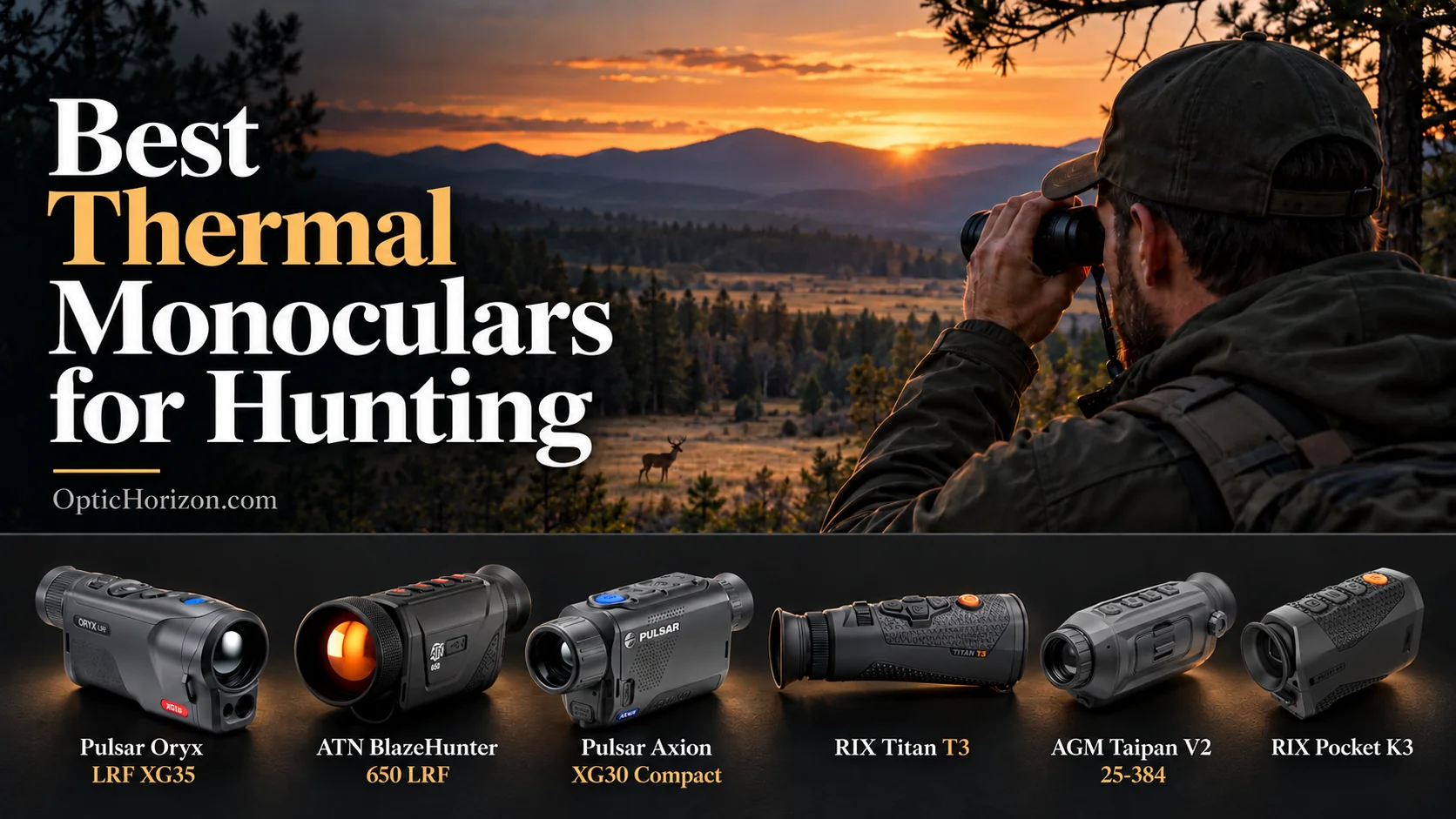
The best thermal monocular for hunting depends on your terrain, observation distances and budget. A wider view helps you search field edges and nearby openings; a narrower view concentrates detector samples on distant animals. An integrated laser rangefinder adds distance information, while battery arrangements and carrying size affect how convenient the device is on longer outings.
For mixed terrain and built-in ranging, our starting pick is the Pulsar Oryx LRF XG35. The ATN BlazeHunter 650 LRF is better suited to concentrated open-country observation, while the Pulsar Axion XG30 Compact offers a compact 640-class option without a laser rangefinder. The RIX Titan T3 adds integrated ranging below the listed cost of the 640-class LRF models. The AGM Taipan V2 25-384 and RIX Pocket K3 provide lower-cost 384-class alternatives with different viewing configurations.
Here are the features, advantages and compromises that separate these six handheld scanners.
In This Guide…
Best thermal monoculars for hunting at a glance
| Model | Our pick for | Native detector | Base magnification / horizontal view | Approx. U.S. price* |
|---|---|---|---|---|
| Pulsar Oryx LRF XG35 | Mixed terrain with laser ranging | 640 × 480 | 2.5× / 12.5° | $3,000 |
| ATN BlazeHunter 650 LRF | Open-country observation with ranging | 640 × 512 | 3.5× / 8.7° | $2,200 |
| Pulsar Axion XG30 Compact | Compact 640-class scanning without an LRF | 640 × 480 | 2× / 14.6° | $2,200 |
| RIX Titan T3 | Laser ranging below $2,000 | 384 × 288 | 2.6× / 10.5° | $1,800 |
| AGM Taipan V2 25-384 | A tighter 384-class view | 384 × 288 | 2.5× / 10.5° | $1,450 |
| RIX Pocket K3 | Budget scanning with broad coverage | 384 × 288 | 2× / 17.5° | $800 |
Approximate prices are rounded from U.S. manufacturer listings and an exact-model Amazon listing retrieved on October 8, 2026. Prices and stock can change; confirm current details through the product links below. The Pocket K3 recommendation is subject to the battery-recall check in its section.
Our comparison method: This is a research-based buying guide, not a field-test report. We checked model-specific manufacturer specifications, U.S. product pages and Amazon catalog details. Recommendations reflect viewing coverage, native resolution, ranging, power arrangements and listed cost. We have not conducted a comparative field test or established species-identification ranges with these devices.
For the broader role of a handheld scanner in your kit, see why hunters use thermal monoculars.
1. Pulsar Oryx LRF XG35
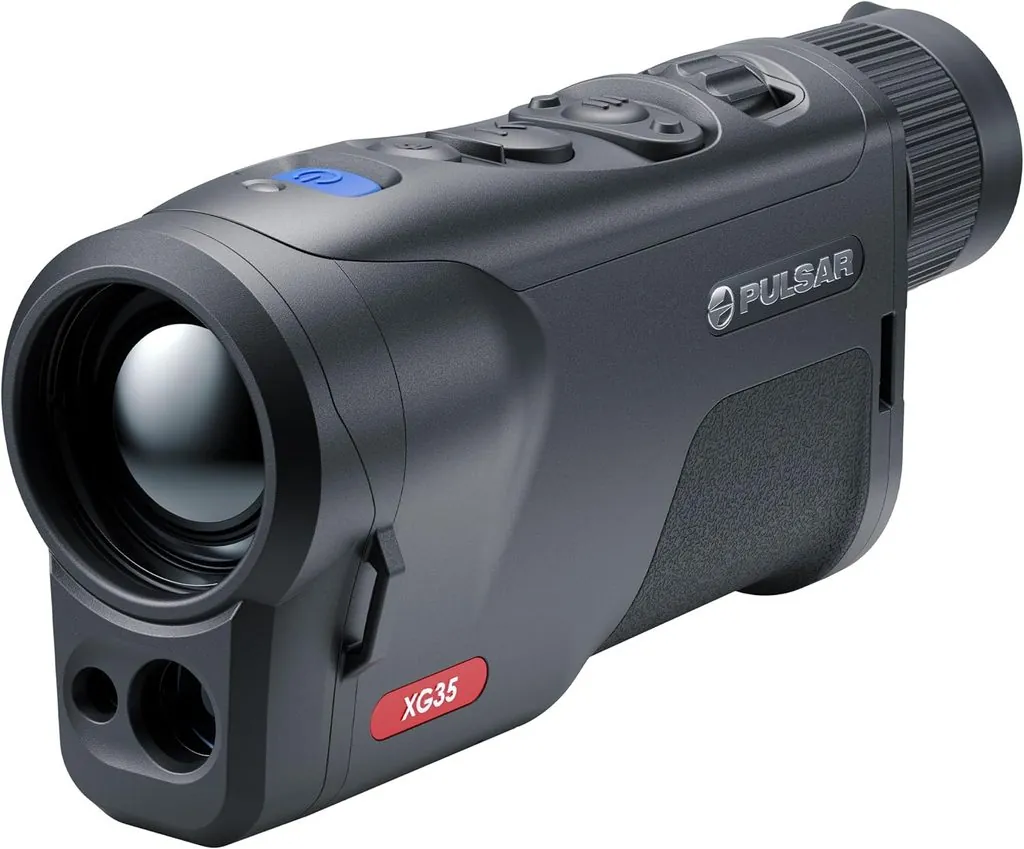
The Oryx is the first model we would compare for hunting outings that alternate between field edges, brush lines and open ground. Its 12.5° horizontal view covers more scene than the BlazeHunter 650 LRF, while its integrated laser rangefinder keeps distance measurement in the same handheld.
That combination lets you search for an animal and measure distance with the same handheld. The Oryx also uses an internal battery alongside a removable APS 5 pack, allowing the external pack to be changed while the internal supply keeps the device operating.
Key features
- Native detector: 640 × 480, 12 µm, 50 Hz.
- Optics: 35 mm F1.0 lens, 2.5× base magnification, 12.5° horizontal view.
- Ranging: Integrated laser rangefinder; manufacturer maximum of 1,500 m.
- Power and housing: Internal battery plus removable APS 5; IP67 magnesium housing.
Pros
- Wider scanning coverage than the BlazeHunter while retaining built-in ranging.
- 640-class resolution provides more native detector samples than the 384-class options.
- Hot-swappable removable pack offers flexibility on longer outings.
- Manufacturer-rated combined runtime of up to 12 hours at 22°C.
Cons
- Highest listed cost among these six selections.
- Uses a dedicated removable pack rather than the 18650 cells used by the BlazeHunter, Taipan, K3 and Titan.
- Its wider view is less concentrated than the BlazeHunter for distant open-country observation.
Our verdict:
Shortlist the Oryx when ranging, 640-class resolution and flexible power justify the price. Its published viewing coverage and dual-power arrangement make it a useful starting point for hunters who move between mixed terrain and open fields. Compare the BlazeHunter if distant open-country observation is your priority, or the Titan T3 if ranging matters more than stepping up to a 640-class detector. The 12-hour figure applies to the combined battery system; recording, Wi-Fi and rangefinder use affect runtime.
2. ATN BlazeHunter 650 LRF
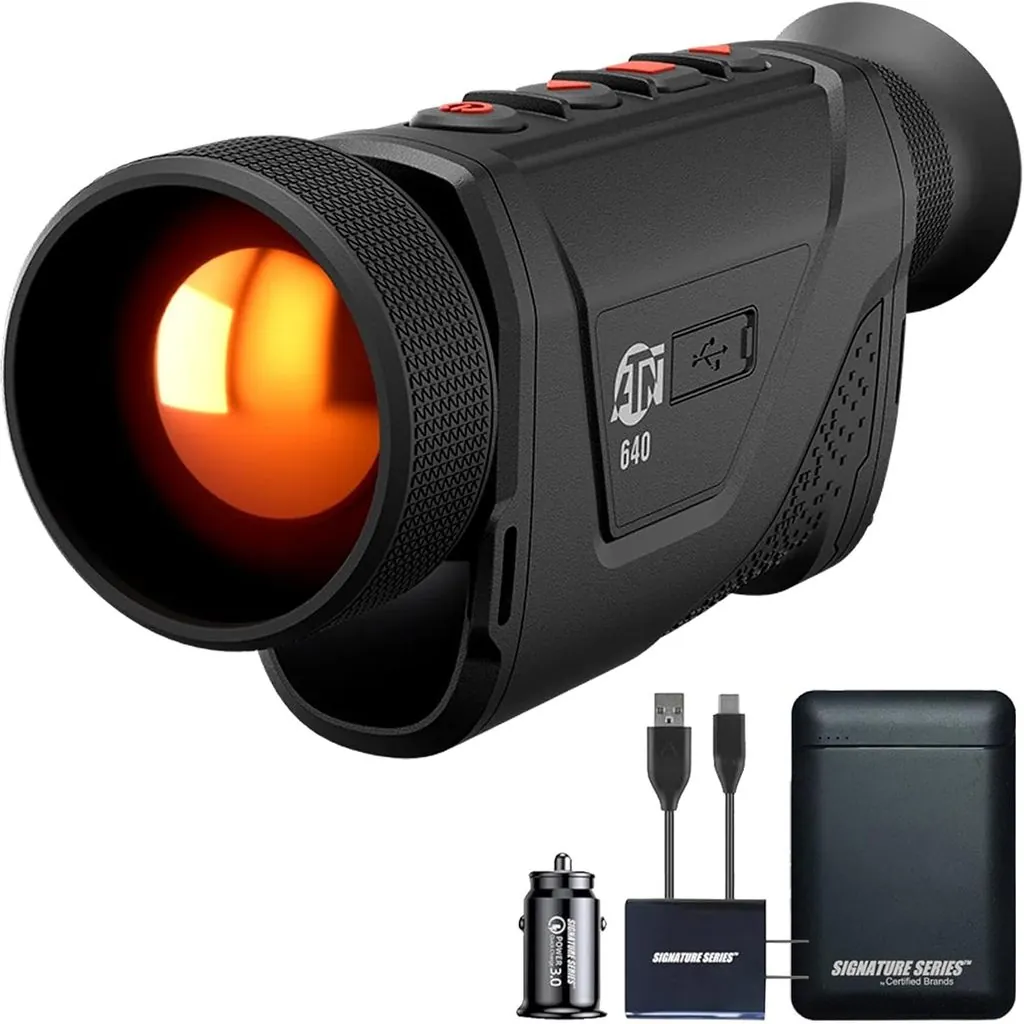
The BlazeHunter 650 LRF is worth comparing when you spend more time examining exposed animals across open ground than searching nearby cover. Its 50 mm lens and 8.7° horizontal view concentrate a 640-pixel-wide detector on a smaller slice of the scene than either the Axion or Oryx.
For the same exposed subject at the same distance, this narrower scene places more native samples across it. That makes the viewing configuration useful for distant observation, although recognition and identification still depend on conditions, focus, contrast and sufficient detail. At ATN’s listed U.S. price of $2,195, it also puts 640-class laser ranging near the Axion’s listed cost.
Key features
- Native detector: 640 × 512, 12 µm, 50 Hz.
- Optics: 50 mm lens, 3.5× base magnification, 8.7° horizontal view.
- Ranging and power: Integrated laser rangefinder; replaceable 18650 battery, with two batteries and a charger included.
- Viewing and recording: 1440 × 1080 OLED display, photo/video recording, Wi-Fi and IP67 rating.
Pros
- More concentrated detector sampling than the wider 640-class picks.
- Built-in ranging avoids switching devices for distance measurement.
- Included spare battery supports longer outings.
- Lower listed cost than the Oryx, with a 640-class detector and an LRF.
Cons
- Narrowest published view here; searching broad areas requires more separate views.
- Higher listed cost than all three 384-class picks.
- Its 3.5× starting view is more magnified than the other selections, which may be less convenient around nearby cover.
Our verdict:
Shortlist the BlazeHunter 650 LRF for open fields, long sightlines and concentrated observation with ranging. The Axion offers wider scanning coverage at a similar listed price; the Oryx combines a wider view with ranging and dual power at a higher cost. The 1440 × 1080 eyepiece display is separate from the native 640 × 512 thermal detector.
3. Pulsar Axion XG30 Compact
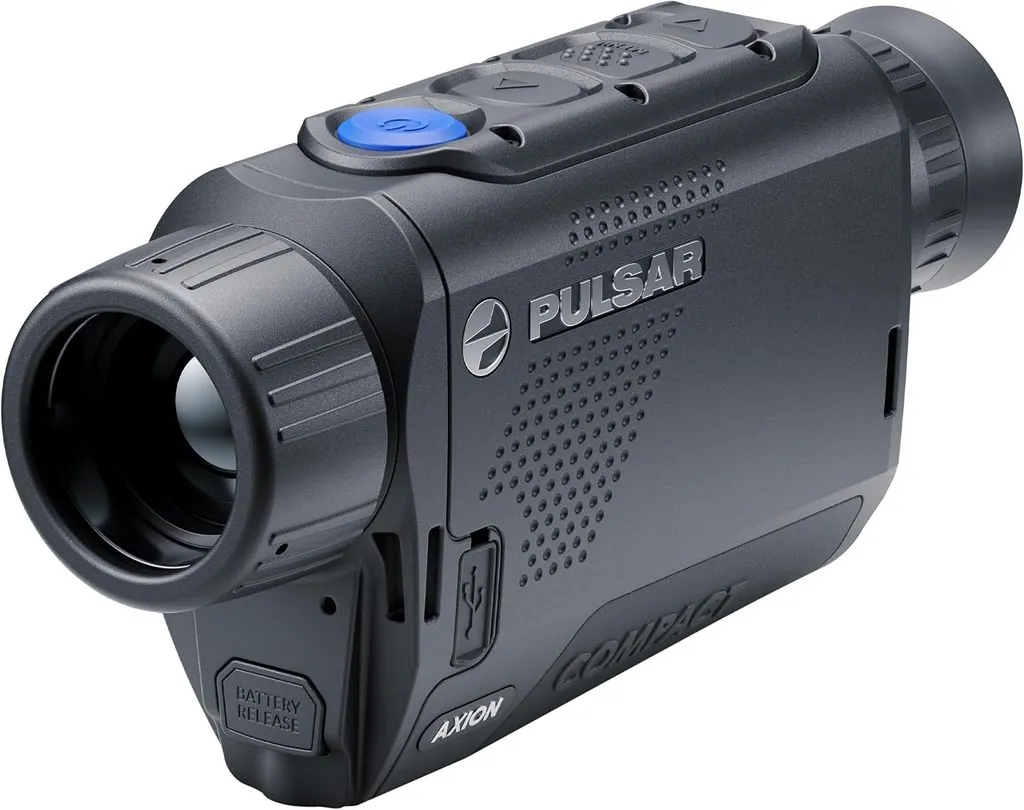
The Axion XG30 Compact suits hunters who want a small 640-class scanner and already have another way to measure distance. Its 14.6° horizontal view covers more surrounding ground than the Oryx’s 12.5° view, making it worth comparing for field edges and mixed cover.
Portability is the main reason to choose it over a rangefinding handheld. Pulsar’s model-specific manual lists a weight of 310 g with the battery, and the removable APS 3 pack lets you carry spare power. Its 2× starting magnification also gives it a less magnified base view than the Oryx or BlazeHunter.
Key features
- Native detector: 640 × 480, 12 µm, 50 Hz.
- Optics: 30 mm F1.2 lens, 2× base magnification, 14.6° horizontal view.
- Power: Removable APS 3 rechargeable battery; USB-C external-power support.
- Recording and protection: 64 GB onboard storage, photo/video/audio recording and IPX7 rating.
Pros
- Wider starting coverage than the Oryx and BlazeHunter, with a 640-pixel-wide detector.
- Pocket-sized housing; manufacturer manual lists 310 g including the battery.
- Lower listed cost than the Oryx; similar listed cost to the BlazeHunter 650 LRF.
- Useful for scanning likely approach routes before switching to another method for distance measurement.
Cons
- No integrated laser rangefinder; its stadiametric tool estimates distance.
- Requires an APS 3 pack rather than a standard 18650 cell.
- Narrower scanning coverage than the less expensive Pocket K3.
- Its wider view is less concentrated than the BlazeHunter for distant animals.
Our verdict:
Choose the Axion for compact 640-class observation when an integrated LRF is unnecessary. It is a practical option for hunters who carry a separate rangefinder or primarily need a lightweight scanner. The BlazeHunter adds ranging at a similar listed cost, with a narrower view. The Oryx adds ranging and dual power; the K3 costs less and shows a wider scene. Check the exact XG30 Compact / PL77508 configuration, because XG35 Compact and XQ30 Pro models differ.
4. RIX Titan T3
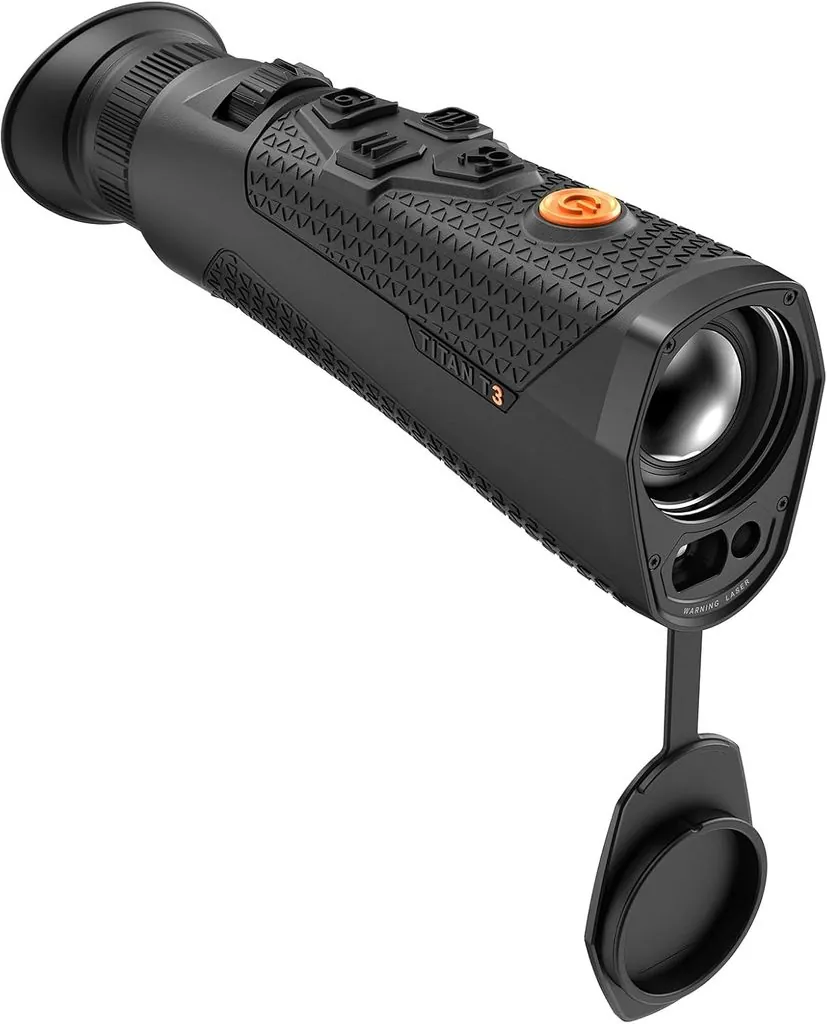
The Titan T3 fills the gap between a lower-cost scanner and the more expensive 640-class rangefinding models. At RIX’s listed $1,799 price, it includes an integrated laser rangefinder while staying below the Oryx and BlazeHunter in this comparison.
Its viewing configuration is close to the Taipan V2 25-384: both use a 384 × 288 detector and publish a 10.5° horizontal angle. Choose between them around the cost and usefulness of laser measurement and electronic stabilization. The Titan’s slightly higher base magnification does not, by itself, establish more native subject detail.
Key features
- Native detector: 384 × 288, 12 µm, 50 Hz.
- Optics: 25 mm F0.9 lens, 2.6× base magnification, 10.5° horizontal view.
- Ranging and stabilization: Integrated laser rangefinder and electronic image stabilization.
- Power and storage: Replaceable 18650 battery, 32 GB onboard storage and IP67 rating.
Pros
- Lowest listed price among the three LRF-equipped choices here.
- Replaceable-cell power supports carrying a spare for longer outings.
- Adds stabilization to the same published horizontal coverage as the Taipan.
- Provides distance information without requiring a separate rangefinder.
Cons
- Lower native detector resolution than the Oryx, Axion and BlazeHunter.
- Narrower search coverage than the K3 or Axion.
- Costs about $350 more than the Taipan at the listed manufacturer prices.
Our verdict:
Shortlist the Titan if integrated ranging is a priority and the 640-class rangefinding models exceed your budget. It is especially worth comparing for hunters who want a built-in LRF at a lower listed cost than either 640-class rangefinding selection here. Choose the Taipan to spend less on a similar viewing configuration, or the Oryx to step up in native resolution and gain a wider view. The Titan’s 1920 × 1080 OLED eyepiece display does not make its thermal detector a 1920-pixel sensor.
5. AGM Taipan V2 25-384
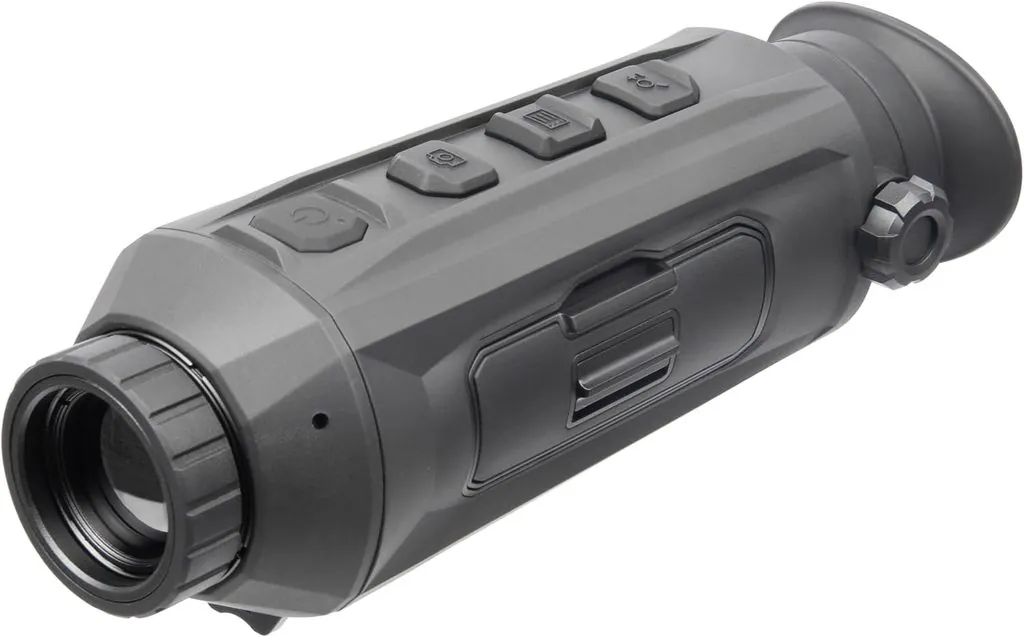
The Taipan V2 25-384 is worth comparing when the 640-class options exceed your budget and you prefer a more concentrated view. Its 25 mm lens produces a narrower horizontal scene than the Pocket K3, despite both using a 384 × 288 detector.
That distinction matters when choosing between searching coverage and concentrated observation. At the same distance, the Taipan places more native samples across an exposed animal, while the K3 shows more surrounding ground. The Taipan does not include an LRF, so distance must be estimated or measured separately.
Key features
- Native detector: 384 × 288, 12 µm, 50 Hz.
- Optics: 25 mm lens, 2.5× base magnification, 10.5° horizontal view.
- Power: Replaceable rechargeable 18650 battery; two included in AGM’s listed package.
- Recording and protection: 16 GB onboard storage, Wi-Fi connectivity and IP67 rating.
Pros
- Tighter viewing coverage than the K3 favors concentrated observation.
- Lower listed cost than all three 640-class selections.
- Included spare battery reduces the immediate need to buy extra power.
- Similar viewing coverage to the Titan at a lower listed price.
Cons
- Less scene coverage than the K3, Axion or Oryx.
- No integrated laser rangefinder; stadiametric estimation is a different function.
- Lower native resolution than the 640-class options.
Our verdict:
Compare the Taipan when you want a tighter 384-class view at a lower price than the Titan T3. Both publish a 10.5° horizontal angle and 384 × 288 detector; the Titan adds laser ranging for about $350 more at the listed prices. Confirm the 25-384 model, because other Taipan V2 versions have different lenses and detectors.
6. RIX Pocket K3
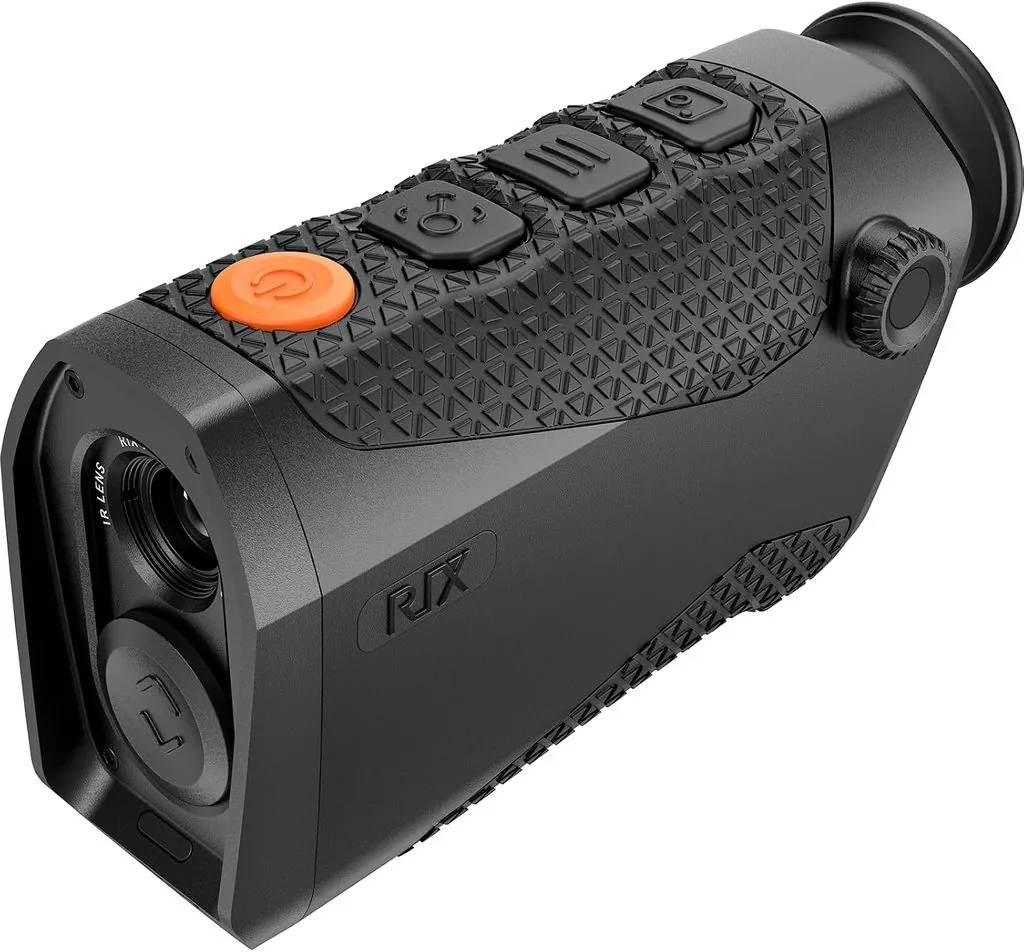
The Pocket K3 offers the broadest published horizontal view and lowest listed price in this comparison. Its 17.5° coverage is useful when your first task is searching an area for an animal whose position is unknown.
The compromise is detector sampling on a distant subject. Compared with the Taipan or Titan T3, the K3 spreads the same 384 horizontal samples across more ground. A small or distant animal can therefore occupy fewer samples, and digital enlargement cannot recover measurements the detector never captured.
Key features
- Native detector: 384 × 288, 12 µm, 50 Hz.
- Optics: 15 mm lens, 2× base magnification, 17.5° horizontal view.
- Stabilization: Electronic image stabilization.
- Power and protection: Replaceable 18650 battery and IP67 rating.
Pros
- Widest horizontal coverage among these six selections.
- Lowest listed entry price in the shortlist.
- Compact design and replaceable power suit a small carrying setup.
- Broad published coverage suits searching field edges and nearby openings.
Cons
- Less concentrated sampling than the Taipan or Titan for the same animal at the same distance.
- No integrated laser rangefinder.
- Certain older supplied batteries require a recall check.
- Lower native resolution than the 640-class options.
Our verdict:
Consider the K3 when lower cost and broad scanning coverage matter most, after completing the battery check. It is the most natural fit for hunters who need to search a wide area before locating an animal. Choose the Taipan if you would rather concentrate the same detector resolution on a narrower view, or the Titan if you also want laser ranging.
Which viewing configuration fits your terrain?
Woodland edges and nearby openings
A wider view shows more of the scene before you move the device. Start by comparing the Pocket K3 if coverage and budget are priorities. The Axion offers a compact 640-class alternative with a moderately narrower view; the Oryx adds ranging. The Titan is a lower-priced LRF option if its tighter view suits your observation task.
Wider coverage does not mean seeing through foliage. An animal still needs exposed surfaces that produce a useful thermal signal through gaps in vegetation. Thermal imaging may help you locate exposed surfaces, but it cannot replace species confirmation or a safe target assessment.
Open fields and distant observation
Compare the BlazeHunter 650 LRF when examining exposed animals across open ground is your usual task. Its narrower view concentrates detector samples but gives you less surrounding scene. The Oryx is the wider alternative if you also want an LRF.
Within the 384 class, the Taipan and Titan favor more concentrated sampling, while the K3 favors broader searching coverage. Choose between the Taipan and Titan primarily around the cost and usefulness of integrated ranging.
What the field-of-view numbers mean
At 100 yards, the published horizontal angles translate into the following approximate scene widths:
| Model | Approximate scene width |
|---|---|
| RIX Pocket K3 | 31 yards |
| Pulsar Axion XG30 Compact | 26 yards |
| Pulsar Oryx LRF XG35 | 22 yards |
| AGM Taipan V2 25-384 | 18 yards |
| RIX Titan T3 | 18 yards |
| ATN BlazeHunter 650 LRF | 15 yards |
These are geometric calculations, rounded to whole yards, for a flat plane perpendicular to the viewing direction. They describe coverage—not detection, recognition or identification range. The K3 shows roughly twice the width of the BlazeHunter at that distance, which helps explain their different observation roles.
Choosing for coyotes, hogs and deer
| Intended use | What to prioritize | Models to compare first |
|---|---|---|
| Coyote observation across open ground | Concentrated sampling, usable focus and distance information | BlazeHunter 650 LRF; Oryx for a wider view; Titan T3 for lower-cost ranging |
| Hog scanning along field edges | Coverage when the animals’ positions are unknown | Pocket K3; Axion XG30 Compact for 640-class resolution; Oryx if ranging matters |
| Deer observation in mixed terrain | Viewing coverage, practical fit and enough evidence for the observation task | Axion XG30 Compact or Oryx, subject to local rules |
| Budget hunting observation | Listed cost, replaceable power and a suitable starting view | Pocket K3 for coverage; Taipan V2 25-384 for a tighter view |
| Observation with integrated ranging | Laser measurement alongside resolution and viewing coverage | Titan T3 for lower cost; Oryx or BlazeHunter for a 640-class detector |
These starting points follow the terrain and optical configuration. They are not tested species-specific rankings. A distant heat signature may not distinguish a coyote from a dog or fox, or establish a deer’s legal characteristics.
How to choose a thermal monocular for hunting
Read native resolution alongside field of view
A 640-class detector has more horizontal samples than a 384-class detector. How those samples describe an animal also depends on scene width, focus, contrast and distance.
The Axion spreads its 640 horizontal samples across a wider scene than the Oryx; the BlazeHunter concentrates the same general detector class on a narrower scene. The Taipan and Titan share both a 384-pixel-wide detector and a 10.5° horizontal view. Our guide to thermal monocular resolution explains why detector resolution and eyepiece-display resolution are separate specifications.
Compare the starting view before maximum zoom
Base magnification describes the view you begin with. Digital zoom enlarges captured information; it does not add new detector measurements of an animal.
Choose a starting view that suits the task you perform most often. A large maximum-zoom number does not compensate for an awkwardly narrow search view or insufficient native detail.
Decide whether laser ranging is worth the cost
The Oryx, BlazeHunter and Titan T3 include LRFs. The Axion XG30 Compact, Taipan and K3 do not. An integrated rangefinder provides distance information without a second handheld.
Stadiametric tools estimate distance using assumed subject dimensions. That is different from laser measurement, and neither establishes species identification.
Check power, controls and practical fit
Compare compatible spare cells or packs, their cost and how easily you can change them. Maximum runtime is measured under stated conditions; plan with a margin rather than assuming every outing will match the advertised figure.
If possible, try the focus control, grip and eyepiece before committing. Gloves, cold weather and your carrying setup can change what feels convenient. A suitable return policy can help resolve fit questions that specifications cannot answer.
Put sensitivity figures in context
NETD describes sensitivity to small temperature differences. Lower values can be favorable when measured comparably, but sensor NETD and processed system NETD are different figures. Pulsar’s buying guide explains the distinction.
Use sensitivity alongside optics and native resolution, rather than choosing a winner from unlike measurements.
For a wider range of lower-cost options, see our separate guide to the best budget thermal monoculars.
Detection, recognition and identification: know the difference
Detection means finding a feature that stands out from the background. Recognition suggests its general type. Identification requires enough evidence to distinguish the subject for the intended purpose. A manufacturer’s maximum detection distance is not automatically a usable coyote, hog or deer identification distance.
Teledyne FLIR’s range guidance explains why target assumptions, weather, clutter and the observer affect these distances.
A thermal monocular may help you locate a heat signature, but that alone does not establish the species or legal characteristics of an animal. Similar thermal shapes can remain ambiguous, especially at distance or when partially obscured. Confirm the subject using all available information and follow applicable hunting and firearm-safety rules.
Thermal also cannot see through solid cover or ordinary window glass, and rain or fog can reduce useful viewing range. It shows thermal contrast rather than normal coat colors. See FLIR’s explanation of thermal limitations and our introduction to how thermal monoculars work.
Frequently asked questions
What is the best thermal monocular for hunting overall?
The Oryx LRF XG35 is our starting recommendation for mixed terrain when you want a 640-class detector, moderate base magnification and built-in ranging. Compare the BlazeHunter 650 LRF for concentrated open-country viewing, the Axion XG30 Compact if ranging is unnecessary, or the Titan T3 for lower-cost integrated ranging. This guide does not establish a field-tested overall winner.
Which thermal monocular should you compare for open fields?
The ATN BlazeHunter 650 LRF is the configuration to compare when you spend most of your time examining exposed animals across open ground. Its narrow 8.7° horizontal view concentrates detector samples on a smaller scene. Compare the Oryx if you want a wider view with integrated ranging.
Is a 384 thermal monocular enough for hunting observation?
It can be useful, but suitability depends on animal size, distance, contrast, focus and field of view. The Taipan, Titan and K3 show why 384-class devices can serve different priorities: concentrated viewing, integrated ranging or broader coverage. There is no universal distance at which 384 resolution becomes sufficient or insufficient.
Can you get a thermal monocular with laser ranging below $2,000?
The Titan T3 is the option in this shortlist; RIX listed it at $1,799 during research. It pairs laser ranging with a 384 × 288 detector. Compare the Oryx if you want ranging and a 640-class detector, and confirm current prices before choosing.
Can you use a thermal monocular during daylight?
Yes. Thermal imaging does not require darkness. Sun-warmed backgrounds can change thermal contrast, so results will vary. Follow the model’s instructions concerning the sun and other intense energy sources.
Can thermal see through brush or a vehicle window?
It may show exposed animal surfaces through gaps in foliage. It cannot see through solid vegetation, and ordinary closed vehicle windows block the outside long-wave thermal scene.
Can a thermal monocular help recover a wounded animal?
It may help locate exposed surfaces that contrast with the surroundings. Cover, cooling and conditions can prevent detection, so recovery is not guaranteed. Do not expect a continuous visible blood trail, and check the rules for the intended recovery activity.
Is it legal to use a thermal monocular for hunting?
Check current wildlife-agency rules for the species, season, location and exact activity. Scouting, hunting assistance, nighttime observation and recovery can be treated differently. Public-land conditions may also differ from private-land rules; Texas Parks and Wildlife’s public-hunting guidance is one example of why unit-specific rules matter. A thermal image does not extend legal shooting hours or establish a safe shooting decision.
Which model should you shortlist?
- Oryx LRF XG35: Starting point for mixed terrain, integrated ranging and flexible dual power.
- BlazeHunter 650 LRF: Configuration to compare for concentrated open-country observation with ranging.
- Axion XG30 Compact: Pocket-sized 640-class observation without an LRF.
- Titan T3: Integrated laser ranging below the listed cost of the 640-class LRF choices.
- Taipan V2 25-384: A tighter 384-class view below the listed cost of the 640 selections.
- Pocket K3: Lower-cost scanning with broad coverage, subject to the battery check.
Choose around your most frequent observation task. Finding a heat signature, recognizing an animal and identifying it are different demands. Shortlist the viewing configuration that suits your terrain, then compare practical fit, power and current cost before buying.

Elliot Vantage is an optics enthusiast and the editor behind Optic Horizon, covering monoculars, binoculars, thermal optics, and related outdoor gear. He researches manufacturer documentation, optical specifications, product features, pricing, and use-case differences to help readers understand their options and choose equipment that fits their needs.