
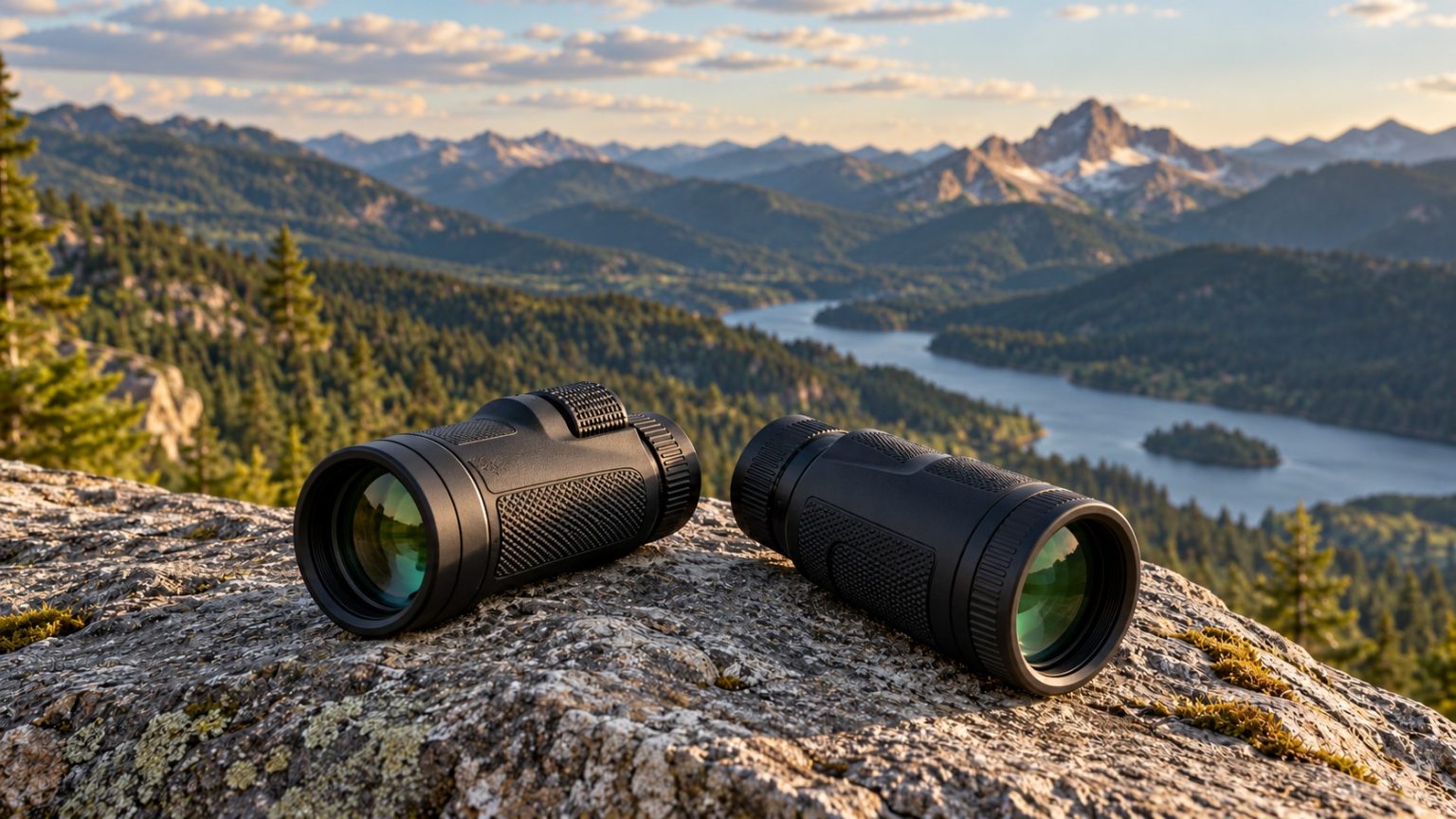
The 8x vs 10x monocular decision comes down to how much apparent detail you can use comfortably. A 10× monocular makes a subject appear 25% larger in apparent linear size than an 8× monocular. An 8× model makes the same hand movement less noticeable and may be easier to use for quick, casual observation.
Neither choice guarantees a better image. Field of view, objective size, eye relief, optical quality and your ability to settle the view can matter as much as the magnification difference.
For mixed handheld nature walks, start by trying 8×. If you regularly stop, brace your arms and inspect distant stationary subjects, give a suitable 10× model equal consideration.
What changes when you move from 8× to 10×?
| Consideration | 8× monocular | 10× monocular |
|---|---|---|
| Apparent subject size | Lower magnification | 25% larger than 8× in linear angular size |
| Apparent movement from the same angular hand motion | Less pronounced | More pronounced |
| Field of view | Often broad, but model dependent | Often narrower, but model dependent |
| Exit pupil with the same objective diameter | Larger | Smaller |
| Main reason to consider it | Comfortable general observation | A larger target image when you can hold steadily |
The table describes optical relationships and common design tendencies, not a ranking of all products. A well-designed 10× monocular can have a wider field than a different 8× model, so compare published figures rather than inferring width from magnification alone.
A 25% larger image is useful—but it is not 25% more usable detail
The calculation is straightforward: 10 ÷ 8 = 1.25. A feature occupying a certain angle at 8× occupies approximately 1.25 times that angle at 10×.
However, the additional enlargement helps only when the optic, the atmosphere and your steadiness preserve enough detail to benefit from it. Looking at a larger moving blur is not the same as seeing a feature more clearly.
Nikon’s explanation of magnification notes the relationship between higher magnification and increased apparent hand shake. The same basic principle applies to a conventional monocular: magnification enlarges movement as well as the subject.
Avoid choosing 10× merely because eight sounds less powerful. Equally, do not reject 10× if you can use it comfortably and the larger image helps your usual observations.
Why 8× can suit mixed nature walks
Think about the sequence of a typical sighting. You notice movement, stop, locate the subject unaided, raise the optic, focus and inspect it. The experience depends on completing that whole sequence rather than on the final image size alone.
An 8× monocular is worth trying when:
- You make short, frequent observations.
- You often look for moving subjects among branches.
- You find a more magnified image tiring to settle.
- You want a relatively forgiving general-purpose view.
A broad field can help with subject acquisition, but verify the exact optic’s field of view. Our guide to choosing a monocular explains the other specifications that belong in the decision.
When 10× makes more sense
Ten-power viewing is worth considering when the subject is small in the image and you can take time to stabilize the monocular.
Examples include inspecting a distant fixed landmark from a viewpoint or examining a stationary bird from a settled position. A larger apparent image may make a visible feature easier to judge.
Try it with your elbows supported or your arms braced against your body. If the subject becomes easier to inspect without adding frustration, the extra power is doing useful work.
Do not assume a monocular has a tripod connection. If supported viewing is part of your plan, check the manufacturer’s mounting instructions and the compatibility of any adapter.
Keep objective size separate from magnification
An 8×25, 8×32 and 8×36 share magnification but have different objective diameters. A 10×25 and 10×50 likewise share magnification while making very different carrying commitments.
| Configuration | Exit-pupil calculation | Exit pupil |
|---|---|---|
| 8×25 | 25 ÷ 8 | 3.125 mm |
| 10×25 | 25 ÷ 10 | 2.5 mm |
| 8×32 | 32 ÷ 8 | 4.0 mm |
| 10×32 | 32 ÷ 10 | 3.2 mm |
These calculated values help explain one consequence of increasing power with the same objective. Whether the larger exit pupil helps brightness depends on your eye and the conditions. It is not a substitute for comparing optical transmission and image quality.
For a lightweight daytime kit, you may accept a small objective. If reduced-light observation matters, compare the complete configuration rather than treating every 10× monocular as equivalent.
Compare actual field of view
Field of view is how much scene you can see at once. Manufacturers may express it as an angle or a width at a specified distance. Nikon explains these measurements in its field-of-view guide.
Before deciding, put both candidates into the same units. Then ask whether their difference matters for your subjects. A narrow view may be perfectly acceptable for a fixed landmark yet inconvenient when repeatedly finding small birds in foliage.
Also check close-focus distance. A higher-power model that cannot focus on a nearby subject may be less useful than a lower-powered one that can.
Our hiking monocular guide compares models by viewing width, close focus, eye relief and carrying weight, so you can assess those features together.
Eye comfort can settle the decision
The better magnification is little use if you cannot see the full field comfortably. Check eye relief, eyecup position and the shape of the eyepiece with your normal viewing setup.
If you wear glasses, use our monocular-and-glasses fitting guide to compare the candidates. Do not assume every 8× model has more usable eye relief than every 10× model.
You may find that one product is simply easier to position consistently. That can be a stronger reason to choose it than the numerical difference in magnification.
A fair five-minute comparison
Use the same safe viewing position and the same subjects for both optics. These are practical checks, rather than a laboratory test.
- Find a small stationary feature. Compare what you can actually distinguish once settled.
- Lower and raise each optic several times. Notice how quickly you reacquire the subject.
- Observe a naturally moving subject from a distance. Compare how often it leaves the frame.
- Try your usual glasses and eyecup position. Check the full field and comfort.
- Carry the complete setup briefly. Include the case if you will use it.
Keep a short note of the limitation you notice most. If 10× shows extra usable detail and remains comfortable, choose it confidently. If its movement and narrower view repeatedly interrupt you, 8× may be the more useful purchase.
For affordable candidates, see our monoculars under $100. Confirm current pricing and the exact magnification before ordering.
Frequently asked questions
How much farther can a 10× monocular see than an 8×?
Neither has a fixed maximum viewing distance. Ten-power magnification gives a larger apparent subject, but the detail you can resolve depends on optics, steadiness, subject size, contrast and atmospheric conditions.
Is 8× enough for wildlife watching?
It can be, particularly for general observations where finding and following the subject matters. Very distant detail may favor another setup, but choose around your normal sightings rather than an exceptional one.
Is 10× too shaky for handheld use?
Not necessarily. Many people can use it comfortably while stopped and braced. The important comparison is how the exact optic behaves in your hands.
Should I choose binoculars instead?
Consider them if observation is the main purpose of the outing or you expect longer sessions. Our monocular-versus-binocular comparison covers that decision separately.
Choose the view you can use repeatedly
Start with 8× for a flexible handheld option and compare 10× when you need a larger apparent subject. Let steadiness, field of view and eye comfort decide whether the additional magnification earns its place in your kit.

Elliot Vantage is an optics enthusiast and the editor behind Optic Horizon, covering monoculars, binoculars, thermal optics, and related outdoor gear. He researches manufacturer documentation, optical specifications, product features, pricing, and use-case differences to help readers understand their options and choose equipment that fits their needs.