
Table of Contents
Monoculars—those single-lens wonders—have come a long way from their humble beginnings. What started as a simple tool for gazing at distant horizons has transformed into a high-tech marvel used for everything from stargazing to thermal imaging. In this article, we’ll trace the fascinating evolution of monoculars, exploring how they’ve adapted over centuries to meet the needs of explorers, scientists, and modern adventurers. Whether you’re a history buff or an outdoor enthusiast, this journey through time reveals why monoculars remain a timeless optic in 2025.
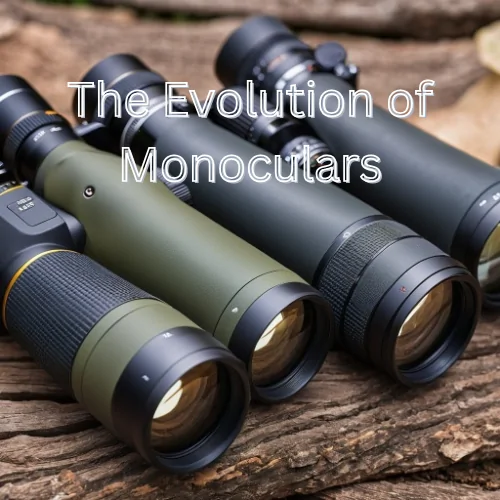
The Early Days: Ancient Optics and Simple Lenses
The story of monoculars begins long before the term itself existed, rooted in humanity’s quest to see farther. Ancient civilizations, like the Greeks and Romans, experimented with glass and crystal to magnify objects. Around 300 BCE, Greek mathematician Euclid described the principles of light reflection, laying the groundwork for optical devices. However, it wasn’t until the Middle Ages that these ideas took physical form.
In the 13th century, Italian monks and scholars, including Roger Bacon, began crafting rudimentary lenses from polished glass. These early “reading stones” magnified text for aging eyes but hinted at broader possibilities. By the late 1500s, Dutch spectacle makers like Hans Lippershey stumbled upon a breakthrough: combining lenses to create a telescope. While these were dual-lens systems, the concept of a single-lens optic—a precursor to the monocular—wasn’t far behind.
The Spyglass Era: Monoculars Take Shape
The 17th century marked the true birth of the monocular as we know it, thanks to the iconic spyglass. Often associated with pirates and sailors, the spyglass was a handheld, single-tube telescope that used convex and concave lenses to magnify distant objects. Galileo Galilei famously refined this design in 1609, turning his version skyward to study the moons of Jupiter and forever changing astronomy.
These early monoculars were simple yet revolutionary. Made of wood, brass, or leather, they offered modest magnification—typically 3x to 10x—and a narrow field of view. Sailors used them to spot land or enemy ships, while explorers like Christopher Columbus relied on them for navigation. Though bulky by today’s standards, the spyglass proved the power of a portable, single-eye optic.
The 19th Century: Refinement and Accessibility
As glassmaking and lens-grinding techniques improved, monoculars evolved from crude tools to precision instruments. The 1800s saw the rise of the “field glass,” a more compact and durable version of the spyglass. Military officers adopted these monoculars for reconnaissance, valuing their lightweight design over bulkier binoculars. By mid-century, companies began producing them with better lenses, offering sharper images and higher magnification.
This era also democratized optics. What was once a luxury for the elite became more affordable, thanks to industrial manufacturing. Hunters, naturalists, and travelers embraced monoculars for their portability and ease of use. The addition of features like adjustable focus and protective casings made them practical for rugged outdoor pursuits, setting the stage for their modern popularity.
The 20th Century: Technological Leaps Forward
The 20th century brought monoculars into the modern age with groundbreaking innovations. Early in the century, optical coatings—thin layers applied to lenses—reduced glare and improved light transmission, delivering brighter, clearer views. This was a game-changer for birdwatchers and wildlife observers who needed detail in low-light conditions.
World War I and II accelerated monocular development. Military demand led to ruggedized designs with waterproofing and shock resistance, as well as the integration of night vision technology by the mid-1900s. These infrared-based systems amplified ambient light, allowing soldiers to see in near-darkness—a precursor to today’s thermal monoculars. Post-war, these advancements trickled into civilian use, expanding the monocular’s appeal for outdoor recreation and scientific study.
The Modern Era: Digital and Thermal Marvels
By the late 20th and early 21st centuries, monoculars had entered a golden age of innovation. The introduction of digital technology transformed them from purely optical devices into hybrid tools. Digital monoculars, equipped with cameras and screens, allowed users to record what they saw—perfect for photographers or researchers documenting distant subjects.
The real revolution, however, came with thermal imaging. Unlike traditional monoculars that rely on visible light, thermal monoculars detect heat signatures using infrared sensors. This breakthrough, refined in the 1990s and 2000s, made them invaluable for night-time activities like wildlife observation, search and rescue, and security. A warm animal or person stands out as a bright shape against a cooler background, even in total darkness or through fog.
In 2025, modern monoculars are lighter, more powerful, and more accessible than ever. Compact designs fit in your pocket, while advanced models offer features like adjustable magnification, color display modes, and long battery life. Materials like polycarbonate and magnesium alloys ensure durability without sacrificing portability, making them a favorite for hikers, hunters, and stargazers alike.
Monoculars Today: A Tool for Every Purpose
Today’s monoculars cater to a wide range of users, reflecting their centuries-long evolution. Outdoor enthusiasts use them to spot wildlife or enjoy scenic views on the trail. Astronomers turn compact, high-magnification models toward the stars. Thermal variants help adventurers navigate low-visibility conditions or observe nocturnal creatures without disturbing them.
Their versatility stems from a rich history of adaptation. From the spyglass’s wooden tubes to today’s sleek, tech-packed designs, monoculars have consistently met the needs of their time. They remain a bridge between human curiosity and the distant world, proving that a single lens can still pack a powerful punch.
What’s Next for Monoculars?
Looking ahead, the evolution of monoculars shows no signs of slowing. Emerging trends in 2025 hint at even smarter optics. Imagine monoculars with AI-enhanced image recognition, identifying birds or constellations in real time. Lightweight materials and improved battery life could make them even more portable, while higher-resolution thermal sensors might push detection ranges further.
Sustainability is also on the horizon, with manufacturers exploring eco-friendly materials and modular designs for easy repairs. As technology advances, monoculars will likely remain a staple for those who seek to explore the unseen—whether it’s a distant galaxy or a hidden trail.
Why the Evolution Matters
Understanding the monocular’s journey isn’t just a history lesson—it’s a window into its enduring appeal. Each leap forward, from ancient lenses to thermal imaging, has made it more practical and powerful. For modern users, this means a tool that’s lightweight yet robust, simple yet sophisticated. Whether you’re tracing a pirate’s legacy or scanning the night for heat signatures, the monocular’s evolution ensures it’s ready for any adventure.
Conclusion: A Legacy of Vision
From ancient reading stones to cutting-edge thermal devices, the evolution of monoculars is a testament to human ingenuity. What began as a basic lens has become a marvel of modern engineering, blending portability with advanced functionality. In 2025, monoculars stand as a link between past and future, offering a clear view of the world—near or far, day or night. Their story reminds us that even the simplest tools can grow into something extraordinary, making them a worthy companion for anyone curious enough to look closer.

Elliot Vantage is an avid optics enthusiast with a passion for exploring the world through monoculars, binoculars, and thermal monoculars. With years of hands-on experience in the field—whether hiking remote trails, birdwatching at dawn, or testing gear under the stars—Elliot brings practical insights and expert knowledge to Optic Horizon. A self-described ‘vision geek,’ he’s dedicated to helping readers find the perfect tools to see beyond the horizon, blending technical know-how with a love for adventure.